

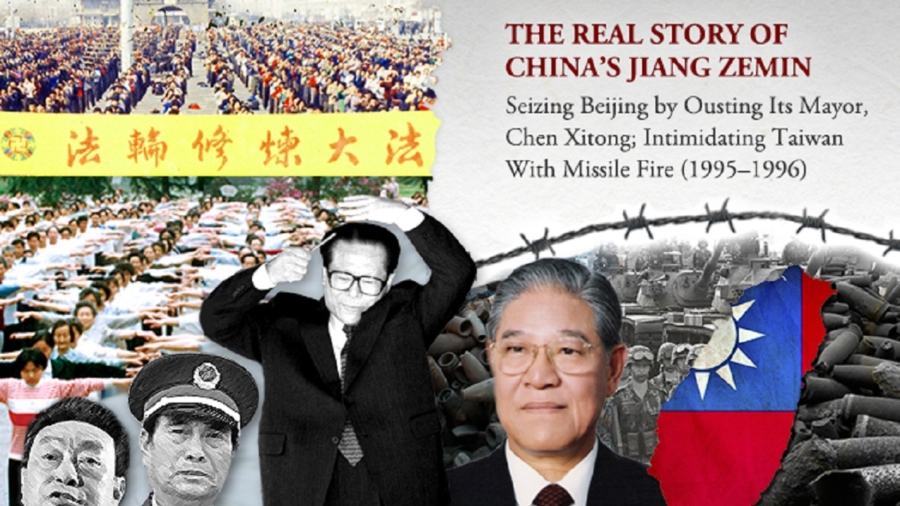
Chapter 8: Seizing Beijing by Ousting Its Mayor, Chen Xitong; Intimidating Taiwan With Missile Fire (1995–1996)
At the 4th Plenary Session of its 14th Congress, the CCP announced the completion of its power transition from its second generation of leaders to its third. At the time Deng Xiaoping's health was steadily declining. At the 14th Congress, Deng undermined his own power base by asking long-time strong supporters Yang Shangkun and his brother to resign from the military. Jiang Zemin, who was Chairman of the CCP's Military Commission though he had never so much as touched a gun, feared terribly that the military would not follow him as its leader. Seeing that other senior Party members were in a weakened position and knowing that he indeed had followers in the military, Jiang proceeded to focus on the Beijing municipal government—a key political battlefront.Jiang likes to show off and is by nature a jealous man. If anyone looks down on him he is sure to retaliate. Jiang both hated and feared Chen at the same time. There were many reasons Jiang couldn't tolerate Chen, the first of which came about when Chen invited Hu Qili, a follower of Zhao Ziyang, to dinner.
After becoming China's "emperor" Jiang spared no expense at removing anyone who had followed Zhao Ziyang. Jiang believed that the greater he distanced himself from Zhao, the more legitimate would be his position. Jiang's resistance to Zhao was such that real facts surrounding Zhao and history mattered not. On the day of his inauguration as General Secretary of the CCP, Jiang claimed that he wanted to make up for "the losses" created by Zhao, and never mentioned so much as a word about Zhao's contributions (during his tenure as Premier and General Secretary) to China's economic development and political reform.
Jiang knew the Chinese people held a special place in their hearts for Zhao. Zhao's attitude toward the suppression of the student democracy movement was clearly different from that of many senior politicians and Party members at various levels of government. This gave Zhao an aura of sincerity, as if he spoke for the people and did so without concern for his own personal safety. During Zhao's time as General Secretary both China's Gross Domestic Product (GDP) and living standard improved swiftly. Many people were grateful to Zhao on this account. Considering Zhao's public approval and political achievements, Jiang stood little chance of keeping his post—which he had in effect stolen from Zhao—were Deng to ever ask Zhao to return to power.
After gaining power, Jiang began purging—under the banner of resisting an alleged attempt by the West to quietly change China—reformers and those who had close ties with Zhao. A defiant Chen Xitong, however, went against Jiang's crusade.
When Zhao fell from power with him went Hu Qili, a member of the Politburo Standing Committee, and Rui Xingwen, the Secretary of the Secretariat of the CCP's Central Committee. These three were the highest-ranking officials ousted in connection with the Massacre. Rather than try to avoid trouble, Chen arranged a secret meeting with Hu Qili and Wan Li at Capital Hotel. Chen not only attended the meeting but went so far as to greet Hu at the entrance of the building.
Coincidence makes for a story, so one wrinkle in the meeting deserves retelling. Chen thought he had planned everything perfectly. Little could he have expected that it would be the Japanese, of all things, who would leak news of his meeting. It just so happened that on that evening journalists from several Japanese television stations and news agencies, who were stationed in Beijing, had a meeting at the hotel's Japanese restaurant. One of them by mistake entered Chen's private room and saw Hu, Wan, and Chen dining and drinking together. Chen mistook the journalist for a Japanese businessman and didn't pay much heed. The next day, however, the Japanese journalist reported in a Japanese newspaper what he had seen. Three days later the Xinhua News Agency's internal reference department passed the information to Jiang Zemin in the "Domestic News Summary" section of its internal circular. The affair took Jiang by surprise and triggered much anger. Jiang was surprised, in that the experienced and capable Chen had now joined up with Hu. And angered, in that Chen was clearly going against him by daring to socialize behind his back with Zhao's followers, whom he most resented. Jiang couldn't tell whether this was part of a plan by Deng Xiaoping to pave the way, by first reinstating Hu, for Zhao's return to power. He immediately ordered the Central Disciplinary Committee to investigate the matter further. After the manager at the Capital Hotel confirmed Chen's meeting, Jiang made a personal call to Chen accusing him of "taking the wrong stand." Chen gave the excuse that Wan Li had requested the meeting and that he therefore had no choice but to arrange for it.
Jiang didn't dare to offend Wan, and so had to keep his anger to himself. Deng later did indeed ask Hu to return to his post, thus confirming Wan's close relationship with followers of Zhao. As Jiang feared more than anything that Zhao would regain power, his resentment of Chen only grew from the incident.
But before Jiang's lingering resentment could be resolved a new grudge was added. Deng Xiaoping in the spring of 1992 went on his now-famous "Southern Tour" of China. Chen knew all along that Deng's intention was to further reforms, and thus Chen aired pro-reform slogans amidst programming on Beijing Television and used every opportunity to advocate for reform. This agitated Jiang, who sided with conservative, Leftist senior politicians such as Chen Yun and Li Xiannian. To keep Deng's unhappiness with him from leaking to the media, Jiang ordered that all coverage of Deng's tour by state media should follow a "unified reporting standard" dictated by the Ministry of Propaganda. Jiang declared that no reporter could write anything on the matter without his consent.
Soon after, Zhou Guanwu, Chairman of Capital Steel's board, and Chen arranged to have Deng visit Capital Steel. During the visit nobody from the Standing Committee of the Politburo made an appearance. In front of many leaders and workers at Capital Steel, Deng said, "As for the things that I have said recently, some people are listening and some aren't. Beijing has mobilized itself, but some in the central government still refuse to act." Deng asked Chen to "pass the word" to the CCP Central Committee that, "Whoever opposes the policies of the CCP's 13th National Congress will have to step down." Upon hearing Deng's words Jiang shuddered, almost as if thunder was rolling overhead.
Fear-stricken, Jiang then went through the Central Committee's General Office to blame Chen for failing to notify him of Deng's visit in advance. Chen retorted that the General Office should seek information on Deng's activities from Deng's office itself, rather than blaming Beijing. Rebuffed and angered, Jiang grew more determined still to remove Chen.
When Chen had been mayor of Beijing, Jiang was the Party Secretary of Shanghai. Chen was thus, as the leader of Beijing, much better informed than Jiang. Jiang was well aware that Chen had a good relationship with Deng Xiaoping and Li Peng. In those days Jiang was thus all smiles whenever he met Chen. During his first two years as General Secretary of the Party, Jiang would mind his behavior and at least show respect towards Li Peng. But after the Yang brothers were removed from their positions at the Party's 14th Congress, Jiang grew increasingly more arrogant.
Chen witnessed the changes in Jiang and knew that his meeting with Hu Qili and his actions in regards to Deng's Southern Tour had made him an enemy. In Chen's judgment, Jiang was the type of person who absolutely couldn't let someone off the hook, even over the most minor of provocations. He had heard of Jiang's retaliation against the students who challenged him during the 1986 student movement in Shanghai. So it was that Chen now hoped to, having offended Jiang and wishing to protect himself, have Jiang removed from his post while Deng was still alive.
Thus in early 1995 Chen reported on Jiang in a letter to Deng co-signed by seven provincial Party heads. The content of the letter is yet unknown to the outside world. Deng didn't make any comment after reading the letter and handed it off to Bo Yibo to handle. Prior to the Tiananmen Massacre, when the eight senior politicians had discussed the issue of Zhao Ziyang's successor, Deng had wanted to pick Li Ruihuan or Qiao Shi. It was Bo Yibo who had strongly backed Jiang Zemin. Deng had reached an old age by that time and lacked the energy to change the General Secretary; were it otherwise he would have done so upon returning from his 1992 tour. Deng's passing of Chen's letter to Bo Yibo was meant to suggest what kind of person Deng recommended for the post—somebody different from whom Bo would or did choose, that is.
Bo was notorious among high-ranking officials for his maltreatment of others, opportunism, ingratitude, and duplicity. A demonstration of this was Bo's relationship with Hu Yaobang. In 1979, a few years after the Cultural Revolution, Bo was rehabilitated and released from prison thanks to Hu. Later, at the 4th Plenary of the Central Committee of the 11th Party Congress, Bo, again thanks to Hu's endorsement, became a member of the Central Committee, Vice Premier of the State Council, a State Councilor, and Deputy Director of the CCP Advisory Committee. However, on Jan. 15, 1987, while at an extended meeting of the Politburo that he chaired, it was none other than Bo who urged Hu to step down.
After reading the accusatory letter from Chen, Bo, instead of investigating Jiang further, grew happy that he had something he could hold against Jiang. The letter, he believed, now gave him means to manipulate Jiang's power. Bo could now blackmail Jiang into promoting his son, Bo Xilai, along with Bo's trusted circle of friends.
Bo then summoned Jiang to his side and handed him the letter, not saying a word. Jiang began to sweat and turned pale upon reading the accusatory letter, visibly shaken. Reportedly he even began to tremble. Jiang pleaded with Bo to pitch in a few good words to Deng on his behalf, allowing him to keep his post as General Secretary. Bo replied that he would do his best. He then instructed Jiang that Jiang must remove Chen Xitong in order to avoid later trouble, and that he should begin with those positioned around Chen. Jiang emphatically nodded "yes." Son Bo Xilai's rapid advance through the ranks of power a few years later stemmed solely from this affair—that is, his father's special relationship with Jiang.
At the 4th Plenary of the Central Committee of the 14th Party Congress, Deng Xiaoping transferred all of his powers to Jiang Zemin. Jiang felt that the time to bring down Chen Xitong had arrived. All that was needed now was an opportunity. Chen's accusatory letter of early 1995 made Jiang feel that he had to act immediately.
Zeng Qinghong advised Jiang that after senior Party members passed away their children would band together and form factions, the result of which could be a threat to Jiang's power. This never was a legitimate cause for concern, however, in that the offspring of China's top officials were busy making fortunes by way of loopholes in the current policies. As long as Jiang held aloft the banner of "fighting corruption," the royal offspring would swear their allegiance so as to avoid punishment and prosecution from police, the judiciary, and the Central Disciplinary Commission.
Jiang planned to strengthen his power base by deploying not only sons Jiang Mianheng and Jiang Miankang, but also extended family and relatives, to various central ministries and local governments after the 14th Party Congress. Jiang had to wait, however, until his political opponents had been purged in the name of fighting corruption. There would be plenty of vacant positions for relatives after opponents had been purged and the supposed "anti-corruption" campaign had come to a close.
Jiang made up his mind, and as Bo Yibo had suggested, he decided to start the purge with one of Beijing's deputy mayors. After careful consideration Jiang made Wang Baosen his target.
In 1995 the former Chairman of Capital Steel's board, Zhou Guanwu, fell from power owing to financial misconduct. His son, Zhou Beifang, was arrested and put in prison. A case of bribery involving secretaries in the Beijing Municipal government was exposed, and Wang, the Deputy Mayor at the time, was found dead. His death occurred in April on Qifengcha Mountain in Huairou County, near Beijing. Authorities claimed that Wang had taken his own life with a bullet. In reality, however, the footprints, wounds, gunpowder, and a bullet shell found at the scene all pointed to murder rather than suicide. One obvious piece of evidence was that at first only the bullet was found at the scene; the bullet shell, not found at first, had been pounded into the ground and was found only later with the help of police who employed a mine detector. Furthermore, the place where Wang died was remote and rarely visited by people. After the body was found the scene was made off-limits. The fact that the bullet shell had been pounded into the ground could mean only that somebody else was present at the time of Wang's death. According to internal information obtained from the National Security Bureau, that "somebody" was a secret agent from the bureau, sent by Jiang.
Chen panicked after Wang's death. The conventions of CCP officialdom have it that how something is to be reported depends fully on the top leader's likings. Since China's Central TV station widely broadcast Wang's death, it meant that a power struggle at the top, launched by Jiang, had begun. The sentencing of Zhou Beifang prompted Deng Xiaoping to contemplate what would happen after he passed away. Were he to clash with Jiang, his children stood to become the target of Jiang's purgings. Now several months after submitting his accusation letter, Chen saw that Jiang was still in power, indicating that Deng had no intention of changing horses mid-stride. Chen knew well the peril he was in.
Jiang made an all out effort to take down Chen. Ultimately what he used to incriminate Chen was the claim that: "Between July 1991 and November 1994, in his official functions with foreigners, Chen accepted 22 expensive gifts (eight gold and silver items, six expensive watches, four expensive fountain pens, three cameras, and one video camera) totaling 555,000 yuan [about US$67,700]." For a leader at the Politburo level such as Chen, the charge was really nothing in effect; a person could even make the case he was relatively clean. Even so, Chen was put in prison on these grounds and sentenced to 13 years for corruption plus four years for neglect of professional duty. Chen was sentenced, in total, to a 17-year prison term.
At the end of 2003 Chen was released on bail so that he might undergo treatment for bladder cancer. Upon his release, Chen wrote a 5,000-word plea letter in which he accused Jiang of persecuting him politically and claimed that he was the victim of a power struggle. He also accused Jiang and his sons of financial crimes. Chen said that he had once had a business partnership with Jiang, and knew from this that one of Jiang's sons, Mianheng, had illegally transferred 15 million yuan (US$1.83 million) of state funds. This was perhaps all Chen could reveal to media at the time. To know more we must, regrettably, wait for the day when Chen can speak freely to media.
Today even ordinary citizens know that Jiang's crusade against corruption was merely a pretext, a weapon, in a prolonged power struggle. One need only look at China's top power brokers of today to see this: among them are the thoroughly-corrupt Jia Qinglin, Huang Ju, and Chen Liangyu, each of whom is marked by a history of wrongdoing. Not one of them has a clean record. The CCP's corruption has penetrated every level of the system, top to bottom.
Around New Years of 1995–1996 the Third Taiwan Strait Crisis erupted in full. On March 23 of that year, Taiwan held its first democratic election. Along with victor Li Denghui, presidential candidates included non-partisan figures Chen Lu'an and Lin Yanggang as well as Democratic Progressive Party candidate Peng Mingmin.
Jiang was terribly worried over Taiwan's holding of elections. He was afraid that the reverberations of a democratic election in Taiwan would stir longings for democracy in mainland China. Thus in order to diminish the likelihood of democratic elections in China, the CCP, represented by Jiang, concocted a host of rather farfetched ideas, claiming things such as that the conditions of the nation and the "quality" of its citizens were not in keeping with the standards necessary for democratic elections; another was that traditional Chinese culture was not fit for democratic elections. Yet Taiwan and mainland China share the same culture and are of the same ethnic heritage, being connected by flesh and blood. Once the elections in Taiwan met with success, this fact itself was enough to negate the CCP's claim that mainland China was unfit for democracy. It was on this account that Jiang—a dictator who usurped state power without election—burned with anxiety.
Jiang gave a speech at the beginning of 1995, titled "Further advance the great cause of unity in the motherland," which was later referred to by the outside world as "Jiang's eight points." It can be said that the "eight points" lacked any form of new insight. At the time, the relationship between Taiwan and the mainland was not tense, what with Hong Kong was about to return to China. The driving force behind things was Jiang's wish to achieve something involving relations between the mainland and Taiwan; he sought to be credited some day in China's history books. Jiang was mediocre and bumbling at best in matters of foreign affairs and internal governance of China, and he was bereft of innovation. His predicament is summed up well by the Chinese idiom, "He who doesn't have diamond tools should not promise the fine work of chinaware." The result of Jiang's ambitions was thus not only the ruining of precious chinaware but the near outbreak of war.
Li Denghui had been practicing pragmatic diplomacy ever since becoming Taiwan's president in 1988. For example, he made a "vacation" trip to Singapore in 1989, and visited the Philippines, Indonesia, and Thailand in 1994. Jiang was wary of Li's goal of promoting international recognition of Taiwan as a sovereign nation. The most insufferable event for Jiang was Li's private visit to Cornell University, in New York State, made as an alumnus in May 1995. Li's visit was approved by the U.S. Government under pressure from both the House of Representatives and the Senate. Li gave a speech at Cornell titled, "The desire of the people often occupies my heart," in which he expressed his democratic ideals. Li then went one step further by preparing to hold Taiwan's first presidential election. Jiang in return, incited by senior army commanders, decided to flex his muscles. [1] But to this we shall return shortly.
Jiang had been cautious up to that time about holding military drills, for though he was China's top military man he lacked even the most basic of military experience. Nor had he ever led a battle, let alone directed a war. In military affairs he was a total outsider. His biggest "military thought" was probably "emphasizing politics," the purpose being to instill in the army loyalty and obedience. Facing pressure from the military, Jiang thus needed to assign a leader—ideally someone who was a die-hard follower and trusted subordinate. Jiang thus thought of the Military Commission's Vice-Chairman, Zhang Wannian.
Zhang Wannian's promotion was dramatic. When Jiang inspected the Jinan Military Region in 1992, Zhang was the regional Commander. Zhang wished not to miss any chance to show Jiang his loyalty and devotion, even shouting aloud slogans such as "Firmly support the Party Central Committee and Central Military Commission with Jiang Zemin as its center." The implication was that Jiang was the center of not only the Party Central Committee but also the Military Commission.
Jiang's position in the Party was not stable at that time. He urgently needed to raise trusted followers within the military. Even though Jiang and Zhang Aiping had a close relationship, and the Third Field Army led by Zhang Aiping didn't like the Yang brothers, they didn't necessarily care much for Jiang still. Jiang, for his part, felt like a junior in the presence of "father figure" type senior commanders and couldn't manage to order them around. Only someone who could truly take orders from Jiang could be his key military man, he knew.
The slogan Zhang Wannian had shouted out made Jiang ecstatic. Upon returning to Beijing, Jiang immediately promoted Zhang to the position of General Chief of Staff of the Central Military Commission. Then in 1993 he promoted Zhang to the rank of full General. Zhang didn't disappoint Jiang. He once gathered his entire personnel in the chief of staff office and ordered them to sing, in front of Jiang, the song "The gun will forever obey the Party's command." Jiang couldn't have been happier. The song, adapted from a Mao Zedong quote, was tantamount to saying "power will forever follow Chairman Jiang's command."
Zhang's flattery proved quite effective, and people soon began to follow in his footsteps, benefiting in kind. Yu Yongpo was one such figure. Flattering Jiang without letup, Yu in 1992 was named Director of the General Political Department of China's military and later, in 1993, given the rank of General. At the beginning of 2001, at a banquet Jiang hosted at the Huairentang Hall in the Zhongnanhai compound meant to entertain the entire top brass military, Yu Yongpo shouted out "Long live Chairman Jiang!" The move made him something of a laughing stock, though it was not seen as such by Jiang.
Another master of flattery was Guo Boxiong. Guo was an army commander and Major General in the 47th Army. In the early 1990s Jiang went to inspect Shanxi Province. Along the way he visited the 47th Army. Jiang usually likes to nap after a full meal. Knowing this, Guo saw an opportunity too good to pass up. After Jiang dined one meal, Guo dismissed the soldier outside of Jiang's door and stood guard himself. Jiang slept for over two hours, which drove Guo to new depths of boredom. Yet Guo didn't dare to leave to so much as use the bathroom for fear that when Jiang awoke he might miss, for lack of fortitude, his golden opportunity. After Jiang awoke he stepped out of his room and was pleased to see a soldier standing guard. He wondered to himself why this soldier was so old. He took a second look and saw that it was none other than Major General Guo Boxiong! No Major General had ever stood guard for him before, and so Jiang took an instant liking to Guo. Guo was soon transferred to the Beijing Military Region to become a Vice Commander. After that he was promoted three times, becoming at one point the Vice Chairman of the Central Military Commission and being awarded the rank of full General.
It was facing a Military Chairman such as this and commanders of this nature that Taiwan's Li Denghui didn't take seriously China's threats.
China's Communist Party proceeded to hold three military drills. One was the East China Sea missile drill, which lasted from Aug. 15 to 25, 1995, and took place 90 miles north of Taiwan; this involved the firing of missiles off the coast of Taiwan. So as to influence Taiwan's Legislative election on Dec. 2, 1995, the CCP arranged another drill, this time involving navy and amphibious operations at Dongshan Island and taking place from Nov. 15 to 25. At the beginning of 1996 the CCP then transferred troops from various regions to the coastal areas directly across from Taiwan.
The CCP's frequent military drills and troop deployment had the U.S. believing the situation was serious. By the end of February, John Deutch, the Director of America's Central Intelligence Agency, raised concerns yet again that the CCP's military drills would result in a miscalculation or inadvertent accident.
The CCP's initial strategy included real ammunition firing, crossing the midline of the Taiwan Strait, deploying submarines, and attacking and conquering the outer islands surrounding Taiwan. The budget for the drill was over 4 billion yuan (US$488 million) and the scale of the drill was shocking. The Clinton administration sent a "clear and unambiguous" message indicating that the drill was a careless and foolish decision. They warned China that if any accident were to happen during the drill, unpredictable consequences would result. In the meantime the U.S. deployed two battleships—"Independence" and "Nimitz"—to patrol the Taiwan Strait.
Jiang knew the hardliners in the military wouldn't give up the drill, but he really did not dare to ruin China's relationship with the U.S. Scarier yet to him was the likelihood that if war broke out the military would seize the opportunity to expand its power. Such a turn of events would likely render his position as Chairman of the Military Commission an empty title.
Jiang carried out Deng Xiaoping's suggestion to "hide one's capacities," and thus made three suggestions: missiles were not to fly over Taiwan, aircraft and navy vessels were not to cross the midline of the Taiwan Strait, and troops were not to attack or conquer the outer islands.
These decisions, made at an expanded meeting of the Politburo, were afterwards reported to Li Denghui by Liu Liankun, a People's Liberation Army Major General who was doubling as an undercover intelligence agent for Taiwan. In order to calm Taiwan's nervous citizenry, Li then publicly declared something he had learned from Liu, namely, that "the missiles the CCP fired were unarmed, and they would not work if it so much as rained." In 1998, two Taiwan intelligence officials defected to Beijing. The information they disclosed resulted in Liu Liankun's arrest and execution.
At the end of 1995, Jiang Zemin brought out his theory of "Three emphases" while inspecting Beijing. The Three emphases could be considered Jiang's first "theoretical" creation. Of the Three emphases, Jiang talked the most about "emphasizing politics." According to Jiang's own explanation, "Politics to be emphasized include political direction, political stance, political discipline, political discernment, and political sensitivity."
The Three emphases are little more than a means for Jiang to build up his own authority. The so-called "emphasizing politics" amounted to nothing but "persistently following the leadership of the Communist Party," or in other words, persistently following "the Party's core"—none other than Jiang's own leadership. At the time, Deng Xiaoping was still alive and Jiang's post as General Secretary was not stable. When the Three emphases were made public hardly was there response. It was something else about Jiang that created commotion: his inopportune hair combing.
Carlos obviously wasn't comfortable with Jiang's behavior—behavior in total disregard of diplomatic protocol. Surprisingly, the Protocol Department of China's Foreign Affairs Ministry never raised with Jiang the issue of his offensive behavior.
More than once has Jiang combed his hair in the presence of TV cameras. When in March 1993 the National People's Congress was held in Beijing, Jiang, who sat center stage, took out his comb and began combing his hair with such focus it was as if the outside world had receded from his mind. Agence France Press captured the moment on camera, making it available to the rest of the world. On Oct. 24, 1995, Jiang was giving a speech in front of the "Centenary Treasured Vessel," which China was presenting to the United Nations. Faced with cameramen and reporters from around the world, Jiang once again pulled from his suit's inner pocket a comb and proceed to groom himself.
Jiang Zemin is nicknamed "the clown." Most all of his foreign visits were more like theatrical performances than diplomatic meetings. In 1996 Jiang visited the Philippines. On the trip he voluntarily proposed to stop disputing jurisdiction over the Nansha Islands (also known as the Spratly Islands) and to develop an economy shared with the Philippines. That same night, Philippine President Ramos invited Jiang to a banquet on a yacht. Jiang was still thinking of the charming Senator Gloria Macapagal Arroyo, [2] though, whom he had just met. At the yacht Jiang, still very much lost in his daydream, to others' surprise grabbed a microphone and launched into a rendition of Elvis's "Love me tender."
Jiang's passion for showboating has often reached alarming heights. He might recite poems, sing songs, or showcase his English without consideration of the occasion. In 2000 Jiang met with overseas Chinese at the Waldorf Astoria Hotel in New York City. When a Chinese man asked about plans to develop China's western region, Jiang responded by reciting two verses from a Tang Dynasty poem, which goes, "Drink up one more cup, please, as beyond the western Yangguan garrison gate friends would be naught." When another Chinese person asked Jiang whether he would retire, Jiang replied by reciting a verse from a Song Dynasty poem, that goes, "I would rather return with the west wind." The answers, if they could be called that, were all show and no substance. While visiting the United States Jiang on one occasion recited a passage from a Lincoln speech to President Bill Clinton for no apparent reason. When in 1999 Jiang stopped by Great Britain en route to France he declared, in English, "The air here is very good. There's natural gas everywhere." Perhaps he meant to say that the air was fresh, which of course had nothing to do with natural gas. The following day the quote was carried in a Chinese-language newspaper, quickly making Jiang the butt of jokes. Jokes about Jiang's sloppy English date back to his days as Mayor of Shanghai. On one occasion as mayor Jiang accompanied foreign visitors to a public park. Jiang wanted to show his guests that Shanghai had become open, and that young people dared to openly date in the parks. He pointed at a young couple and declared "Making love!" much to his guests discomfort.
On Oct. 24, 1999, Jiang was visiting a museum in France. Out of sudden excitement, Jiang grabbed the hands of first lady Bernadette Chirac and started dancing the waltz as a surprised President Jacques Chirac looked on. Just as alarm began to set in for the president, Jiang again grabbed Bernadette's hands and laughed aloud, ostentatiously. President Chirac was upset by the showing, thinking Jiang was embarrassing himself. French people fumed over the incident, feeling it to have been insulting.
On April 19, 2000, President Suleyman Demirel of Turkey was prepared to give Jiang a national medal during his visit to Turkey. It is common courtesy that on such occasions the host country's president would himself place the medal on its recipient. To everyone's surprise, however, an eager Jiang jumped to the fore and physically bestowed the medal upon himself, much to the shock of onlookers.
On Feb. 21, 2002, Jiang welcomed President George W. Bush from the United States at the Great Hall of the People. He sang "O Sole Mio" in front of more than 100 guests. President Bush clapped in response and half-jokingly asked U.S. Secretary of State Colin Powell to sing a serenade. Powell smiled and politely declined. At the dinner party that evening Jiang grabbed the U.S. First Lady Laura Bush for a dance. Then, not satisfied, Jiang grabbed U.S. National Security Advisor Condoleezza Rice and the wife of the U.S. Ambassador to China, Sarah Randt, for yet another dance. That same year Jiang created an even more embarrassing scene while dining during a visit to Iceland. While everyone present was busy eating at the banquet, Jiang stood up unexpectedly and broke into song, leaving guests and hosts at a loss for what to do. Jiang's wife, Wang Yeping, appeared very much embarrassed. The scene was afterwards detailed, complete with a large color photo, by the largest Icelandic daily newspaper.
When the head of a nation visits a foreign country there are certain diplomatic protocols and etiquette. A lack of etiquette doesn't reflect merely on the individual involved but also on his or her nation. If Jiang were not his country's leader on the above occasions, his approach to engaging foreign leaders wouldn't matter much, for he would just be the jester of another leader's court. But as the head of the Chinese nation, Jiang's exaggerated acts and disregard of diplomatic protocol reflected poorly on not only himself but the image of China and its people.
During the period of 1995–1996, the number of students of the Falun Gong in China grew exponentially. In just two short years the number of adherents grew to over 20 million, with the practice growing still quicker at that point.
While working for the grain and oil company Li was just a common worker. At the time he lived with his family in a dormitory provided by his work unit, and living conditions were rather modest. According to practitioners of Falun Gong who have been to Li's home, the furniture in the unit was very humble, and corridors of the building lacked electric lighting. In the early period of his public teachings Li would typically travel with a few students, and living conditions were said to have been most difficult; little money was put into material comfort or convenience. When Li first arrived in Beijing nobody knew who he was. He and his students spent their first few nights in the city staying in a crowded train station, benches serving as beds.
During the two years from 1992 to 1994, Li held 54 workshops around the country, most lasting between 8–10 days. Often he had to hurry from class to class, rushing about China's many cities owing to the demand for his teachings. Often Li couldn't even manage to purchase train tickets with a seat. When tired, Li could often sit only on the train's floor; when hungry, he would often just fill his stomach with instant noodles; when sleepy, he would often nap by leaning on a nearby chair or wall.
Li Hongzhi can be considered a star at the 1992 Oriental Health Expo. I have seen Li create many miracles. I saw patients with canes, patients in wheelchairs, and those who had challenges moving about come to him for help. After receiving treatments from Li they could miraculously stand up and walk. As the chief consultant to the expo, I am here to responsibly recommend Falun Gong to you. I think this practice will indeed bring people healthy bodies and new deportment.
With the spreading of Falun Gong numerous people were benefiting physically and spiritually. Many recovered from incurable illnesses or refractory conditions. The practices founder, Li Hongzhi, came to be called honorifically "Master Li," as is standard in traditional Chinese practices. The name of Master Li was soon known to almost every family and person of every age. News of the practice spread quickly by word of mouth, with persons who recovered from long-term illness or intractable ailments, for example, often encouraging family members and friends to try it out.
But significantly, what Falun Gong was changing wasn't limited to physical health. As Falun Gong is a Buddhist practice, it is rooted very much in moral teachings, of which the virtues of honesty, compassion, and tolerance are stressed. Its aspirations thus extended beyond health to include becoming a better, more moral person; the heart, or mind, is in Falun Gong to become more pure and the realm of being loftier.
That this came at a time when China was transitioning to a market economy is significant. With China's market transition a corresponding decline in moral values was noticeable, with pursuit of material gain increasingly coming to trump more traditional values. It was precisely in such a setting that those who aspired to live by honesty, compassion, and tolerance felt the preciousness of Falun Gong. Before Falun Gong met with suppression (in 1999), one could make out the positive impact of the practice even in reports from China's tightly-controlled media. The following, which after 1999 Chinese officials sought to blot out, prove telling.
Jiang, meanwhile, grew only more intrigued about Li after hearing more praise of the man from the outside world. He once again requested a meeting with Li, this time arranging a meeting time a good two weeks in advance. At the last minute, however, Jiang's subordinate felt that he wouldn't profit much from the meeting personally and was afraid Li would refuse to answer Jiang's questions, which would put Jiang in an awkward position. He offered Jiang many reasons why it would be better to not meet with Li, and persuaded Jiang to cancel the meeting the day before it was slated to take place.
In 1995 Li Hongzhi concluded the teaching of his practice in mainland China. Early that year he went to Paris to give a class, his first teaching outside of China. While in Paris he had a small meeting with several Chinese diplomats, one of whom was China's ambassador to France. Li was then invited to give a speech at the Culture and Education Division of the Chinese Embassy in France. Afterwards Li traveled to Sweden and later to the United States. Falun Gong began to grow around the world.
____________________