

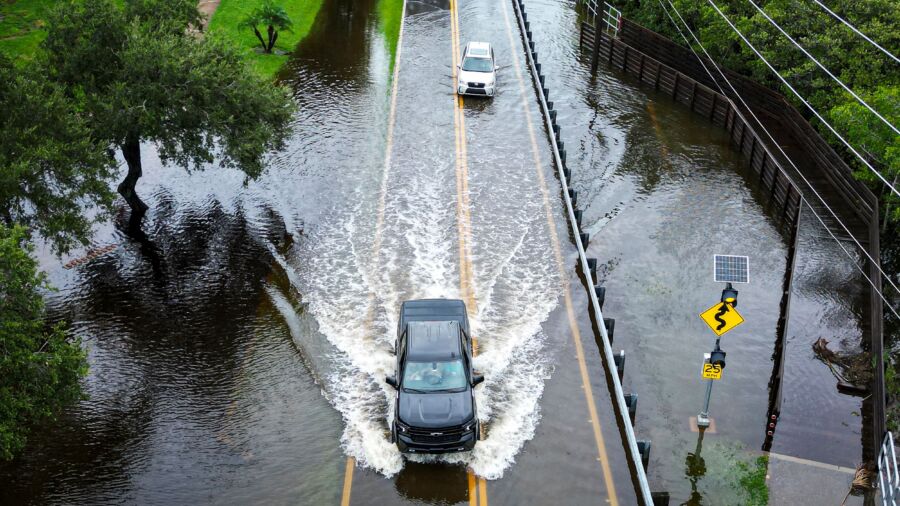
A fire department in Florida has issued a warning to owners of electric vehicles that their vehicle's batteries are at risk of catching fire if exposed to saltwater.
The announcement by Palm Harbor Fire Rescue on Florida’s Gulf Coast came on Aug. 30 after Hurricane Idalia made landfall in Florida’s Big Bend near Keaton Beach earlier that day. The warning applies to owners of all electric-powered vehicles, including golf carts and scooters.
Owners were urged to move any battery-powered vehicles out of their garages or storage units if they had come into contact with any salt water to avoid the risk of fire spreading to the buildings in the case of an ignition.
“Saltwater exposure can trigger combustion in lithium-ion batteries. If possible, transfer your vehicle to higher ground. This includes golf carts and electric scooters. Don’t drive these through water. PHFR crews have seen numerous residents out in golf carts and children on scooters riding through water,” the post continued.
The warning was issued following a fire that broke out at a Tesla outlet in the nearby city of Dunedin earlier that day, and comes nearly a year after an announcement by Florida's state fire marshal, raising caution about the risk of electric vehicle batteries in coastal areas in the wake of Hurricane Ian.
“Subsequently, I was informed by the fire department that the vehicle, once again reignited when it was loaded onto the tow truck. Based on my conversations with area firefighters, this is not an isolated incident. As you can appreciate, I am very concerned that we may have a ticking time bomb on our hands,” it goes on to say.
In addition, Patronis outlined a series of questions to the NHTSA, pertaining to the safety of lithium-ion batteries.
The questions related to adequate guidance from EV manufacturers to customers about the risk from saltwater exposure, and also delved into the safety of protective gear for firefighters, when exposed to EV fires.
The NHTSA has reportedly been studying the effects of saltwater exposure on electric vehicles since Superstorm Sandy hit the state in October 2012.
“Fires in electric vehicles can pose unique challenges for firefighters and other first responders. Since similar issues emerged with EVs after Superstorm Sandy, NHTSA has been researching the effect of saltwater immersion on batteries, and working with stakeholders to equip first responders with best practices on fighting battery fires,” according to an e-mail viewed by The Western Journal.
Additionally, the NHTSA launched an initiative in 2021 specifically aimed at EV safety. The initiative serves to ensure that future cars with onboard batteries are as safe as possible, by conducting research on battery diagnostics, management systems and cybersecurity.
As EV's have become more popular in the last few years, it has increased the importance of understanding and mitigating the risks by adhering to whatever safety guidelines are currently available, but more research is needed to gain a better understanding of the safety surrounding battery-powered vehicles.
As of July this year, close to 170,000 EV's are registered in Florida.