


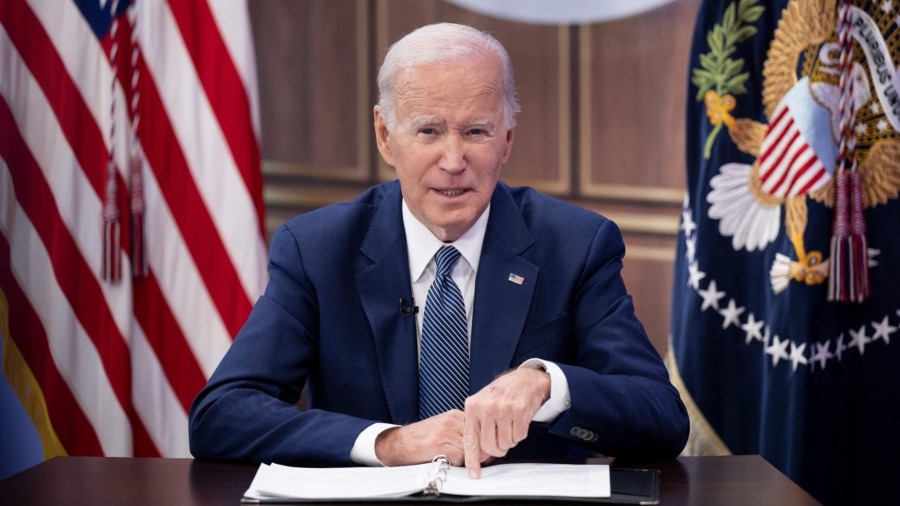
The Biden administration unveiled its National Security Strategy on Oct. 12, nearly 22 months into the presidency. The document historically labels communist China as the greatest challenge to the nation.
The document will provide the overarching framework within which the administration will seek to safeguard the United States and pursue its interests within an increasingly contested international space.
Notably, the strategy explicitly calls out China’s communist regime as the single greatest danger facing the nation.
“Although the Indo-Pacific is where its outcomes will be most acutely shaped, there are significant global dimensions to this challenge."
Moreover, the strategy underscores that the Chinese Communist Party (CCP), which rules the country as a single-party state, is currently engaged in a campaign to undermine the liberal international order and remake the world in its own, authoritarian image.
“We will leverage all elements of our national power to outcompete our strategic competitors; tackle shared challenges; and shape the rules of the road," it added.
The strategy outlines three key tactics and areas of focus for the United States in its pursuit of a safer, more free world: Investing in the sources of American influence and power, building coalitions of strong and likeminded nations, and modernizing the U.S. military for a new era of strategic competition.
The strategy refers to both China and Russia as autocratic regimes seeking to remake the world according to their own desires, but adds that communist China is the more serious and lasting of the two threats.
“In their own ways, they [China and Russia] now seek to remake the international order to create a world conducive to their highly personalized and repressive type of autocracy,” the document said.
To that end, the strategy says that the “critical difference” between the United States and communist China was that the United States was dedicated to preserving the rights of less powerful states, whereas the CCP was intent on forcing them into vassals of its own regime.
Speaking on a press call about the issue, national security advisor Jake Sullivan said that the coming years would present a “decisive decade” between democracy and autocracy, and that the United States' commitment to the principles of a free and open society now would make the difference later on.
“We recognize that in the geopolitical space, the PRC represents America’s most consequential geopolitical challenge.”