

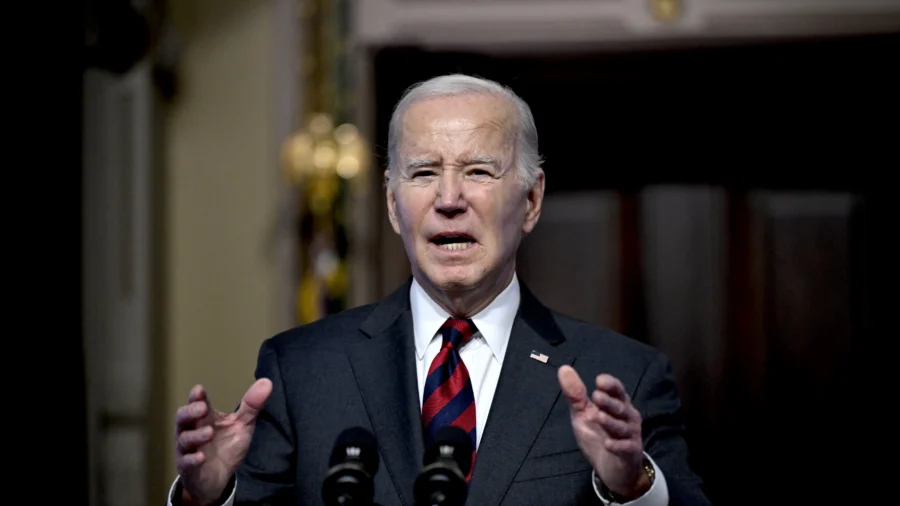
President Joe Biden on Monday invoked a Cold War-era measure aimed at boosting investment in U.S. manufacturing of medicines and medical supplies necessary for national defense.
President Biden used the first meeting of his supply chain resilience council to boast about his administration's efforts to improve supply chains upended by the COVID-19 pandemic and help bring inflation under control but acknowledged more work needs to be done.
“We know that prices are still too high for too many things, that times are still too tough for too many families,” President Biden said. “But we’ve made progress."
The White House issued a statement in which it said that the administration will authorize the Department of Health and Human Services to use powers under the Cold War-era Defense Production Act to commission investments in essential medicines.
The measures will also include investments in "medical countermeasures,” which specifically pertain to medicines for the diagnosis, prevention, and treatment of diseases related to chemical, biological, radiological, or nuclear attacks.
President Biden has been under intense scrutiny over his handling of the economy and inflation, with his approval ratings having dropped significantly in recent months.
The measures are part of a strategy to boost the economy ahead of the 2024 presidential election, for which the president is seeking reelection.
In an effort to prove to his voter base that he is tackling inflation and a failing economy, President Biden held the first meeting of a new White House Council on Supply Chain Resilience on Nov. 27.
Lael Brainard, who heads Biden's National Economic Council, told reporters on a conference call that supply chain stress had been reduced from record highs during the COVID-19 pandemic, but that more work was still to be done.
During the pandemic, the United States was heavily impacted by supply chain issues and export restrictions—much of it due to heavy reliance on Chinese imports.
The Cold-War-era measure comes after President Biden implemented other war-time-era measures to fund more domestic manufacturing of electric heat pumps.
Earlier this month, the Department announced it was using the 1950s Defense Production Act to obtain investment of around $170 million for more than half a dozen programs nationwide.
These programs are aimed at producing the heat pumps and associated components required to reduce the nation’s dependency on fossil fuels and boost energy independence, the Department said.