


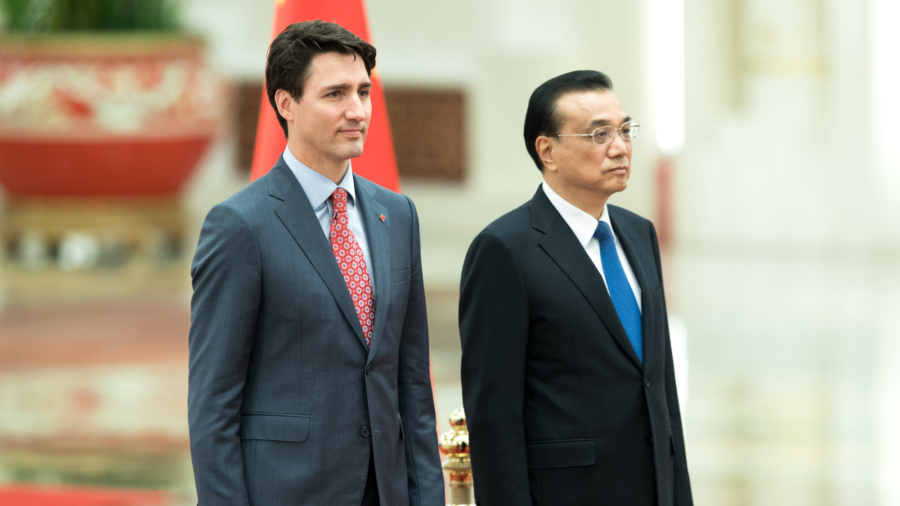
Canada's opposition leader recently said the country needs to rethink its relationship with China. So how are China-Canada relations and what's the significance during the pandemic?
But as the CCP virus emerged from China in late 2019, the regime's Canadian “friend” was kept in the dark just like every other country.
Ottawa refused to restrict travel from China until March, even though over 50 countries implemented some restrictions at their borders in early February. Ottawa’s move was praised by Beijing.
In February, Canada’s Chief Public Health Officer Theresa Tam, an adviser to the World Health Organization (WHO), argued against blocking travel from China, citing guidelines by the WHO.
Canadian physician and WHO adviser Bruce Aylward repeatedly praised China’s response to the outbreak, but refused to recognize Taiwan’s efforts, despite the island's few cases given its proximity to China.
The WHO has blocked Taiwan from joining the organization under pressure from China.
As of Friday, over 50,000 Canadians have been infected with the CCP virus and nearly 3,000 have died.
In December 2018, at the request of the United States, Canada arrested Huawei CFO Meng Wanzhou, the daughter of the company's founder Ren Zhengfei, who is a former member of China’s People’s Liberation Army (PLA).
The United States charged Meng and Huawei with violating U.S. sanctions on Iran.
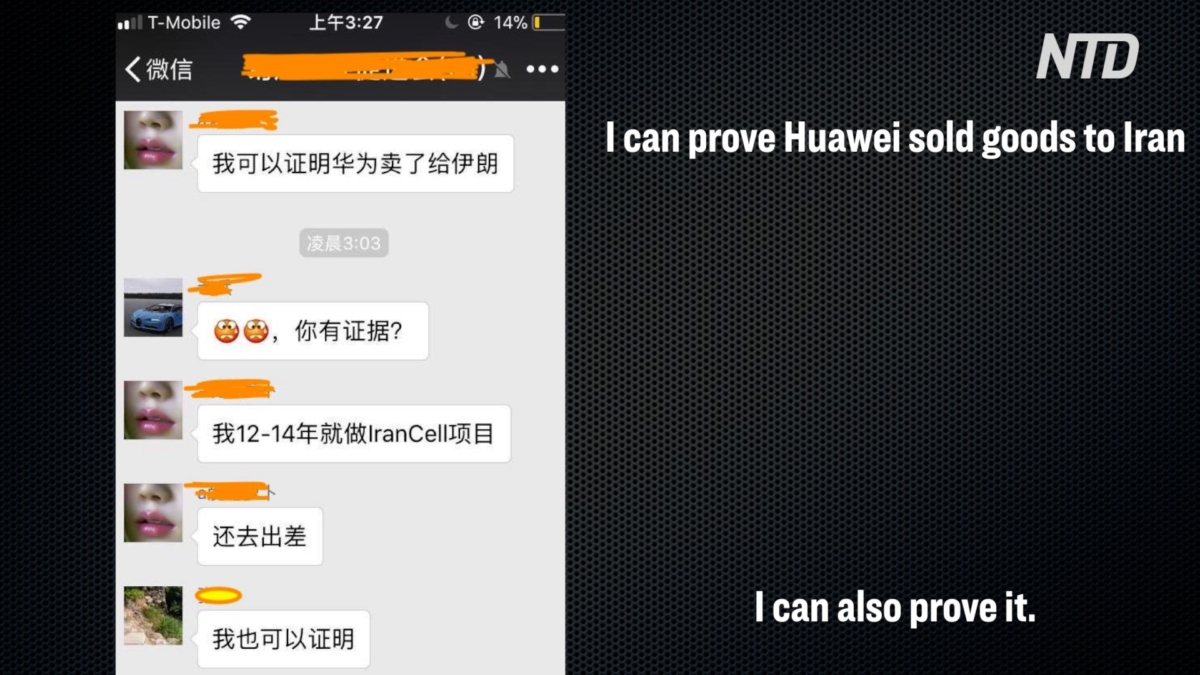
NTD previously obtained group chat messages between former Huawei employees. One said he can prove that Huawei was selling sanctioned goods to Iran. The employee was later arrested by Chinese authorities.
After Meng’s arrest, China arrested two Canadian citizens, Michael Kovrig and Michael Spavor, a former diplomat and a businessman, respectively. The incident was seen as retaliation for Meng’s arrest.
“The Chinese Communist Party does not believe in the rule of law," Jonathan Manthorpe, Canadian journalist and author told NTD in a previous interview. "I mean, if your first reaction, when you have a problem with Canada is you kidnap two senior Canadians, we can’t, we can’t work with a government like that.”
But some don’t see it this way.
According to Canadian public media CBC News, Manley sits on the board of Telus, which, like many Canadian telecommunication companies, has business relations with Huawei.
Another of Meng’s sympathizers is the former Canadian Ambassador to China John McCallum. Last January he spoke in front of Chinese media, including state media CCTV and Xinhua, and listed out three arguments Meng can make before a judge to avoid extradition to the United States.
McCallum was eventually forced to resign by Trudeau.
“The whole story of John McCallum ought to be a warning to Canadian politicians and the Canadian government, that they have to be very careful in how they deal with the Chinese Communist Party and Beijing, and the people they appoint to positions in that relationship,” Manthorpe said.
In 2006, Sam Sullivan, the mayor of Vancouver at the time, told the Vancouver Sun: “When I go to China, they treat me like an emperor.”
After coming back from China, Sullivan pursued court action to shut down a long-running protest site outside the Chinese consulate in Vancouver. The site is run by practitioners of Falun Gong, a spiritual practice persecuted in China.
Years of Canadian appeasement may have emboldened China. The regime started to take actions that surprised even longtime Canadian allies.
This despite the fact that she had worked for decades to help China build up its economic institutes.
McCuaig-Johnston was also told by a Chinese national that the Chinese Communist Party (CCP) has a list of 100 Canadians it could pick up at any time.
According to the report, she encouraged Canada to pull out of the Beijing-centered AIIB and to use the Global Magnitsky Act to punish Hong Kong officials who abuse human rights. She also urged the country to pay more attention to China’s actions in the Indo-Pacific.
And she's not alone.
Lee said he was targeted by the CCP for joining the commemoration of the Tiananmen Square massacre in front of Vancouver’s Chinese embassy which takes place every year on the fourth of June.
Lee kept silent for years. He said he didn’t want to cause troubles for the Canada-China relationship, but the Chinese regime’s growing infiltration into Canadian politics compelled him to speak out.
In a recent interview with American Thought Leaders, J. Michael Cole, a China scholar and senior fellow with Canada’s Macdonald-Laurier Institute, said that the COVID-19 outbreak should serve as a moment of reckoning for democracies like Canada.
He said countries need leadership who are more willing to challenge China.
“That probably signifies a bit more confrontation," he said, "There's going to be costs, but the problem is that, especially countries like Canada, we never tested the waters. The moment Beijing threatens something or expresses displeasure, we back away, we back off, and Beijing gets what it wants. But leaders oftentimes forget, especially countries like Canada, China needs our natural resources. China wants access to certain technologies that its own people still cannot produce. So it needs us at least as much as we need it. So that should give us the ability to push back on fundamentals and values that are dear to us.”
China affairs expert David Shambaugh, who testified remotely, said "Retaliation is greater. It will happen. You have to enter into it with expectation that there will be Chinese retaliation. So that’s the big choice. Do we go public and confront China on these issues, despite the retaliation or not?"
"I noticed your previous diplomats who testified say we are working very hard behind closed doors to press the case of the Two Michaels and other issues," he said, "Well, that’s exactly where China wants to keep it, behind closed doors. I think, personally, going public about China’s egregious behavior in a wide range of issues whether it’s Tibet, the Uygurs, the Two Michaels, Liu Xiaobo, you name it ... China just hates being internationally called out publicly.”
Bonnie Glaser, an expert on Asia-Pacific affairs, who was also at the hearing, said Canada is not alone in facing economic coercion from China. She said right now may be a good opportunity for many middle-power countries to come together.
“What it would signal to Beijing is that countries that are targeted by this economic coercion by China are willing to work together. They are willing to stand up to China." she said.