


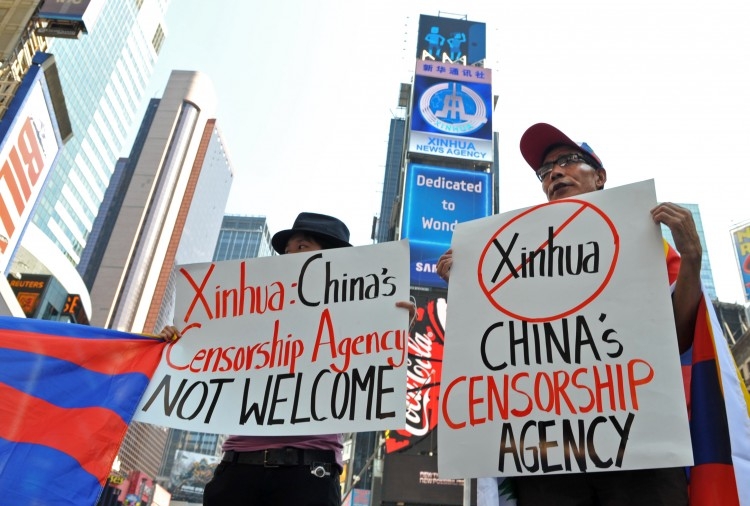
The Chinese regime has been deploying “covert, corrupt and coercive” means to weaponize Chinese-language and Western media in a campaign to impose its vision of current affairs on the rest of the world, a recent French military think tank report finds.
The year 2008 marked a turning point. The Olympic Games in Beijing, an event the regime had hoped to leverage to showcase its economic success, gave rise to protests in nearly a dozen cities around the world that disrupted torch relays.
The humiliation Beijing suffered from the resulting negative coverage had stung the authorities. To better control the regime’s global image, the Chinese Communist Party (CCP) soon came up with a “10-year plan,” noted the report by the Institute for Strategic Studies of Military Schools (IRSEM), a think tank funded by the Ministry of the Armed Forces.
The values of tolerance that characterize Western democracies have afforded Beijing “considerable freedom of movement,” allowing it to multiply its foreign offices, recruit foreign journalists to adapt its messages to different audiences, infiltrate local press with gifts and other material benefits, while dispensing billions of advertising dollars on Western media to further expand its reach, the report said.
In China, rather than a watchdog meant to keep the government in check, the press under Beijing has become a tool to serve the Party, the report said. Such vision was made plain in a 2016 speech by Chinese leader Xi Jinping, during which he told around 180 state media representatives to align their ideology with that of the top officials, “speak for the Party's will ... and protect the Party's authority,” according to a Xinhua readout.
Buying Influence
Chinese state media are active on all social media networks, with a sizable influence on Twitter, Facebook, YouTube, and Instagram—all of which are blocked in China.Chinese state media set up English- and regional-language pages on Facebook in 2013. Eight years on, they have topped world’s media in term of following, with four major outlets—CGTN, China Daily, Xinhua, and People’s Daily—having between 86 million to 116 million followers each at the time of the French report’s publication, or about 2.5 to 3 times larger than that of CNN’s.
These “spectacular scores” have been the outcome of a deliberate effort to artificially inflate subscriber numbers, the authors said, pointing to the “exceptional growth rate” and the “extremely low interaction rate” these accounts receive.
According to the report, around eight major Chinese state media in English have an average growth rate of 37.8 percent from the period Jan. 1, 2019 to March 31, 2020, or about 5,000 times higher than that of U.S. mainstream media, but their level of engagement is 68 times lower.
“When … you see tens of millions of people following, then you feel like this is pretty credible,” Sarah Cook, a China analyst at human rights watchdog Freedom House, told The Epoch Times at the time. She described it as a “new frontier,” that is, "an avenue for accessing the grassroots in society and public in other countries.”
The proportion of fake accounts among their Twitter followers is hard to ignore: For an average Twitter user, from 5 to 30 percent of the accounts that follow them are bots or spam; but the fake account ratio for the four aforementioned media ranges from 34.3 percent to 38.4 percent. For their French versions, the numbers shoot up to as high as 62.8 percent, the researchers found.
The collaboration has a three-fold benefit, the authors said. Not only does it help the Chinese media reach its target audience, it makes them appear more credible, and gives them financial leverage over their partner media.
A New Global Media Order
The U.S. State Department has designated a total of 15 Chinese state-run outlets’ entities based in the country as foreign missions because they are “substantially owned or effectively controlled” by a foreign government, a department spokesperson told The Epoch Times in September.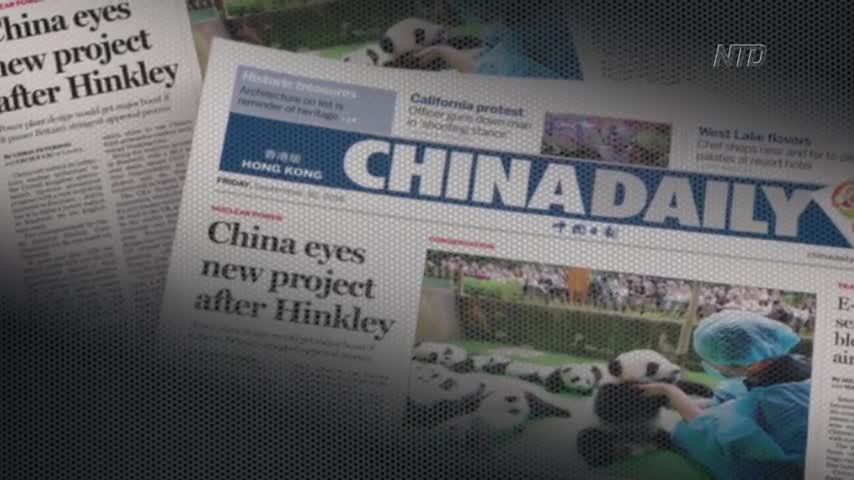
In the case of state-run news agency Xinhua, its local journalists have the “sole mission of translating dispatches previously penned by Chinese staff,” the French report said. A French journalist for Xinhua told a report author in 2018 that their Xinhua dispatches consist of 80 percent translations from English and 20 percent from Chinese. The translations and occasional original article would all be proofread by a Chinese journalist fluent in French and attuned to “Party’s expectations as well as the ‘preferred stories,’” according to the Xinhua reporter.
David, a former senior editor for Sing Tao’s New York office, said that he was briefed on “two principles” on his first day: no reporting of news on Falun Gong, a spiritual group persecuted by Beijing, nor Taiwan independence. Another, who worked for the outlet’s San Francisco office years ago, said she was told not to use the word CCP—the acronym for the Chinese Communist Party—nor “Republic of China,” the official name for the self-ruling island of Taiwan that the regime claims as its own. Instead, she was to use the words “China” and “Taiwan Province of the People’s Republic of China” respectively, she told The Epoch Times.
In South Africa, journalist Azad Essa saw his weekly column canceled from Independent Media, the country’s second-largest media group, hours after the publication of his Sept. 2018 story condemning the persecution of Uyghurs in China’s Xinjiang region. The media group is 20 percent owned by two Chinese entities backed or controlled by Beijing.

“Politically sensitive topics or criticisms against the Chinese government would put our staff members or their families at risk. We don’t want them or their families to get detained in China,” one media proprietor told the think tank.