


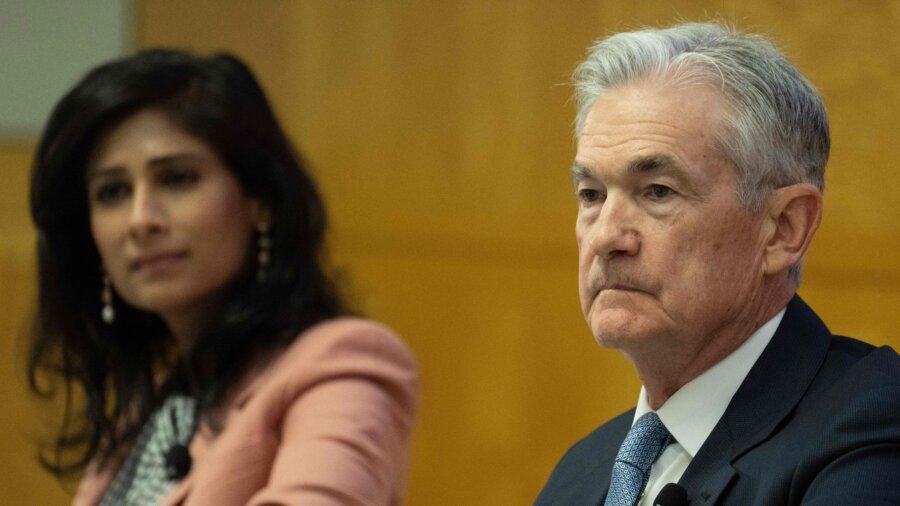
Federal Reserve Chair Jerome Powell is “not confident” that the central bank has done enough to eradicate inflation from the U.S. economy, he stated in a prepared speech.
Appearing before an International Monetary Fund (IMF) audience on Nov. 9, Mr. Powell warned that additional work must be done to restore price stability.
“The Federal Open Market Committee is committed to achieving a stance of monetary policy that is sufficiently restrictive to bring inflation down to 2 percent over time; we are not confident that we have achieved such a stance,” he said.
Because much of the supply-chain bottlenecks have been resolved and economic growth remains strong, Mr. Powell believes it will be harder to combat inflation.
“Going forward, it may be that a greater share of the progress in reducing inflation will have to come from tight monetary policy restraining the growth of aggregate demand,” he stated.
While he acknowledged that progress is being made in bringing inflation back down to the rate-setting committee’s 2 percent target, Mr. Powell noted that officials would not hesitate to “tighten policy further.” At the same time, he added that caution and balance must be considered.
“If it becomes appropriate to tighten policy further, we will not hesitate to do so,” said the Fed chief, who was interrupted by a group of climate change protesters. “We will continue to move carefully, however, allowing us to address both the risk of being misled by a few good months of data, and the risk of overtightening.”
Mr. Powell and his colleagues have suggested they could raise interest rates at any moment if warranted.
“We know that ongoing progress toward our 2 percent goal is not assured: Inflation has given us a few head fakes,” he told the audience.
Stocks and Bonds
The U.S. stock market slumped following Mr. Powell’s comments, with the leading benchmark indexes sliding as much as 0.9 percent. The S&P 500 also ended its longest winning streak in two years.In addition to the Fed’s higher-for-longer mantra, the latest long-term duration bond auction drove some of the action. The Treasury sold $24 billion in 30-year Treasurys and garnered weaker-than-expected demand.
Treasury yields were up across the board, including the benchmark 10-year yield, which rose around 13 basis points to 4.636 percent. The 2-year yield edged up close to 10 basis points to above 5.03 percent, while the 30-year bond jumped more than 11 basis points to top 4.77 percent.
A Warning From Tom Barkin
Speaking during an MNI webcast on Nov. 9, Richmond Fed President Tom Barkin conceded that he adopts a more “holistic” view of financial conditions.“I don’t think long rates are quite useful as a policy variable. They can move, you know, pretty significantly over a relatively short time period,” Mr. Barkin said.
He also warned that the net impact of all the Fed tightening “will eventually hit the economy harder than it has.”
“I think there is more lags to come,” the Richmond Fed chief noted.
In the third quarter, the U.S. economy expanded 4.9 percent. Early projections suggest that the fourth quarter might not emulate this growth. The Atlanta Fed Bank’s GDPNow model estimate shows around 2 percent, while the New York Fed Nowcast points to similar growth.
The LEI has declined for 18 consecutive months, including a 0.7 percent drop in September. The LEI has fallen 3.4 percent over the six-month span between March and September 2023.
“So far, the US economy has shown considerable resilience despite pressures from rising interest rates and high inflation,” said Justyna Zabinska-La Monica, the senior manager of business cycle indicators at The Conference Board, in a statement. “Nonetheless, The Conference Board forecasts that this trend will not be sustained for much longer, and a shallow recession is likely in the first half of 2024.”