


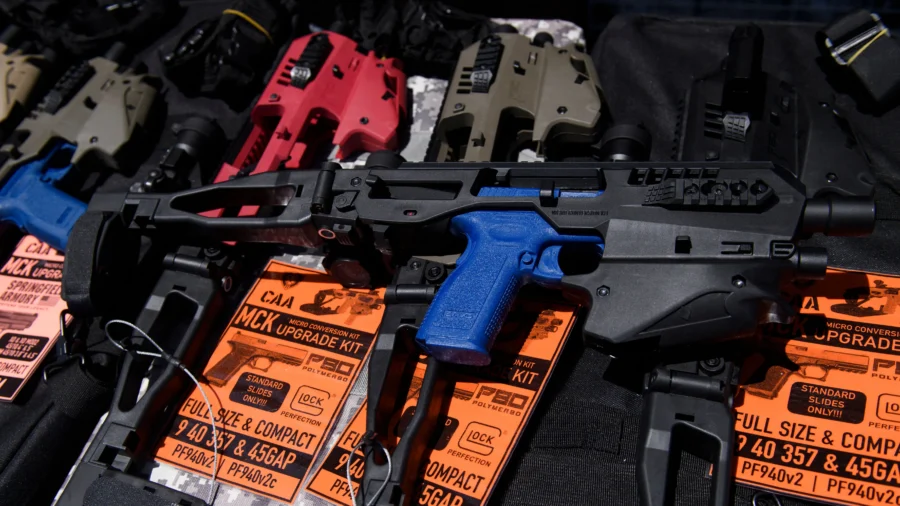
A U.S. district judge on Wednesday ruled against a federal pistol brace ban, saying federal officials overstepped their authority when crafting the rule.
“The Court is certainly sympathetic to ATF’s concerns over public safety in the wake of tragic mass shootings. The Rule 'embodies salutary policy goals meant to protect vulnerable people in our society,'" Judge Matthew Kacsmaryk wrote in his order.
The case, Britto v. ATF, challenges the pistol brace rule under the Administrative Procedures Act, a decades-old law that governs in which federal agencies propose or establish regulations. Judge Kacsmaryk found that the plaintiff's case will likely prevail, meaning that the ATF rule will likely be struck down.
Citing another case, Mock v. Garland, over the pistol brace ban, the judge wrote that "as explained in Garland, ‘[t]he controlling law of this case is that the Government Defendants’ promulgation of the Final Rule ‘fails the logical-outgrowth test and violates the APA’ and ‘therefore must be set aside as unlawful’ under the APA.'”
However, he found that some parties could be injured, including those who own and deal the braces.
"Additionally, ATF admits the 10-year cost of the Rule is over one billion dollars ... and because of the Rule, certain manufacturers that obtain most of their sales from the stabilizing braces risk having to close their doors for good," the order stated.
Before that, multiple federal judges have issued preliminary orders blocking enforcement of the rule enacted by President Joe Biden's administration and challenged by lawsuits from gun rights groups. But those orders had applied only to members of the groups, and only in those judges' jurisdictions.
Pistol braces were first marketed in 2012 as a way of attaching a pistol to the shooter's forearm, stabilizing it and making it easier to use for disabled people. Many users found that the braces could also be placed against the shoulder, like the stock on a rifle.
According to text the ATF submitted to the Federal Register, "Because short-barreled rifles are among the firearms considered unusual and dangerous, subjecting them to regulation under the [National Firearms Act], it is especially important that such weapons be properly classified."
It also suggested that the "use of a purported 'stabilizing brace' cannot be a tool to circumvent the [National Firearms Act] and the prohibition on the unregistered possession of 'short-barreled rifles.'"
Gun rights groups and gun organizations have been uniformly critical of the ATF rule. An opinion article published by the National Shooting Sports Foundation, a trade organization, say the "stabilizing pistol brace rule redefined brace-equipped pistols as short-barreled rifles, requiring that they be registered as controlled items under the National Firearms Act, requiring tax stamps and submission of fingerprints, photos and redundant background checks," but termed the rule as "unconstitutional."
The pistol brace rule as well as 2022 ATF rulemaking targeting "frames or receivers" creates a "criminal law without the consent and will of Congress. It is important to remember that only Congress can draft laws—especially those that involve criminal punishments," according to the group. "When an executive authority does that on their own, that’s tantamount to tyranny."
The Epoch Times has contacted the Department of Justice, which oversees the ATF, for comment Thursday.