


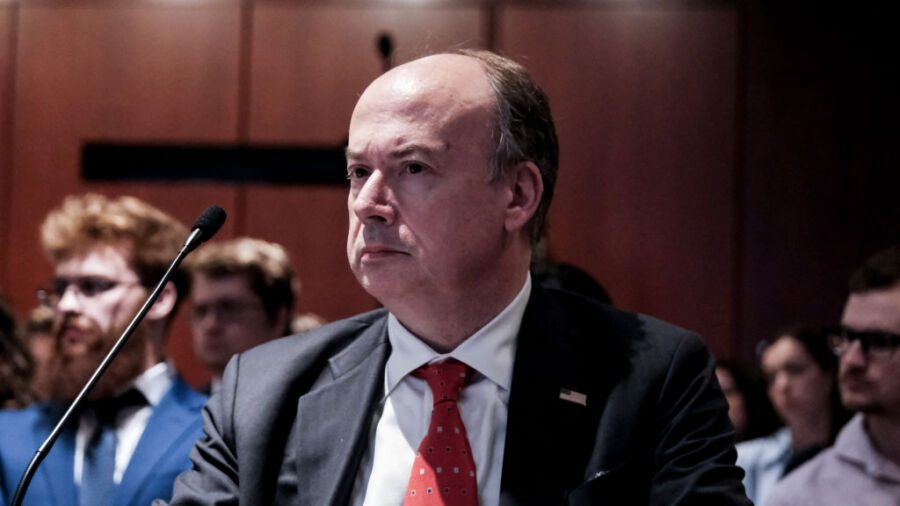
A federal judge has ordered a second evidentiary hearing for removal of the Fulton County case against former President Donald Trump and 18 others over violating Georgia's Racketeer Influenced and Corrupt Organizations (RICO) Act in their challenge of the 2020 election results.
Jeffrey Clark, former Justice Department (DOJ) official, filed a notice of removal on Aug. 21, requesting that his case be moved from state to federal court, where he is expecting the charges to be dismissed. A request to expedite the process before the arrest deadline was denied by Judge Steve Jones of the U.S. District Court for the Northern District of Georgia, who will oversee the hearings related to removals.
The hearing will take place Monday, Sept. 18, and the district attorney's office has until Sept. 5 to file a response.
The indictment accuses Mr. Clark of violating the RICO Act as well as allegedly making a false statement when he issued a DOJ statement alerting Georgia officials to election fraud concerns. He is arguing that he acted as a federal official, and thus "asserts federal jurisdiction" in the case.
4 Notices of Removal
Notices of removal must be filed no later than 30 days after arraignment or anytime before trial, whichever is earlier. Besides Mr. Clark, three other defendants have filed notices of removal.Mark Meadows, former chief of staff to the president, was the first to do so on Aug. 15, a day after the indictment. An evidentiary hearing will take place Monday, Aug. 28.
Ahead of the hearing, Ms. Willis and Mr. Meadows's lawyers have filed responses that give a preview of their arguments. Mr. Willis is arguing that Mr. Meadows's actions were not the actions of a federal officer, but that in fact he neglected the duties of his federal office and participated in illegal political activity under the Hatch Act. Mr. Meadows's lawyers argued that the political or election-related nature of Mr. Meadows's actions don't disqualify them from being part of federal conduct.
Mr. Meadows was accused of arranging or taking meetings and phone calls involving the subpoenaed witnesses, and Ms. Willis is expected to ask them to recount the meetings and calls.
The notice claims Mr. Still, and Mr. Shafer, followed procedure and the advice of the president's attorneys in their actions to cast the alternate ballots. For this, Mr. Still was charged with eight counts, all tied to a Dec. 14, 2020 meeting where he cast his ballot.
Similar to previous notices of removal, his lawyers make additional arguments that the First, Fifth, and 14th Amendments should further protect Mr. Still from these charges.
"Mr. Still attended a meeting with other contingent electors and cast a ballot in accordance with the instructions from legal counsel," they wrote. "Such conduct clearly constitutes political expression, association, and expressive conduct protected by the First Amendment."
Rudy Giuliani, who served as an attorney to President Trump during the period on the indictment, has said he plans to file a notice of removal as well.
Many have speculated as to whether President Trump would do the same, given that a president can't pardon a state conviction, only a federal one.
President Trump's attorney Steven Sadow, an Atlanta-based, veteran criminal defense lawyer known for representing high-profile clients and taking on high-profile cases, declined to comment.
"I will not be disclosing my defense strategy or tactics to the media in advance," he said.