


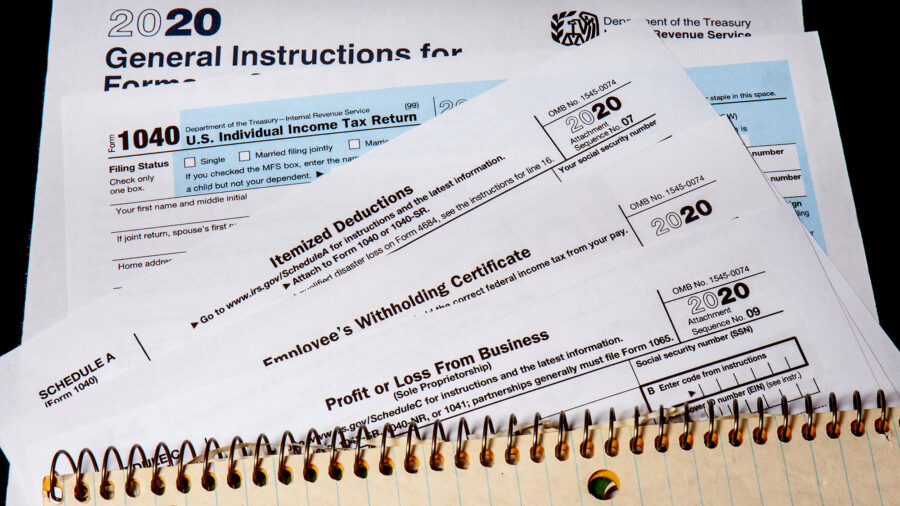
No one likes doing their taxes.
But there is very good reason for everyone to file a federal tax return this year, even if your 2020 income was so low that the IRS doesn't require you to file.
You could get back more money than you think, or at least lower your tax bill. A number of COVID relief provisions may be claimed in full only through your tax return. Some tax credit rules have become more advantageous as a result of the pandemic. And you may find yourself eligible for some tax breaks for the first time due to COVID.
The IRS will start accepting returns on Feb. 12, and the filing deadline is April 15, unless you apply for an automatic extension.
Claiming Stimulus
If you earned less than $75,000 as a single person, $112,500 as head of household or $150,000 as a married couple in 2020 and didn't already receive COVID relief payments from the federal government, filing your federal tax return will be the best way to get the full amount of the two economic impact payments for which you're eligible.The IRS sent out two payments so far—the first was for up to $1,200 per adult, and the second for up to $600, with even more money going to those who had dependent children.
But anyone who didn't file a federal tax return in 2019 or whose 2019 income was above the 2020 income eligibility thresholds for the stimulus payments may not have received what they are owed. That's because the IRS, for the sake of speed, shipped out payments based on the 2019 tax information it had as well as information it had for Social Security recipients.
The same situation may have affected parents who got a divorce in 2020, said Elaine Maag, a principal research associate at the Urban-Brookings Tax Policy Center.
It's possible the IRS sent the family's full stimulus payment to the non-custodial parent.
In that case, Maag noted, the IRS will not require non-custodial ex-spouses to pay back any of the money they erroneously got. And it will still send a duplicate payment to the parent who can prove their custodial status last year.
You May be Eligible for an Earned Income Tax Credit
Given how difficult 2020 was financially for so many people, you may qualify for another tax break—the refundable Earned Income Tax Credit—which is geared toward rewarding work for low- and moderate-income filers.To be eligible for the EITC, your income must be below certain thresholds depending on the number of children you have. For instance, for tax year 2020, your adjusted gross income can't be above $21,210 if you are a childless married couple, but can go as high $56,844 if you have three kids. (There are other factors that go into determining EITC eligibilty detailed in this IRS summary.)
The credit is worth up to $6,660 for married couples with children and up to $538 for single, childless filers.
Plus, the rules for the EITC have been tweaked to provide more Covid relief for those who qualify. You may choose whether to base your EITC on your 2019 or 2020 income, whichever would be most advantageous for you.
That same lookback provision will also apply if you qualify for the refundable Child Tax Credit.