


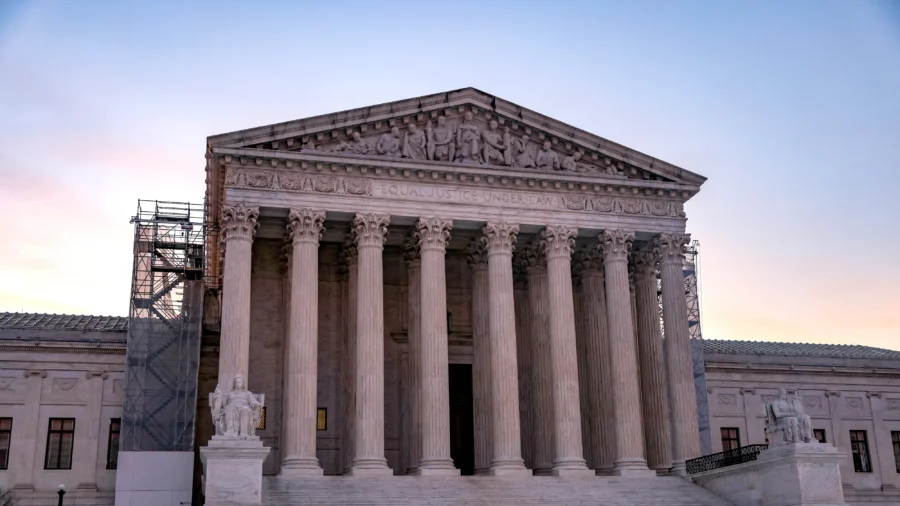
What to Know About Today's Hearing
By Catherine YangThe Supreme Court appeared skeptical that the doctors group who challenged the Food and Drug Administration's (FDA) loosening of regulations of the abortion pill mifepristone had the right to bring the case.
Justice Neil Gorsuch pointed out that the universal injunction the group was requesting is a relatively new form of court order that the high court itself has "never adopted." He said this case was a prime example of a small case turning into a "nationwide legislative assembly."
The pro-life doctors argued that they've suffered harm from having to conduct emergency procedures for women who've taken the abortion pill and experience complications. The government counters this by contending that complications from the abortion pill are rare, and the objecting doctors can themselves opt out of the procedure under federal conscience laws.
Justice Ketanji Brown Jackson expressed concern there was a "mismatch" between the claimed injury and relief sought.
"The obvious common sense remedy would be to provide them [the doctors] with an exemption," she said, noting that federal law already allows doctors to opt out of doing abortion procedures over conscience objections.
Justice Sonia Sotomayor and Justice Amy Coney Barrett both questioned whether any of the doctors had actually been put in a specific situation where their conscience was an issue.
A judgment is expected in June.
The doctors' group challenged two FDA decisions loosening the restrictions on mifepristone. In 2016, the agency rolled back some safety protocols for its prescription, allowing the drug to be prescribed after just one in-patient visit and to women as far along as 70 days’ gestation—an extension from the previous cutoff of 49 days.
Case Concludes
Oral arguments have concluded after about 1 hour and 45 minutes.Solicitor General Asks Court to Reverse 5th Circuit’s Ruling
By Samantha FlomIn her rebuttal, Solicitor General Elizabeth Prelogar reiterated her assertion that the respondent doctors did not have standing to challenge the FDA’s approval of mifepristone.
“What is so telling is that respondents don’t have a specific example of any doctor ever having to violate this care in violation of their conscience,” Ms. Prelogar said. “Instead, respondents pointed to generalized assertions and the declarations that never come out and specifically say, by one of their identified members, ‘Here’s the care I provided, here’s how it violated my conscience, and here’s why conscience protections were unavailable to me.’”
That lack of testimony, she said, indicated to her that “the past harm hasn’t happened.”
Ms. Prelogar further charged that if the respondents were found to have standing, that would open the floodgates for every organization in the country to challenge any federal policy they disliked.
In its ruling, the 5th Circuit Court of Appeals allowed mifepristone to remain on the market, but prohibited its distribution by mail and its prescription to women later in pregnancy or by anyone other than a doctor.
Ms. Prelogar argued that those restrictions cause “profound harm” to the FDA, pharmaceutical companies, and women.
Barrett Asks About First Visits
By Catherine YangMs. Hawley argued that the FDA rule effectively turns emergency rooms into "follow-up visits."
Justice Barrett pointed out that first visits did not require ultrasound and would not be able to give an "accurate gestational read on age or detect an ectopic pregnancy."
"So why would the elimination of the visit necessarily increase the risks?" she asked.
Ms. Hawley said FDA's data already shows risk went up, three-fold according to one study.
"Is that because doctors were voluntarily saying 'hey let's do an ultrasound,' or try to detect a fetal heartbeat?" Justice Barrett asked.
Justices’ Questions on Conscience Harm
By Savannah Hulsey PointerJustices Ketanji Brown Jackson and Elena Kegan questioned attorney Erin Hawley, who is representing Alliance Hippocratic Medicine (AHM), about whether the doctors represented in her case suffered conscience harm, and whether this was a broad or narrow application of the alleged harm.
The justices asked the attorney to clarify the broader conscience harm, according to AHM's case.
Ms. Hawley asserted that the broader harm "is being complicit in the process that unnecessarily leads a takes an unborn life, such as performing DNC and abortion."
Justice Jackson asked for further specificity, saying: "What do you mean [by] 'complicit in the process'?"
Ms. Hawley responded, saying: "What harms our doctors, your honor, is being involved in completing … an elective abortion. And it's really not that hard to see why that might be a conscious harm. If you think about what's involved in it."
Justice Keagan interjected that she took the involvement in abortion to be part of the "conscience objection" and asked, "is there any broader conscience objection that appears?"
Ms. Hawley responded, saying: "Yes, your honor, and in this sense, completing an elective abortion means removing an embryo fetus whether or not they're alive, as well as placental tissue."
Justice Keagan again asked for clarification, asking: "Whether or not there's any live tissue?"
Sotomayor Challenges Doctors’ Conscience Objections
By Samantha FlomJustice Sonia Sotomayor pressed Erin Hawley, attorney for the Alliance of Hippocratic Medicine, on whether there was sufficient basis for the organization’s argument that its doctors were being forced to violate their consciences by treating women injured by mifepristone.
Ms. Hawley pointed to the cases of two doctors who claimed to have been in that situation.
One, Dr. Francis Scott, said she was required to perform a dilation and curettage, or D&C, procedure because she did not have an opportunity to state her objection.
“These are life threatening situations in which the choice for a doctor is either to scrub out and try to find someone else, or to treat the woman who’s hemorrhaging,” she said.
But Justice Sotomayor interjected that “usually … the way people with conscience objections do this is they make those objections known.
“And you know, that may be harder, it may be easier in a particular context, but most hospitals have mechanisms in place, routines in place to ensure the doctors who are allowed to do this, you know, in advance, right, and are allowed to do it at the moment.”
The justice went on to say that she did not think either of the doctors referenced had a clear case where they could say their consciences were violated in the past.
Ms. Hawley, however, pushed back on that claim.
“I think we do, your honor. Given the emergency nature, it’s simply impractical to have an objection lodged prior to understanding what’s going on in that operating room,” she said.
Ms. Hawley further cited judicial precedent where conscience objections were found not to apply in emergency situations.
“So, it’s a lot to ask our respondent doctors to go up to the top floor and litigate this with the general counsel when the federal government’s telling them they don’t have a conscience protection.”
While Justice Samuel Alito seemed amenable to Ms. Hawley’s argument, Justice Amy Coney Barrett appeared to be more aligned with Justice Sotomayor.
She noted that Dr. Francis’s affidavit did not state that the procedure she participated in involved a living fetus or embryo.
Gorsuch Interrupts, Says Case 'Prime Example' of New Trend Supreme Court Has 'Never Adopted'
By Catherine YangJustice Neil Gorsuch interrupted a back-and-forth between Justice Ketanji Brown Jackson and attorney Erin Hawley on the topic of conscience injuries.
Normally, courts issue relief that addresses the plaintiff's injuries "and go no further," he said. Here there were a "handful" of individuals with conscience objections.
"Normally, we would allow equitable relief to address them. Recently, I think what Justice Jackson's alluding to, we've had what one might call a rash of universal injunctions of vacatures. And this case seems like a prime example of turning a small lawsuit into a nationwide legislative assembly on an FDA rule or any other federal action," he said, asking for Ms. Hawley's thoughts.
Ms. Hawley said she thought the lower court's ruling in their favor had been "perfectly appropriate" under Section 705.
"When the parties before the court are nonregulated parties, the only avenue which they can possibly get relief ... is, as in this case, a state issue, or in other cases a vacature," she said. "And that's because without that sort of relief the very parties before the court won't get it."
Ms. Hawley was asked why the doctors would not seek direct relief and instead targeted the entire FDA. She pivoted to the merits of the case before Justice Gorsuch cut in with clarification.
Justice Gorsuch said during President Franklin Roosevelt's tenure there were zero universal injunctions issued. In the past four years, there were 60-some such court orders.
"They're a relatively new thing, and you're asking us to pursue this relatively new remedial course which this court has never adopted itself," he said. "Lower courts kind of run with this."
Respondent Argues FDA Didn't Consider Safety Concerns
By Savannah Hulsey PointerIn her opening argument before the Supreme Court, Erin Hawley, representing Alliance Hippocratic Medicine (AHM), asserted that the FDA's approval of abortion drugs without adequate data violates the Administrative Procedure Act (APA).
Ms. Hawley emphasized that the lower court's decision simply restored protections for women who use abortion drugs, highlighting the need to safeguard their well-being: "The lower court's decision merely restored long-standing and crucial protections under which millions of women used abortion drugs."
Addressing the issue of standing, Ms. Hawley presented evidence to satisfy Article III requirements, saying, "Article III is satisfied here because one, the FDA relies on OB hospitalists to care for women harmed by abortion drugs.
"Two, the FDA concedes that between 2.9 and 4.6 percent of women will end up in the emergency room. And three, the FDA acknowledges that women are even more likely to need surgical intervention and other medical care without an in-person visit."
Ms. Hawley cited statistics indicating that nearly 650,000 women take abortion drugs annually, leading to an increase in emergency room visits and the need for medical intervention. The attorney also underscored the ethical dilemma faced by respondent doctors.
"Doctors will be forced to manage abortion drug harm is not a bug in the FDA system, but part of its very design. Ruling against respondents standing here would allow federal agencies to conscript non-regulated parties into violating their consciences and suffering other harm without judicial recourse," Ms. Hawley said.
The AHM attorney also criticized the FDA's failure to comply with basic APA requirements, highlighting what she asserted were inconsistencies in its decision-making process, ending her comments by asking the court to affirm the lower court's decision and uphold protections for women seeking to use these drugs.
Pharma lawyer: Judges ‘Not in a Position’ to Second-Guess FDA
By Samantha FlomJessica Ellsworth, representing mifepristone manufacturer Danco Laboratories, asserted that judges should not question the FDA’s decision-making, holding that they are not qualified to make those determinations.
“You have a district court that, among other things, relied on one study that was an analysis of anonymous blog posts. You have another set of studies that he relied on that were not in the administrative record and would never be because they post-date the FDA decisions here. They have since been retracted for lack of scientific rigor, and for misleading presentations of data,” Ms. Ellsworth said, referencing the emergency room visit studies Justice Alito raised earlier.
Alito Presses Drug Company on Stake in Case
By Catherine YangJustice Samuel Alito asked Jessica Ellsworth, attorney for drug company Danco Laboratories, who her company thought would be "aggrieved" by the case.
Mifepristone is the only drug the company is currently marketing, and the lower court decision did not prohibit the company from continuing to do so.
"So I gather your injury is that you're going to sell more if the restrictions that were previously in place were lifted," Justice Alito said.
"Yes," Ms. Ellsworth said.
"You're going to make more money," Justice Alito said.
Justice Alito asked Ms. Ellsworth about adverse event reporting, and what numbers increase would be "enough" to warrant more safeguards.
"Don't you think the FDA should have continued to require the reporting of non-fatal consequences?" he asked.
Ms. Ellsworth said the FDA decided not to continue in 2016 after "more than 15 years of a well-established safety profile."
Justice Alito asked why that would be a bad thing to continue.
"I mean, you don't want to sell a product that causes very serious harm to the people who take your product, relying on your tests and the FDA tests. Wouldn't you want that data?" he asked.
Ms. Ellsworth said that data "is something we're looking for all the time." She pointed to 1-800 numbers on the company's website for reporting.
Justice Jackson Questions Possible ‘Mismatch’ In Injury Claim
By Savannah Hulsey PointerJustice Ketanji Brown Jackson questioned Solicitor General Elizabeth Prelogar about the concern that there is a "mismatch" in the case before the court, saying there could be dissonance between the claimed injury and the remedy sought.
"I don't know that our doctrines sort of capture this, but I guess I see it that the injuries that the respondents allege … are conscience induced injury, that they are being forced to participate in a medical procedure that they object to," Justice Jackson said. "And so the obvious common sense remedy would be to provide them with an exemption … and you say, and you've said here several times that federal law already gives them that."
Ms. Prelogar echoed Justice Jackson's concerns, likening the situation to a "zone of interest" analysis, suggesting that the respondents were seeking relief under a statute that did not regulate them.
FDA Argues Conscience Protections Apply
By Catherine YangMs. Prelogar said that only two of the seven doctors had argued conscience objections, but protections are in place.
"Federal conscience protections are specifically designed to deal with this issue," she said, adding that they provide "broad coverage here."
In the 1970s, the "Church Amendments" were added to conscience laws to protect the rights of those who object to performing abortion or sterilization procedures.
Ms. Prelogar argued these and additional state laws would protect doctors who object to participating in abortion and any related procedures.
Alito Raises Concern About Studies Showing Increased Emergency Room Visits
By Samantha FlomJustice Samuel Alito questioned whether the FDA had adequately assessed studies showing an increased frequency in emergency room visits among women who took mifepristone.
The studies in question, first referenced in an amicus brief filed by the Charlotte Lozier Institute, were cited by U.S. District Judge Matthew Kacsmaryk in his initial injunction blocking mifepristone’s approval last year. The studies were recently retracted by Sage Journals after a review.
Justice Alito noted that, in its response, the FDA acknowledged the studies’ implications but simply stated that there are “no apparent increases in other serious adverse events related to mifepristone use.”
“Does that really count as a reasoned explanation to the suggestion that the data shows there are going to be more emergency room visits. The increase in emergency room visits is just of no consequence, it doesn’t even merit some comment?” he asked.
Solicitor General Elizabeth Prelogar responded that she did believe it was a reasoned explanation.
“What FDA was observing in that passage is that although we acknowledge the fact that some of the studies reported additional emergency room visits, that didn’t equate to additional serious adverse events,” Ms. Prelogar said.
“And, in fact, in one of the studies, half of the women who went to the emergency room didn’t get any treatment at all,” she added. “Many women might go because they’re experiencing heavy bleeding, which mimics a miscarriage, and they might just need to know whether or not they’re having a complication. But in that kind of circumstance, the woman is not having a serious adverse event from mifepristone.”
FDA: Not Responsible for Considering Law Against Mailing 'Obscene' Material
By Catherine YangJustice Samuel Alito asked Ms. Prelogar if the FDA should have "at least considered" a statute prohibiting the mailing of "obscene or crime-inciting matter."
Ms. Prelogar said those statutes, known as the "Comstock laws," don't "fall within the FDA's lane."
Roberts Asks if Higher ER Visits Would Change Argument
By Catherine YangSupreme Court Chief Justice John Roberts said Ms. Prelogar emphasized that adverse effects were a remote possibility and asked if there was a number at which that assessment would change.
"The significant number of consequences? A higher likelihood of an emergency room visit? Doctors who spend more time in the emergency room?" he asked. "At some time does this lead to the other result?"
Ms. Prelogar said it was hard for her to imagine that it could.
Government Asserts No Standing to Challenge FDA
By Savannah Hulsey PointerJustice Samuel Alito pressed Solicitor General Elizabeth Prelogar about who would have the standing to bring a case for a drug like mifepristone because of the government's argument that the respondent, Alliance for Hippocratic Medicine (AHM), has no standing.
Justice Alito asked Ms. Prelogar if "there anybody who could challenge in court" on the lawfulness of the FDA's decision on the use of mifepristone, due to her previous answer to Justice Clarence Thomas's similar question, starting with whether states had the right to bring a suit.
Ms. Prelogar responded that she did not believe there was standing to bring the case, saying, "No, we think the state's lack standing there asserting indirect injuries," and went on to cite the case United States v. Texas.
Justice Alito responded, saying, "So your argument is, that doesn't matter if FDA flagrantly violated the law … It's just too bad. Nobody can sue in court?"
Ms. Prelogar continued to defend her position, saying "It would be wrong to suggest that if FDA had made a mistake and a drug were actually producing safety consequences that there would be nothing to be done.”
The solicitor general continued, assuring the justices that, while the states and respondent don't have standing in the mind of the federal government, the FDA "takes very seriously its responsibility to ensure the safety of drugs, conducts ongoing surveillance and can make adjustments to the regulatory regime and safety situations emerge.
"The drug sponsors themselves remain responsible at all times, we have a tort system in this country, and that can help ensure that if there are safety problems that come to pass the sponsors will take action and reaction to that. So if the premise here is that unsafe drugs could somehow remain on the market, I think that that's incorrect."
Justice Alito again clarified, saying, "Your argument here is that even if the FDA acted unlawfully, nobody can challenge that in court?"
Justice Thomas: Who Has Standing to Challenge?
By Samantha FlomThe government has argued that the medical professionals and organizations challenging the FDA’s approval of mifepristone have no standing to bring a lawsuit.
Supreme Court Justice Clarence Thomas asked Solicitor General Elizabeth Prelogar who would have standing in the case.
“We’ve seen lawsuits in the past that are brought by, for example, prescribing physicians or patients who want greater access to a drug,” he noted. “Sometimes, we’ve seen theories of competitor standing where a competing drug manufacturer might sue and claim that FDA approval of a drug creates a competitive harm or injury in that sense.”
Ms. Prelogar replied, “You know, Justice Thomas, I think that if the question is whether there would be individuals who generally oppose abortion who would have standing and want to challenge FDA’s actions, the answer to that is no. But the reason is because those people aren’t regulated in any relevant way under FDAs decisions here.”
She held that as the challenging doctors don’t prescribe mifepristone or take it, they would not be affected by the FDA’s regulations.
“FDA is not requiring them to do or refrain from doing anything. They are required to treat women who take mifepristone. FDA is not directing the women who take the drug to go seek out care from these specific doctors. And so, they stand at a far distance from the upstream regulatory action they’re challenging.”
FDA Gives Opening Statement
By Catherine YangSolicitor General Elizabeth Prelogar argued the doctors had no standing.
"FDA approved mifepristone based on the agency's scientific judgment that the drug is safe and effective. Its maintained that judgment through five presidential administrations and millions of Americans have used mifepristone to safely end their pregnancies," Ms. Prelogar said.
"Respondents may not agree with that choice but that doesn't give them Article 3 standing or a legal basis to upend the regulatory scheme.
Solicitor General Elizabeth Prelogar argued that only an "exceptionally small number" of women would suffer serious complications from mifepristone that require emergency treatment.
Sen. Josh Hawley's Wife Represents Challengers
By Savannah Hulsey PointerErin Hawley, the wife of Sen. Josh Hawley (R-Missouri) is representing Alliance for Hippocratic Medicine. Ms. Hawley is Senior Counsel and Vice President at Alliance for Defending Freedom and has an extensive background in litigation, including before the Supreme Court.
She taught constitutional law at the University of Missouri and is a constitutional law as senior fellow at the Kinder Institute for Constitutional Democracy, and was part of the legal team that argued the Dobbs decision from 2022 that overturned Roe v. Wade.
Students for Life Presses Pharmacies to Stop Distributing Abortion Pills
By Samantha FlomAs the justices hear oral arguments in the case, letters will be making their way around the country to the CEOs of some of the nation’s leading retail pharmacies.
Written by Students for Life of America (SFLA) President Kristan Hawkins, the letters urge the companies to reject efforts to “coerce medical professionals into the business of abortion” through the sale and distribution of abortion pills.
“However this case turns out, the Pro-Life Generation is looking for pharmacies offering life-affirming care,” Ms. Hawkins said in a March 25 statement.
“Chemical abortion pills expose women to risks of injury, infertility, and even death. And stories nationwide illustrate how abusers use the pills against women and that mistakes can be made. The business of death by abortion pills is one to avoid. It’s bad for women; bad for babies; and bad for pharmacies.”
Both on the eve of the hearing and the day of, SFLA members gathered outside of the U.S. Supreme Court to pray and demonstrate on behalf of the unborn.
March for Life: FDA Failed to Meet Its Own Standards
By Samantha FlomThe question at the core of the lawsuit is whether the FDA followed the appropriate protocols when it approved mifepristone in 2000 and subsequently removed certain safeguards in 2016 and 2021.
March for Life President Jeanne Mancini said she believed the agency ignored its own standards with its decisions surrounding the drug, putting the health of women and girls at risk.
Catholic Organization Chides FDA for ‘Endangering and Abandoning’ Women
Ahead of the hearing, CatholicVote, a Catholic advocacy organization, called out the FDA in a statement for its “reckless removal of basic safeguards” to protect women from the potentially harmful side effects of the abortion drug mifepristone.The agency’s decision, CatholicVote President Brian Burch said, “endangers women every single day—leaving them to suffer horrific, sometimes life-threatening, complications completely alone, without the oversight of a qualified medical provider.
“The FDA’s own data shows that about 1 in 25 women end up in the emergency room after taking chemical abortion pills and may require attention for serious, even life-threatening complications,” Mr. Burch continued. “This is unacceptable. It’s long past time to hold the FDA accountable for endangering and abandoning women and downplaying their sufferings for the sake of abortion politics.”
Mifepristone was approved by the FDA in 2000. In 2016, the agency rolled back some safety protocols for its prescription, allowing the drug to be prescribed after just one in-patient visit and to women as far along as 70 days’ gestation—an extension from the previous cutoff of 49 days.
Dueling Protests
By Sam DormanThe abortion pill case brought a chaotic scene of dueling protests outside the Supreme Court on March 26. Before the justices entered the courtroom, fake magazine covers with the conservative justices’ faces could be seen with derogatory messages near the steps of the building.
To the right was a rally hosted by Alliance Defending Freedom, which is representing the group of doctors who sued the FDA.
What to Know
By Sam Dorman, Matthew VadumThe case focuses on a challenge to the Biden administration’s decision to relax certain regulations around how women receive the pill.
Oral argument will likely focus on whether the Food and Drug Administration (FDA) failed to abide by its standards for protecting women’s safety and health, as well as whether the individuals challenging the FDA regulations have standing—the idea that they suffered harm that allows them to sue in court.
A group of doctors is challenging the FDA’s 2016 and 2021 decisions, which collectively altered the dosage of the medication known as mifepristone, as well as how much women had to interact with doctors in person and receive the pill in person. The FDA’s rules, they argue, should receive scrutiny under the Administrative Procedures Act, which allows for judicial review of certain types of agency action.
The Biden administration has argued that the doctors’ group, known as the Alliance for Hippocratic Medicine, lacks standing to bring the case given that the doctors rely on the possibility they might encounter patients with botched medication abortions. It also argues that overruling the FDA requires too much intervention by courts like the Fifth Circuit, which sided with the doctors.
During the COVID-19 pandemic, the FDA relaxed its requirement that providers dispense the pill in person to women. Pro-life doctors like Dr. Christina Francis, who leads the American Association of Pro-Life Gynecologists and Obstetricians, argue that in-person visits are important for ensuring women’s safety by, among other things, screening for ectopic pregnancies and gestational age.
A more favorable legal environment may support the doctors’ case, according to Committee for Justice President Curt Levey. Levey told The Epoch Times that legal challenges to Trump administration regulations “ushered in an era of less deference to administrative agencies under the APA.”
Post-Dobbs, the pill has garnered additional attention given its potential for providing abortions for women in states that have restricted the procedure. The cases FDA v. Alliance for Hippocratic Medicine and Danco v. Alliance for Hippocratic Medicine, combined for oral argument, are arguably the most important abortion-related cases to reach the justices since Dobbs.
The Supreme Court has declined to review the FDA’s initial approval of mifepristone, which received pushback from Texas Judge Matthew Kacsmaryk. But his decision set the stage for a battle over the FDA’s other regulations while also sparking a debate about so-called “judge shopping” by attorneys seeking to secure favorable rulings.