


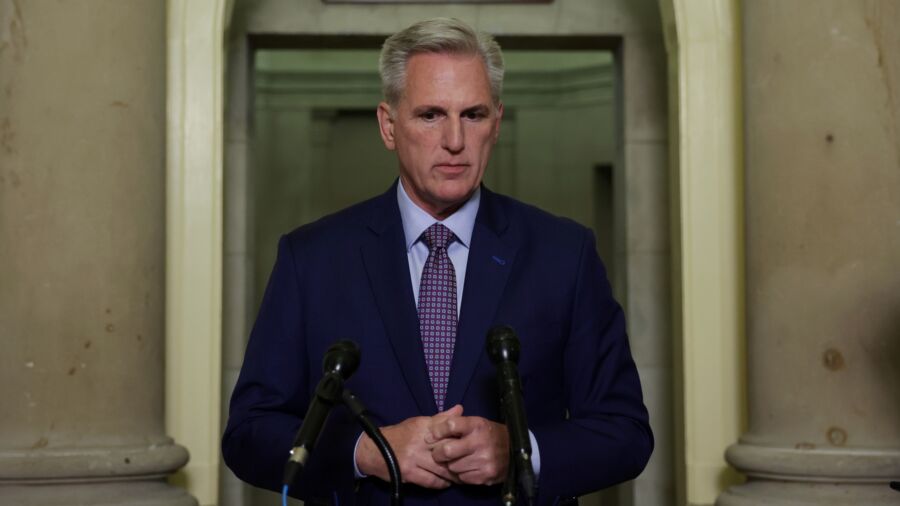
House Speaker Kevin McCarthy (R-Calif.) on Tuesday criticized President Joe Biden’s veiled threat to invoke the 14th Amendment as a way to override the debt ceiling and avert a possible default, with the two politicians fresh off a meeting with no breakthrough on the debt limit standoff.
Biden on Tuesday confirmed that he’s looking at the possibility of using the 14th Amendment as a last-ditch option to work around the $31.4 trillion debt limit in the event that negotiations on lifting the borrowing cap fall through and the country faces the prospect of defaulting on its debt obligations.
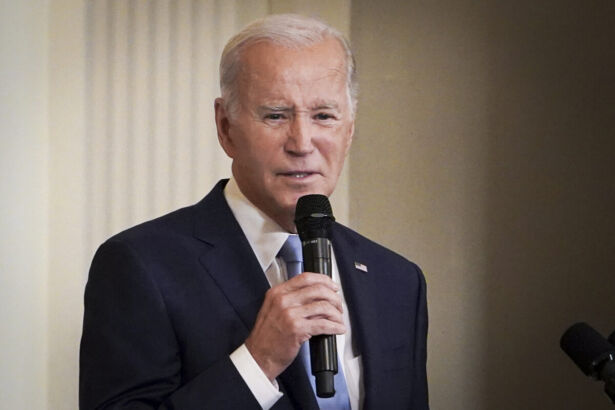
McCarthy argued that the move would represent a failure on the part of the president to work across the aisle on an issue of key importance to Americans.
“Really think about this, if you’re the leader, if you’re the only president and you’re going to go to the 14th Amendment to look at something like that—I would think you’re kind of a failure of working with people across sides of the aisle, or working with your own party to get something done,” McCarthy told reporters in Washington, The Hill reported.
Biden and the Democrats have insisted on legislation with no preconditions to raise the debt ceiling, while McCarthy and the Republicans have demanded spending cuts in exchange for their support to lift the borrowing cap.
House Republicans have put forward a proposal that pairs raising the debt cap by $1.5 trillion with $4.5 trillion in spending cuts over a decade.
X-Date
When the United States reached the $31.4 trillion debt cap in January, the Treasury Department started resorting to so-called “extraordinary measures” to keep making payments on outstanding federal debt obligations and keep the government from defaulting.At some point, however, the scope for continuing to resort to these extraordinary accounting maneuvers will run out. The federal government will then stand face to face with the prospect of being unable to meet its financial obligations—known as the X-date.
When the X-date is reached and there’s no agreement to lift the debt cap, the Treasury Department will be unable to issue any more bills, bonds, or notes. It could only make payments on its debt obligations from tax revenues.
The National Association of Government Employees (NAGE), which filed the lawsuit in a federal court in Boston on Monday, argues that the debt limit law adopted over a century ago goes against the Constitution’s separation of powers by forcing the president to cut spending already approved by Congress to prevent a default.
Invoking the 14th Amendment
The question of invoking the 14th Amendment to avert a debt crisis has been mostly unaddressed by the courts, and legal experts disagree whether it could be used in this way.Biden was asked during an interview on MSNBC on May 5 whether he’s “prepared to invoke the 14th Amendment and blow through the debt ceiling,” with the interviewer saying there are members of Congress who might be willing to allow a government debt default to hurt the president politically.
“I’ve not gotten there yet,” Biden replied, adding that he’s prepared to negotiate with Republicans on a budget, but not on the GOP’s latest legislative proposal to raise the debt cap in exchange for spending cuts.
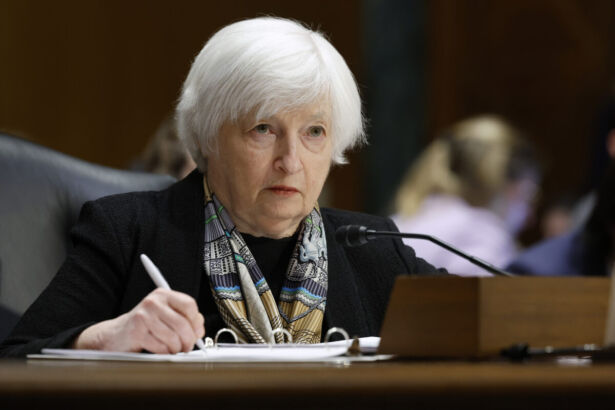
Yellen was asked about the possibility that Biden would invoke the 14th Amendment in an ABC interview on May 8, and she downplayed the idea that this would be a viable solution.
“I’m still not exactly clear on whether it’s on the table or off the table,” ABC’s George Stephanopoulos said to Yellen. “Is it a ‘break glass in case of emergency’ option?”
Yellen replied by saying she doesn’t want to focus on the prospect of last-ditch emergency measures and reiterated her call for Congress to act.
“What’s important is that members of Congress recognize what their responsibility is, and avert what will surely be—regardless of how it’s handled, what option is used to handle it—an economic and financial catastrophe,” she said.
Stephanopoulos then said it seems Yellen isn’t taking the option off the table.
“There is no way to protect our financial system in our economy other than Congress doing its job and raising the debt ceiling and enabling us to pay our bills. And we should not get to the point where we need to consider whether the president can go on issuing debt,” Yellen said.
“This would be a constitutional crisis,” she added.
An attempt to override the congressionally mandated debt ceiling has never been tried, though it has been suggested as an emergency option in prior debt limit standoffs.
During the last debt ceiling impasse, in 2011, former President Bill Clinton said that if he were in the shoes of then-President Barack Obama, he would be prepared to invoke the 14th Amendment “without hesitation, and force the courts to stop me.”
Congress ultimately resolved that debt ceiling crisis by passing the Budget Control Act of 2011, which allowed the debt cap to be raised by $2.4 trillion in two phases.