

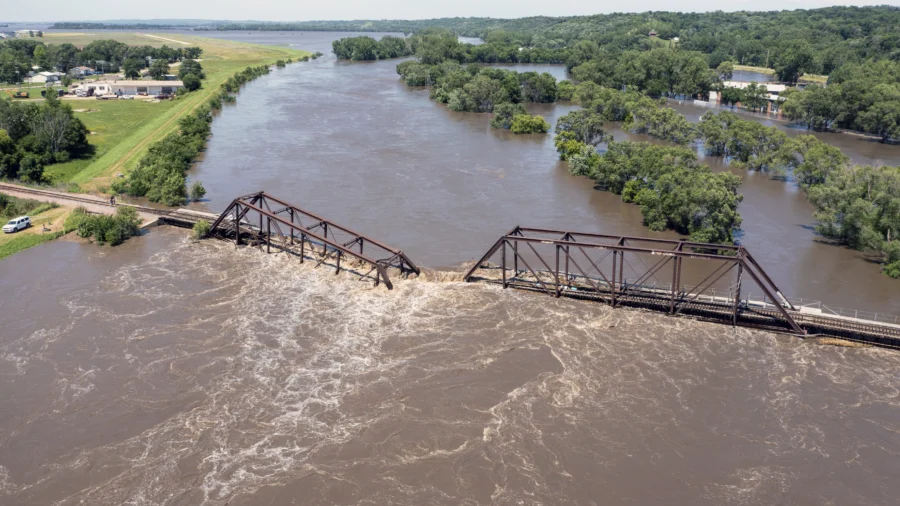
A railroad bridge on the Iowa–South Dakota border collapsed due to flooding on Sunday. The incident, which occurred shortly before 11 p.m., is expected to cause major logistical disruption in the area.
The bridge had spanned the Big Sioux River, connecting North Sioux City in South Dakota with the Riverside neighborhood of Sioux City, Iowa just a short distance before the Big Sioux merges into the Missouri River.
The bridge was used as a preferred route for the transportation of grain and other commodities.
"We have damaged roads, we have damaged bridges," Ms. Noem said at a press conference on June 24.
"We did lose a Burlington Northern Santa Fe (BNSF) railroad bridge—that is the main bridge going into Iowa that a lot of commodities and different materials move on throughout the state."
She said the BNSF bridge "collapsing and going down the Big Sioux last night was a big loss for us that'll impact us for many, many months to come."
U.S. Rep. Dusty Johnson (R-S.D.) also spoke at the press conference, where he praised the "leadership and capacity" in the community that he said were mitigating the flooding disaster.
"With regard to the BN bridge," he said, "our team is in contact this morning with BN, we're in contact with transportation officials, with the administration, and with the US House.
Collapse
Local authorities had already anticipated the bridge's collapse, and blocked rail lines before the incident as a precautionary measure.The bridge ended up partially submerged in the river after structural elements in the central section gave way.
The counties the disaster proclamation was issued for comprise Buena Vista, Cerro Gordo, Cherokee, Clay, Dickinson, Emmet, Floyd, Hancock, Humboldt, Kossuth, Lyon, O’Brien, Osceola, Plymouth, Pocahontas, Sioux, Webster, Winnebago, Woodbury, Worth, and Wright Counties.
The National Guard has been mobilized to provide assistance with rescues and transporting essential medicines, as efforts to evaluate the damage are now ongoing round the clock.
The heavy rainfall has forced entire neighborhoods—and at least one entire town—to be evacuated.
The town of Spencer, Iowa imposed a curfew on June 23 for the second night in a row after flooding surpassed a record set in 1953.
The heavy rain, which has been plaguing the area for weeks, has prompted flood warnings and alerts for rivers in multiple parts of Iowa, as well as in Illinois, Minnesota, Nebraska, South Dakota, and Wisconsin.
According to the National Weather Service, catastrophic rainfall of up to eight times the average was recorded in parts of northern Nebraska, southeastern South Dakota, southern Minnesota, and northwest Iowa, with further downpours expected to hit later this week.