


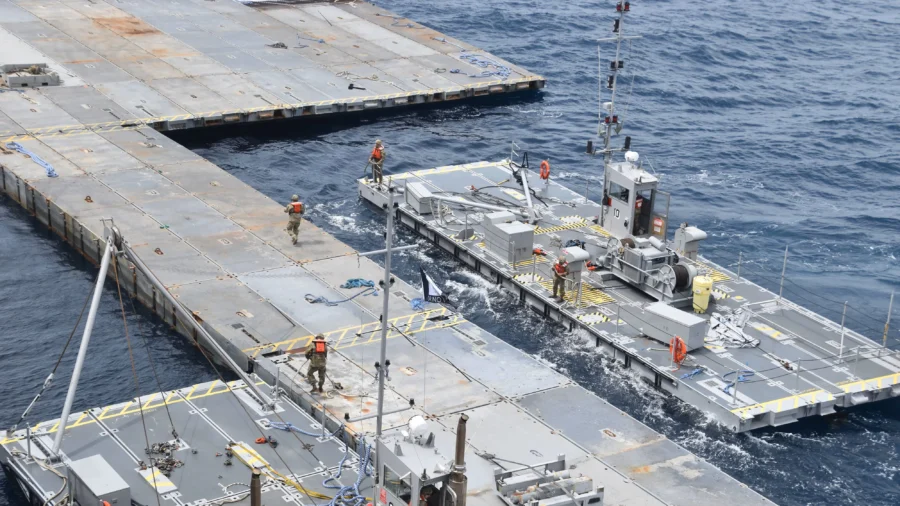
The U.S. military has announced that U.S. forces have finished installing a makeshift pier for delivering humanitarian supplies into the Gaza Strip, and aid has begun to flow into the territory.
President Joe Biden initially ordered the U.S. military to construct the pier in March, to facilitate increased deliveries of food and humanitarian supplies by sea. Speaking at a press briefing on Thursday, Deputy Pentagon Press Secretary Sabrina Singh announced U.S. military engineers, working with Israeli military counterparts, had successfully anchored the temporary pier system to the beach in Gaza.
Ms. Singh said the pier was successfully installed without the need of U.S. boots on the ground in the embattled territory. She told reporters at the Thursday press briefing that the aid would begin to flow through the pier system "as soon as the Commander feels that we are ready to go."
"This is an ongoing, multinational effort to deliver additional aid to Palestinian civilians in Gaza via a maritime corridor that is entirely humanitarian in nature, and will involve aid commodities donated by a number of countries and humanitarian organizations," CENTCOM added.
Ms. Singh said last month that it would initially cost $320 million to begin operating the temporary pier. Costs could continue to rise as the U.S. military and U.S. and international partners continue to operate the makeshift humanitarian delivery route.
At a White House press briefing on Friday, National Security Council spokesman John Kirby said there's "a small footprint" of U.S. troops stationed on the pier who will not step foot onto shore as part of the operation. Mr. Kirby declined to provide a specific number of troops who will comprise this U.S. military presence on the pier, but said they are there to "provide a modicum of security" for the humanitarian operation and to assist in the logistical operations as cargo ships approach the pier and let off trucks to flow across a makeshift causeway onto the Gazan shoreline.
US Expanding Humanitarian Delivery Capacity Amid Famine Concerns
Completion of this humanitarian aid pier comes more than seven months into the ongoing Israel-Hamas conflict in the Gaza Strip, with the Israeli government bent on eliminating the designated terrorist group and freeing hostages taken by Hamas gunmen and other terrorists on Oct. 7, 2023.At this April 10 hearing, Ms. Power said around 500 commercial and humanitarian trucks would enter the Gaza Strip on a daily basis prior to Oct. 7. The flow of supply trucks fell after the start of the conflict. Ms. Power said the number of these supply trucks reaching the Gaza Strip has recovered somewhat but that "we need to go way beyond that" to meet the humanitarian needs in the territory.
“The destruction of greeneries, and markets, and arable land, and then the fact that so few trucks got in over so many months means we have massive catch-up to do,” Ms. Power added during her April 10 testimony.
The U.S. military has facilitated some additional aid deliveries with airdropped packages.
"The amount of trucks coming off of the pier is not going to be the same of what can come from the land crossings," Ms. Singh said Thursday. "So, we have to see those land routes open. And the quickest way to get aid in, whether it be the north or anywhere else in Gaza, is going to be through those land routes. This is just meant to be an additive measure."