

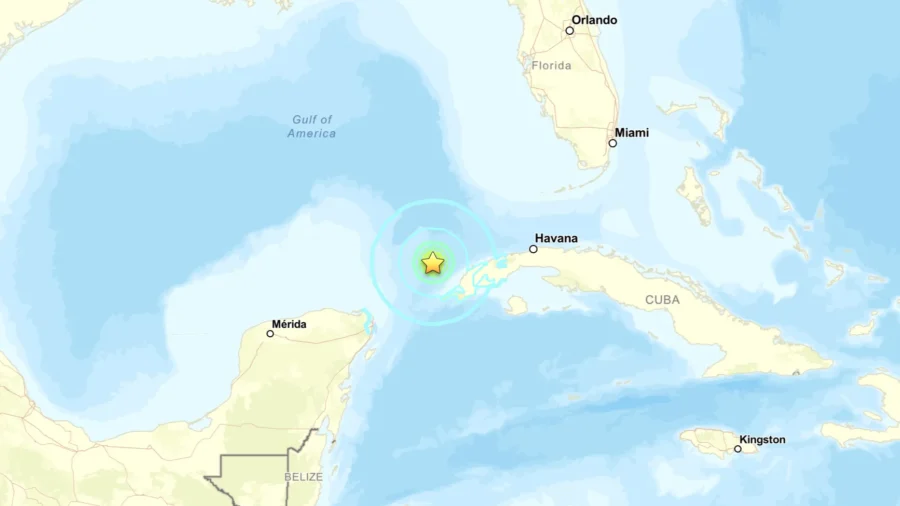
6.1 Earthquake Near Cuba Sends Shockwaves Across Florida, Rattles Havana

No significant injuries or major property damage were immediately reported—in Cuba or across Florida.
Published: 6/8/2026, 9:22:26 PM EDT
6.1 Earthquake Near Cuba Sends Shockwaves Across Florida, Rattles Havana
A map shows the location of a 6.1 magnitude earthquake that struck near western Cuba on June 8, 2026. (USGS/Screenshot via NTD)

A powerful 6.1 magnitude earthquake struck just west of Cuba on Monday afternoon, rippling across the Gulf of Mexico with enough force to rattle buildings from Havana to Fort Lauderdale and as far north as Orlando.

The quake hit at around 2 p.m. local time at a depth of about 6 miles, or 10 kilometers, in waters off Cuba's western coast, according to the U.S. Geological Survey. It stands as the largest earthquake ever recorded in the Gulf of Mexico using modern seismic instruments, which date back to the 1950s, according to USGS geophysicist William Barnhart.

"It's one of only five or six earthquakes of magnitude 5 or greater that we're aware of in the entire Gulf," Barnhart said.

Despite its large size for the region, no significant injuries or major property damage were immediately reported—in Cuba or across Florida.

In western Cuba, Flavia Pupo, a manager at the Pinar del Rio hotel, described how the building rattled and left guests and passersby anxious.

"Everyone here is OK," she said by telephone. "The people on the street are a little bit scared."

The tremors didn't stop at the Florida Straits. Hundreds of miles away, residents across South Florida, Central Florida and beyond reported feeling the ground move beneath them. The National Weather Service in Miami posted on social media at around 2:15 p.m. that it had received numerous reports of shaking across southwestern Florida within the previous 30 minutes, noting the quake had occurred just west of Cuba in the southern Gulf.
A seismograph in Ochopee, Florida, captured the seismic activity shortly after 2 p.m., the agency said, sharing readings in a follow-up post showing clear up-and-down oscillations from the event. The USGS "Did You Feel It?" map collected reports from across the state, with accounts stretching from South Florida to areas north of Orlando. Reports also came in from Cancun and Cozumel, Mexico.

For Maria Moncayo, who works at a law office in downtown Fort Lauderdale, the sensation was disorienting.

"I have a little pendant dangling in my desk, and it was moving," she said. "That's why I realized that it's actually not me or my chair or anything."

Moncayo, originally from Ecuador, said the shaking triggered memories of a 7.8 magnitude earthquake that killed hundreds in her home country in 2016.

"Since I moved here, it kind of left my mind, but when I felt my desk moving, I thought it was going to be like Ecuador," she said. "It kind of gave me flashbacks, but then I realized that it's not bad, it's just a little one."

Miami Evacuates Buildings, Suspends Rail Service

The quake prompted a quick precautionary response in Miami-Dade County. Officials ordered the evacuation of several buildings, including the county's main government office building—a 28-story high-rise in downtown Miami—out of an abundance of caution. Two elevated commuter train lines running through downtown were also temporarily suspended.
Miami Fire-Rescue responded to multiple calls for service following reports of seismic activity felt throughout the city. All calls were handled without further issue, and the situation remained stable.

No Tsunami, But Aftershocks Possible

The National Weather Service Miami confirmed that there was no tsunami threat from the earthquake, noting that a Tsunami Information Statement had been posted at tsunami.gov.

Cuba’s most seismically active area is typically its southeastern coast, where the Oriente fault zone has been responsible for damaging earthquakes over the centuries—including a 7.7 magnitude quake in January 2020 that caused destruction in Cuba and the Cayman Islands.

The Associated Press contributed to this report.