


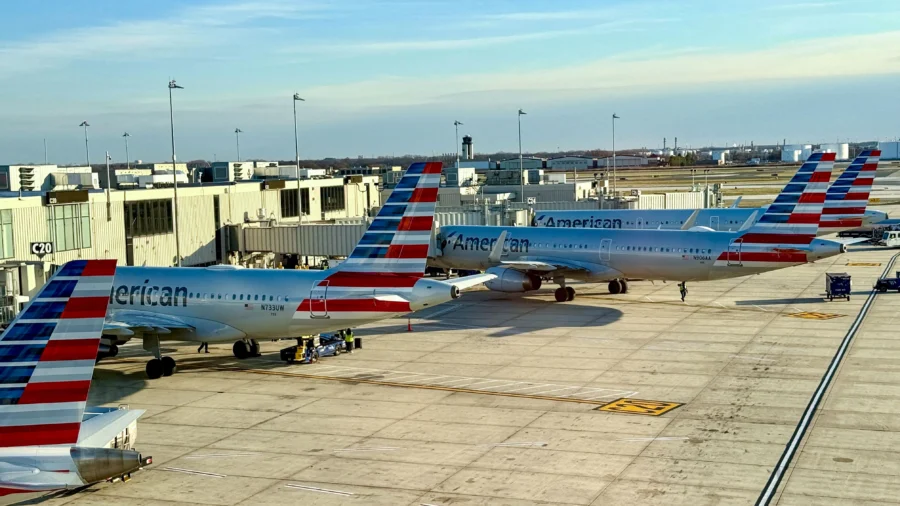
An American Airlines flight bound for Charlotte was forced to return to Myrtle Beach after the commercial plane struck birds shortly after takeoff, prompting an emergency response and precautionary landing.
“American Airlines Flight 1760 returned safely to Myrtle Beach International Airport around 8:40 a.m. local time on Monday, Aug. 10, after the crew reported striking a bird while departing. The Boeing 737-800 was headed to Charlotte Douglas International Airport,” the Federal Aviation Administration (FAA) told NTD in an emailed statement.
American Airlines told NTD in a separate, emailed statement that a total of 172 people were on board at the time and nobody was injured. The aircraft has since been removed from airline operations, it said.
“The aircraft landed safely and has been taken out of service to be inspected by our maintenance team. Our team worked to get customers on their way to Charlotte (CLT) on a replacement aircraft,” the airline said in its statement. “We thank our team members for their professionalism and our customers for their understanding.”
The dramatic footage of the incident, recorded by passengers and circulated on social media, appeared to show flashes coming from the aircraft's engine as the plane turned back toward the airport.
Despite what appeared to be flames, the airline told NTD that there was “no indication of a fire in the engine.”
The incident highlights one of the longstanding hazards faced by commercial aircraft, particularly during takeoff and landing. Bird strikes can range from harmless impacts to serious events when birds are ingested into jet engines.
Additionally, the agency notes that about 62 percent of bird strikes with civil aircraft occur during the day, eight percent occur at dawn or dusk, and 30 percent happen at night.
The FAA maintains a database that records aircraft-wildlife collisions, commonly known as wildlife strikes. Voluntary reports from pilots, airlines, airports, aircraft maintenance personnel, air traffic controllers, and engine manufacturers provide data that the FAA uses to analyze strike trends, track wildlife movements and bird migration, and evaluate the effectiveness of wildlife management plans.
According to the FAA, a flock of European starlings struck an Eastern Air Lines Flight 374 during takeoff on Oct. 4, 1960, resulting in damage to all four engines. The aircraft crashed into the Boston Harbor, killing 62 people on board.
The incident happened prior to the creation of the FAA Wildlife Strike Database.
Monday's incident is expected to determine the extent of the damage and provide additional information about the bird strike.