

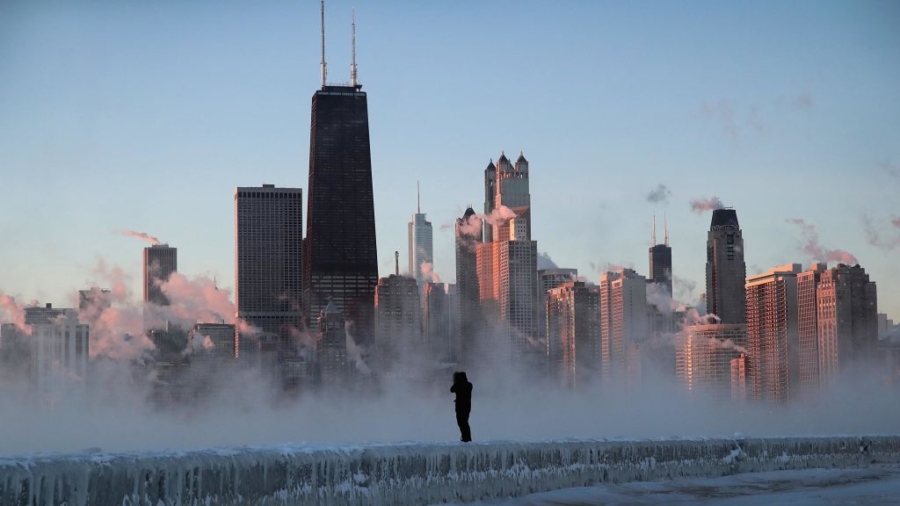
Record-breaking blasts of Arctic air caused at least a dozen deaths in the Midwest as the cold spread eastward on Jan. 31 to the Northeast, leaving behind a trail of school closures, major travel disruptions, and the suspension of the U.S. postal service in some areas.
Icy conditions, brutal winds, and temperatures as low as minus 30 degrees F rocked the Midwest. Warmer temperatures expected this weekend offered little respite to those struggling with the sub-zero torment.
"This morning is some of the coldest of the temperatures across the upper Midwest and we still have some dangerous wind chills," Andrew Orrison, a forecaster for the National Weather Service said.
The bitter cold was caused by the displacement of the polar vortex, a stream of air that normally spins around the stratosphere over the North Pole but whose current was disrupted. It pushed eastward and states including Massachusetts, New York, and Pennsylvania were experiencing bitterly cold temperatures. Boston was at minus 5 degrees F according to the National Weather Service.
"This morning is the worst of the worst in terms of the cold," Orrison said. "It'll be the coldest outbreak of Arctic air for the Mid-Atlantic and the Northeast."
Due to the chill, states of emergency have been issued in Wisconsin, Illinois, and Michigan.
In Minnesota and upper Michigan, temperatures were at minus 20 F on Jan. 31 and parts of North Dakota were minus 30 F. Meanwhile, Chicago had near record cold of minus 23 F on Jan. 3o and minus 21 F on Jan. 31.
Temperatures at this range can cause frostbite on exposed skin in just a few minutes. The condition results in a loss of feeling and color in affected areas. Common areas affected by frostbite are the body's extremities—the nose, ears, cheeks, chin, fingers, or toes.
The cold snap has caused at least 12 deaths across the Midwest since Jan. 26, according to officials and media reports. Some died from apparent exposure to the elements, others in weather-related traffic accidents.
The extreme weather prompted President Donald Trump to issue a warning about the coming chilling temperatures.
USPS Takes Cover
In a rare move, the U.S. Postal Service suspended mail delivery on Jan. 30 in parts or all of several Midwest states including Michigan, North and South Dakota, Nebraska, Kansas, Minnesota, Wisconsin, Iowa, and Illinois. Mail service won't be restored in Michigan until Feb. 1, officials said.Videos this week showed boiling water freezing as it was tossed in the air in Cedar Rapids, Iowa, and transit workers in Chicago, Illinois, setting fire to train tracks to keep them from locking up.
Even parts of the South, such as the mountains of Kentucky, Tennessee, and upper Georgia, would be in the single digits.
The weather caused hundreds of traffic accidents, including a chain-reaction collision of about two dozen cars in Grand Rapids, Michigan, during a white-out on Wednesday, local media reported.
More than 2,500 flights were canceled and more than 3,500 were delayed on the morning of Jan. 31, most of them out of Chicago's O'Hare International and Midway International airports, according to flight tracking site FlightAware.com.
General Motors suspended operations at 11 Michigan plants and it's Warren Tech Center after a utility company made an emergency appeal to customers to conserve natural gas. Fiat Chrysler Automobiles NV also canceled a shift on Jan. 31 at two of its plants.
It has been more than two decades since a similar arctic blast covered a swath of the Midwest and Northeast.