


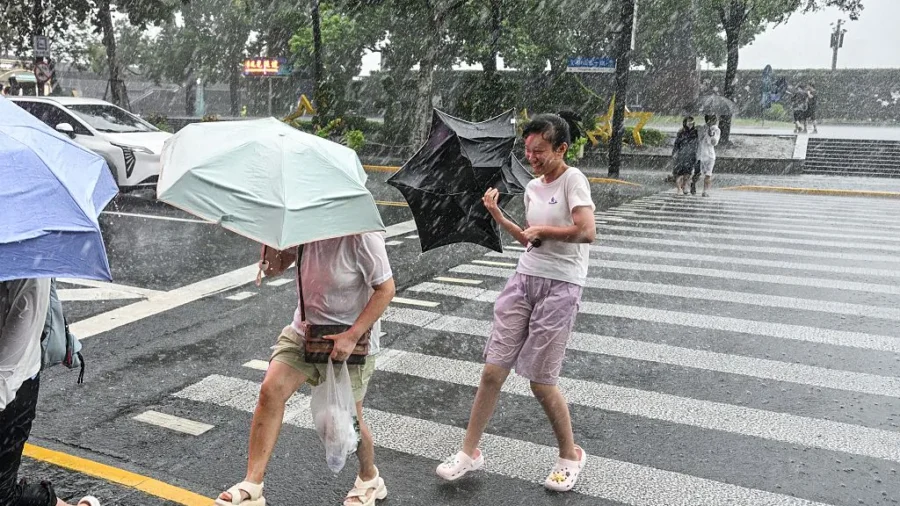
Typhoon Dolphin, the strongest typhoon to hit China this year, will push deeper inland over the next few days and has already begun affecting the Beijing-Tianjin-Hebei region, with Beijing in particular on high alert.
On Aug. 11, the Beijing Meteorological Bureau issued multiple warnings: a citywide Orange Alert for rainstorms, predicting heavy to torrential rain across Beijing from the evening of Aug. 11 through the daytime of Aug. 13, with the peak intensity expected between early morning and night on Aug. 12.
Red Alerts for rainstorms in seven districts/areas, including Tongzhou, Beijing Economic-Technological Development Area (BDA), Mentougou, Fangshan, Daxing, Huairou, and Fengtai; and an Orange Alert for waterlogging risks, warning of high risks of urban flooding in the central city area from Aug. 11 to 13.
Officials also warned that this rainfall covers a broad area, features high short-term intensity, and will last for a long duration, carrying high disaster potential. Low-lying areas are extremely vulnerable to waterlogging, while mountainous areas face potential flash floods and flooding in small- to medium-sized rivers.
Some kindergartens in Beijing announced a three-day suspension of classes in advance, some companies instructed employees to work from home, and businesses remaining open have taken extensive precautionary measures.
All 196 construction projects underway in the Beijing Economic-Technological Development Area have been halted, and all parks and underground commercial places will close as scheduled. A total of 4,000 emergency flood-control personnel have been deployed.
Multiple Eastern Provinces Struck with Over 1 Million People Evacuated
Typhoon Dolphin made landfall on Sunday evening in Zhejiang Province, south and west of Shanghai, packing maximum sustained winds of up to 94 mph near its center before weakening into a tropical storm.It hit several provinces in eastern China, bringing torrential rain to coastal areas. The heavy downpours paralyzed local transportation and caused severe waterlogging and flooding in many areas.
Numerous streets in Shanghai, China's second-largest city, were flooded, including major commercial centers. On Monday alone, nearly 1,000 flights were canceled in Shanghai.
According to reports from China Central Television (CCTV), China Eastern Airlines stated on Monday that it was working to "orderly" restore flights to Shanghai, Zhejiang, and other destinations.
More than 1 million people across eastern China, including the financial hub of Shanghai, were urgently evacuated.
Elsewhere in Zhejiang Province, the Wenzhou municipal government relocated approximately 900,000 residents and opened over 1,000 emergency shelters, while about 390,000 people were evacuated in Taizhou.
According to CCTV, the storm traveled up to 3,700 miles before making landfall, meaning its duration was more than three times that of an average typhoon.
On Monday, rain clouds from the typhoon's remnants continued to cover eastern provinces, including Anhui, Jiangsu, and Shandong.
Chinese official sources had not released any reports on casualties at the time of publication.