


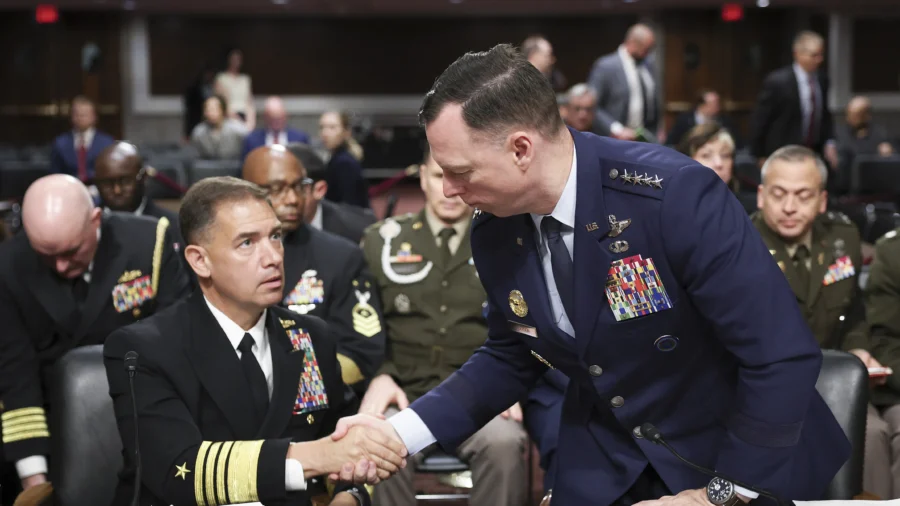
Adm. Brad Cooper, the commander of the U.S. military’s Middle East component, told lawmakers on May 19 that Iran’s missile arsenal remains largely defeated and inaccessible in response to recent reports to the contrary.
In a written statement to the House Armed Services Committee, Cooper wrote that the recent U.S. military operations against Iran—known as Operation Epic Fury—had damaged or destroyed more than 85 percent of Iran’s ballistic missile, drone, and naval industry.
“We destroyed or buried much of Iran’s ballistic missiles, launcher vehicles, and long-range attack drones with more than 450 strikes on ballistic missile storage and systems and roughly 800 strikes on Iran’s drone-launching units and storage,” Cooper added.
Meanwhile, recent reports, including a May 12 article in The New York Times, have claimed that Iranian forces have since regained access to many of the missile storage sites that had been struck.
During a House Armed Services Committee hearing on Tuesday, Rep. Seth Moulton (D-Mass.) asked about the reports.
“Those reports are inaccurate,” Cooper answered.
U.S. forces have reported defending against Iranian missile attacks in recent days. Though the United States and Iran officially entered into a ceasefire on April 7, both sides have traded fire in the weeks since.
Rep. Adam Smith (D-Wash.), the ranking member on the House Armed Services Committee, expressed continuing uncertainty about Iran’s remaining arsenal.
“We have knocked back a lot of Iran’s capability. The truth of the matter is, in all the questions that I’ve asked, we don’t know for sure how much. We don’t know exactly how many ballistic missiles they have, what their capabilities are. We know it has been substantially weakened, but we don’t have specific answers to that,” Smith said in his opening remarks at the hearing.
Smith also said that, despite the reported battlefield successes of Operation Epic Fury, Iranian forces have been able to cause significant economic disruptions by threatening shipping in the Strait of Hormuz, and a lasting resolution appears unclear.
“We can go through the body count here and say we destroyed this many ballistic missiles, we destroyed this many launchers, we set their capability back. That’s all fascinating. Strategically, we are in a disaster right now, and that’s what needs to be fixed, and we do not see a path out of that,” Smith said.
During his testimony on Tuesday, Cooper reported that U.S. forces had met all of the military objectives of Operation Epic Fury. Cooper noted U.S. forces are still enforcing a blockade of Iran and are prepared for further action.
President Donald Trump announced on May 18 that he had postponed a plan for renewed strikes on Iran.