


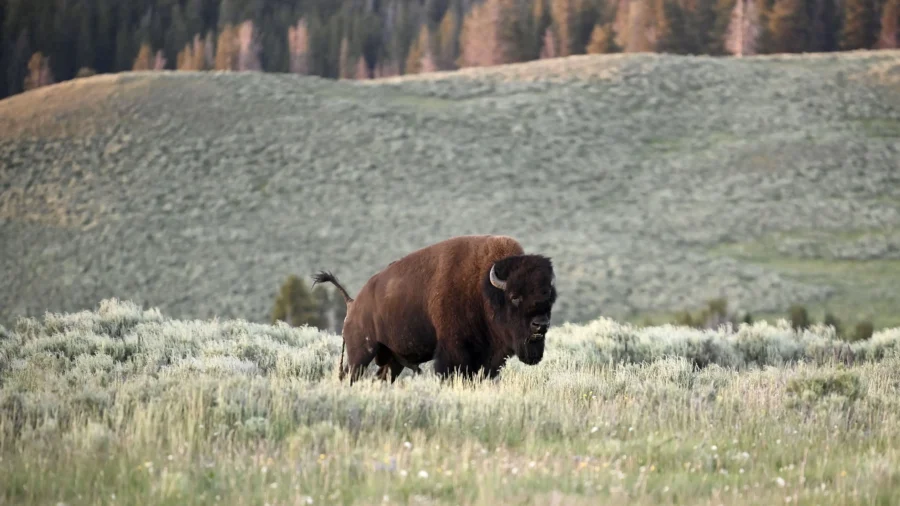
Video circulated online Tuesday showing a child’s dangerously close encounter with a bison at Yellowstone National Park, just weeks after another bison charged at a man at one of the park’s campsites.
The footage, taken by Brittany Peteler on July 28, shows a family with young children walking near the grazing bison.
Witnesses can be heard on the video warning the child to turn back and not go toward the bison. The child, instead, moved closer and ran past the bison, prompting the animal to briefly chase the child.
NTD reached out to Yellowstone National Park seeking additional information. Officials told NTD that the agency did not receive a report on this particular incident.
"We'd like visitors to know that bison may appear calm, but they are wild, unpredictable animals that will defend their space when threatened. They can run up to three times faster than humans," Yellowstone said in an emailed statement to NTD.
Despite often appearing calm while grazing, the animals are highly unpredictable and capable of sprinting at speeds approaching 35 miles per hour.
The animal may charge if they feel threatened or if visitors enter their personal space. Signs that a bison feels threatened may include a bluff charge, head bobbing while staring, pawing the ground, bellowing, or raising its tail. These behaviors indicate that a person is too close and that a charge could follow.
Additionally, Yellowstone National Park rules state that visitors must stay at least 25 yards away from all large animals, including bison, elk, bighorn sheep, deer, moose and coyotes, and at least 100 yards away from bears, wolves and cougars.
Visitors should never attempt to stand their ground. Instead, they should immediately move away from the animal. If the bison continues to follow, officials recommend using bear spray while retreating and seeking shelter behind nearby trees, vehicles, or other barriers.
Bison can weigh more than 2,00o pounds and are the largest land mammals in North America.
"Bison are responsible for more visitor injuries in Yellowstone than any other wild animal," the park told NTD. "While serious injuries are uncommon and fatalities are extremely rare, encounters with bison can result in severe consequences. Most incidents occur when people approach too closely for photographs or fail to give the animals enough space, putting both people and wildlife at risk."
Yellowstone also said the best way to observe the park’s wild animals is from a vehicle. Authorities encourage anyone who witnesses wildlife encounters to report the incidents to park rangers.