


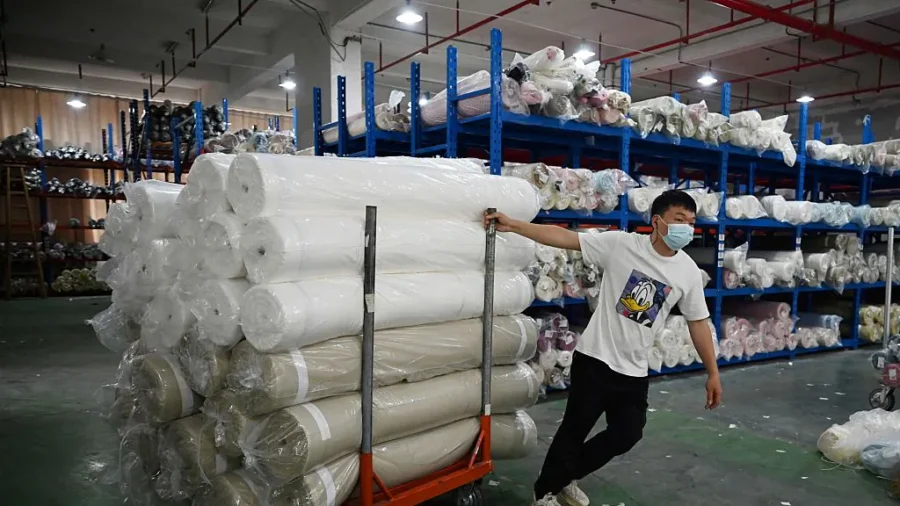
Textile manufacturers in eastern China are facing mounting pressure as surging raw material costs collide with falling orders, pushing some factories to the edge of shutdown.
In recent weeks, prices for key inputs used across Zhejiang province’s vast textile sector have doubled, according to industry insiders. At the same time, demand has softened, leaving many companies caught in a squeeze where production costs exceed selling prices.
Several industry insiders spoke to The Epoch Times on condition of anonymity out of fear of reprisal.
“Materials that used to cost 1 million yuan (approximately US$140,000) are now 2 million,” a member of a local textile industry association told the publication. “The more you produce, the more you lose.”
Impact of the Iran War
Changes brought about by the Iran War and the closure of the Strait of Hormuz are reverberating through global manufacturing networks.Since February, the war has disrupted shipping through the Strait of Hormuz, a critical chokepoint for global energy supplies. The resulting constraints have driven up oil prices and, in turn, the cost of petrochemical-based textile inputs.
“People think the Middle East has nothing to do with us, but for textiles the impact is direct,” said a fabric trader in Huzhou, China, to The Epoch Times.
Textile production relies heavily on oil-derived materials such as purified terephthalic acid (PTA), ethylene glycol, and polyester fiber. When crude prices rise, those costs quickly cascade through the supply chain, lifting prices for yarn, greige fabric, and finished textiles.
“There’s almost no buffer,” the fabric trader said. “When upstream prices rise, the pressure hits factories almost immediately.”
Manufacturers say they are trapped between rising input costs and weak downstream demand.
“Upstream prices are climbing, but downstream buyers won’t accept higher prices,” the trader said. “All the pressure gets stuck in the middle.”
That dynamic has left factories in a bind—those without stockpiled materials are reluctant to buy at inflated prices, while those with inventory are hesitant to ramp up production without firm orders.
A textile factory owner who spoke in a video posted on Douyin, the Chinese version of TikTok, described the current moment as the toughest in years.
Shifting Supply Chains
Zhejiang Province is one of China’s most important textile manufacturing bases, and its tightly integrated supply chain serves both domestic and international markets.However, the sector’s structure—dominated by small- and medium-sized enterprises—makes it especially vulnerable to price volatility and demand swings.
“Raw material prices change every day, but finished products have very thin margins,” the textile industry association member said. “If you produce, you lose money. If you stop, you still have to pay workers, rent, and utilities.”
Logistics disruptions are compounding the uncertainty. Another industry association member told The Epoch Times that shipping constraints linked to the Strait of Hormuz are making companies wary of taking on new orders.
“Even when orders come in, we don’t dare accept them easily,” the industry association member said. “Some companies are deliberately cutting back to avoid bigger losses.”
The current pressures are accelerating longer-term shifts in global supply chains.
The Epoch Times reporter found that over the past four years, a growing share of garment orders has moved from China to countries such as Vietnam, along with parts of the upstream supply chain. As low-cost inventories in China are gradually depleted, manufacturers are being forced to operate with higher-priced inputs.
That has left many firms being forced to choose between running production lines and suspending operations, while adopting a wait-and-see approach.
April is typically a pivotal month for Zhejiang’s textile sector, the industry association member said. This year, it may determine how many factories can stay afloat.