


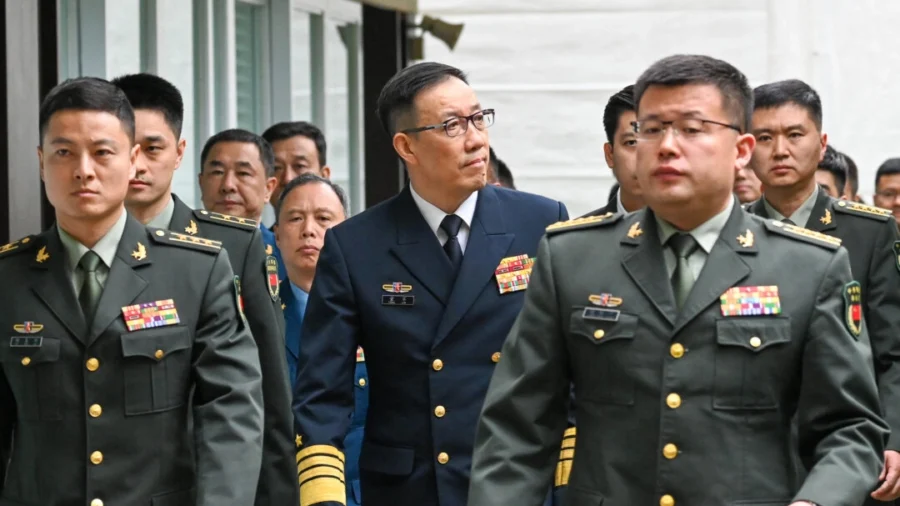
Touted as Asia's premier defense summit, the 2025 Shangri-La Dialogue (SLD) took place in Singapore from May 30 to June 1. The unusual absence of Chinese Defense Minister Dong Jun has further fueled reports of power struggles within the communist regime.
Since 2019, three successive Chinese defense ministers—Wei Fenghe, Li Shangfu, and Dong Jun—have attended and addressed the forum. (The SLD was cancelled in 2020 and 2021 due to COVID.)
The U.S. Secretary of Defense has gone to every meeting since its inception in 2002, to deliver a policy address and engage in bilateral and multilateral meetings.
This year, the Chinese Communist Party's (CCP's) sent a lower-ranking official, marking a significant shift in military diplomacy. China was represented by a one-star general, the vice-president of the People’s Liberation Army National Defence University, Hu Gangfeng.
Dong's absence meant that high-level discussions between the Chinese and U.S. military officials could not occur.
Since President Donald Trump’s second term began, the only publicly reported China–U.S. military diplomatic efforts have been working-level discussions on maritime risks conducted last month.
Shift in 'Wolf Warrior' Policy
In recent years, Xi has promoted a narrative of "the East rising and the West declining" while pursuing an aggressive policy of "wolf warrior diplomacy," where China’s representatives issue starkly blunt threats or warnings to foreign officials or nations in the form of fiery nationalist rhetoric.Since 2019, China's defense ministers have engaged directly with their U.S. counterparts at the SLD, deliberately projecting an image of diplomatic parity.
Last year, Dong met with then-U.S. Defense Secretary Lloyd Austin for a face-to-face on the sidelines.
It's also closely connected, Tang believes, to the power shifts within the CCP leadership. "Xi Jinping might have lost control over the military, and his aggressive wolf warrior military diplomacy may have been terminated.”
Avoiding Direct US–China Confrontation
Ming-Shih Shen, a researcher at the Taiwan Institute for National Defense and Security Research, said that by lowering the level of representation, China is avoiding high-profile dialogue between counterpart defense ministers, which "reduces the likelihood of further U.S.–China tensions."China affairs commentator Wang He, in an article for Chinese Epoch Times, said that in the face of U.S. confrontation, the CCP is adopting a defensive posture. "The Trump administration’s China policy is very aggressive, attacking on multiple fronts, and the CCP is currently on the defensive with few cards to play against the United States," he said.
Given the current situation and speculation surrounding of Xi Jinping’s apparent loss of power, CCP leaders are taking a more cautious approach to the regime's U.S. policy to avoid exacerbating tensions, Wang said. In the past, Dong and his U.S. counterpart had sharp exchanges at the Shangri-La Dialogues, but the CCP aimed to avoid any such confrontations this time.
"The CCP’s top leadership is undergoing a power shift, and the situation remains unsettled," Wang said. "Consequently, its approach to U.S. relations is also undecided. In this context, the CCP is opting to avoid contact with the U.S. for now, waiting until the internal situation stabilizes before engaging further."