


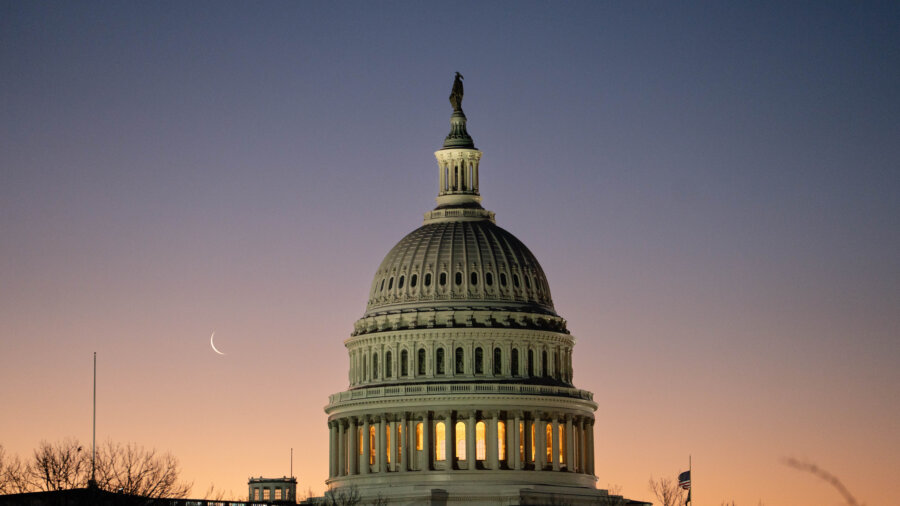
The U.S. House of Representatives on Jan. 20 released the text of a $1.2 trillion three-bill spending package that would fund several federal departments and agencies until Sept. 30.
The Consolidated Appropriations Act, if passed, would fund the departments of Defense, Labor, Health and Human Services, Education, Homeland Security, Transportation, as well as Housing and Urban Development. The legislation was negotiated between the Senate and House in a conference process between Democrats and Republicans.
The negotiation process was governed by a spending deal previously reached by lawmakers to limit Fiscal Year 2026 discretionary spending to $1.598 trillion. Congress, in 2025, enacted a permanent spending bill funding the Departments of Agriculture and Veterans Affairs, military construction projects, and the legislative branch.
The House Appropriations Committee, in its summaries of various portions of the bill, said the defense spending portion amounts to $839.2 billion and includes a 3.8 percent pay increase for all uniformed service members.
The committee said it will fund new weapons development programs—for the F-47 fighter, the B-21 bomber, the Columbia Class nuclear ballistic missile submarines, and Sentinel ballistic missile—and impose bans on the use of funds for such policies as "diversity, equity, and inclusion (DEI) programs, Critical Race Theory, or abortion-related travel."
The homeland security portion of the bill allocates $10 billion to U.S. Immigration and Customs Enforcement (ICE) for law enforcement and removal operations as part of the administration's policy of mass deportation of illegal immigrants. This funding adds to the $75 billion ICE received in a budget bill—the One Big Beautiful Bill Act—signed into law on July 4 of last year.
Additionally, $18.3 billion has been provided to U.S. Customs and Border Protection, which is responsible for border security, including funding to sustain 22,000 U.S. Border Patrol agents. The U.S. Secret Service will receive $1.4 billion for protective operations, which covers the cost of protecting President Donald Trump, Vice President JD Vance, their families, visiting foreign leaders, former U.S. presidents, and others.
The portion of the bill dealing with transportation provides funding for 2,500 new air traffic controllers, to be hired by the Federal Aviation Administration, which will receive a $1.5 billion funding increase. On education, amid the Trump administration's plans to shut down the agency, $79 billion has been provided to continue existing programs.
The bill also cuts many programs and funding for management expenses across various offices.