


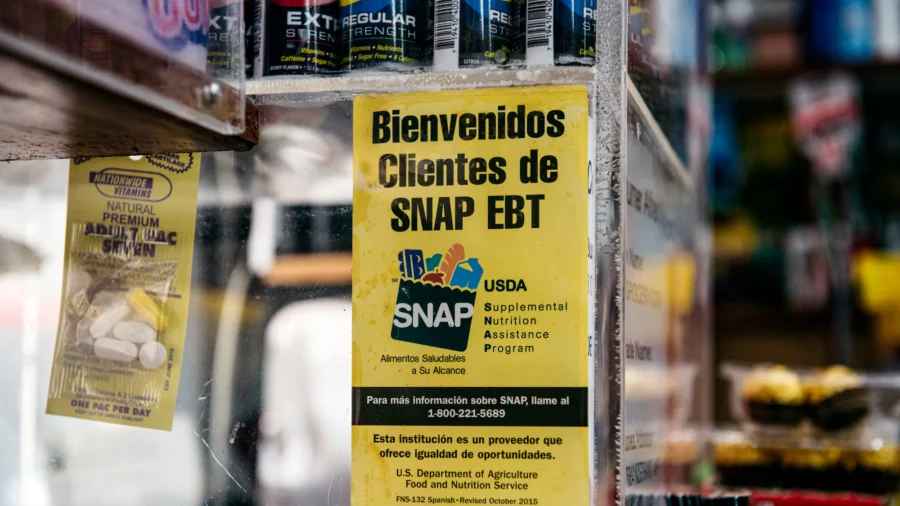
House Speaker Mike Johnson said Monday that $5 billion in contingency funds likely cannot be used by the federal government to cover the Supplemental Nutrition Assistance Program (SNAP), which is set to expire on Nov. 1.
"The SNAP benefits is a unique situation. I got a summary of the whole legal analysis, and it looks legitimate to me, that the contingency funds are not legally available to cover the benefits right now," Johnson (R-La.) told reporters on Oct. 27, referring to the Trump administration's decision not to tap the funds to support food stamps during the government shutdown.
He added that the reason for the decision is that the emergency fund "is a finite source" that was congressionally appropriated, and "if they transferred funds from these other sources, it pulls it away immediately from school meals and infant formula."
"So, it's a tradeoff," Johnson said.
SNAP benefits have never lapsed in modern U.S. history, including during government shutdowns. The U.S. Department of Agriculture (USDA) and some states have warned that the benefits won't get paid on Nov. 1 if the shutdown persists.
"Bottom line, the well has run dry," it said, as the agency's message blamed Senate Democrats.
"The contingency fund is a source of funds for contingencies, such as the Disaster SNAP program, which provides food purchasing benefits for individuals in disaster areas, including natural disasters like hurricanes, tornadoes, and floods, that can come on quickly and without notice,” the memo stated.
It cited Hurricane Melissa as an example of why it’s important to have the money available to mobilize quickly in the event of a disaster. The Category 5 storm in the Caribbean Sea is threatening to wreak devastation across Jamaica, Cuba, and several other countries.
The shutdown, which began on Oct. 1, is now the second-longest on record. Democrats have said that they will not agree to reopen the government until Republicans negotiate with them on extending expiring health care subsidies under the Affordable Care Act. Republicans say Democrats must first agree to reopen the government before any negotiations take place.
Amid the warnings on the benefits running dry, some members of Congress, including Senate Republicans, have suggested a separate bill that would fund SNAP on a standalone basis if needed this week.
On Sunday, some Democrats accused Republicans and the Trump administration of not wanting to negotiate.
“The reality is, if they sat down to try to negotiate, we could probably come up with something pretty quickly,” Sen. Chris Murphy (D-Conn.) said on Sunday on CNN’s “State of the Union.” “We could open up the government on Tuesday or Wednesday, and there wouldn’t be any crisis in the food stamp program.”
"I don't know what good it does to summon them to the White House," Bessent said, referring to House Minority Leader Hakeem Jeffries (D-N.Y.) and Senate Minority Leader Chuck Schumer (D-N.Y.).
"Both of them are worried about their primaries, and not the American people, not the government employees, not our military employees, because we were able to pay the military employees from excess funds at the Pentagon, middle of this month."