


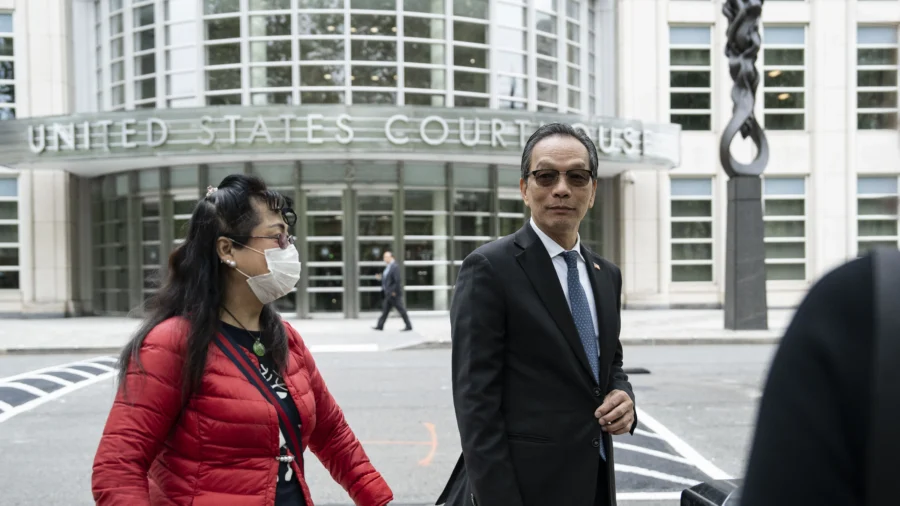
Jury deliberations started on May 12 in the case of a Chinese-American who helped Beijing launch an undercover police station in New York’s Chinatown.
Lu Jianwang, 64, a community leader and former president of the America ChangLe Association, was on trial in Brooklyn federal court, charged with acting as an agent of the Chinese regime for operating an undeclared outpost of the Chinese Ministry of Public Security (MPS) on U.S. soil.
Lu cultivated ties with Chinese officials for years, reporting on Falun Gong practitioners to gain Chinese officials’ trust and confidence before he helped the Chinese regime turn their vision of a police outpost in New York into a reality, said Assistant U.S. Attorney Antoinette Rangel at the close of his trial in Brooklyn federal court on May 12.
Lu, also known as Harry Lu, was in contact with Chinese security for years, said Rangel, and “he has been ready, willing, and able to help them.”
She said the police station wasn’t his idea or initiative and that “ordinary people don’t maintain dozens and dozens of contacts with the MPS.”
Lu, who opened the outpost of China’s police in New York’s Chinatown, had extensive connections with China’s Ministry of Public Security. He appears in photos with officials from the security arm of the Chinese Communist Party (CCP) at press events in Fuzhou, China; there are photos of him welcoming public security officials on a visit to his hometown in Fuqi Village; and he had the phone numbers of more than 50 Chinese security officials on his phone.
On Lu’s phone, among those 50, the FBI found contact information for the vice mayor of Fuzhou, Wang Xizhang, and the deputy director of the MPS and the 610 Office, Shang Wei.
The 610 Office within the MPS is the office tasked with persecuting Falun Gong practitioners.
Falun Gong, also known as Falun Dafa, is a spiritual practice that was introduced to the public in 1992 and consists of meditative exercises and moral teachings centered on the principles of truthfulness, compassion, and forbearance.
In 2015, Lu welcomed the deputy director of the MPS, Sang Linyu, and the head of the 610 Office, Shang Wei, to his hometown, Fuqi Village. During the visit, Sang presented him with a plaque for his assistance in organizing a counter-protest to block a demonstration by Falun Gong practitioners during Chinese leader Xi Jinping's visit to Washington in 2015.
His defense attorney, John Carman, discounted the photos, calling the many group photos a “Chinese thing.” He warned jurors not to believe the prosecution’s argument that, because officials took photos with Lu, the officials must trust Lu.
His defense said the hometown association office was a community gathering place where people socialized and played Mahjong and ping-pong and that the center provided a service to the community: Chinese driver's license renewal via teleconference with bureaucrats in China.
But Rangel countered that Lu set up the facility in New York after attending the launch of the overseas Chinese police station campaign in Fuzhou on Jan. 10, 2022. Shortly thereafter, he returned to New York, and on Feb. 15, 2022, the Overseas Police Service Station in New York officially launched.
“Once the overt side was set up, the dark side began,” said Rangel, who said that renewing driver's licenses via teleconference for Chinese citizens living in the United States was just the cover for CCP efforts to monitor and repress the Chinese diaspora in the country.
By March 2022, Lu’s main contact at the MPS, Liu Rongyan, who was based in Fuzhou, asked Lu to confirm the address and existence of Xu Jie, a Chinese dissident who posted videos on YouTube criticizing the CCP.
Liu was the key MPS official in Fuzhou communicating with Lu and the American ChangLe Association in New York that ran the unofficial police station. Once he was alerted that the FBI was investigating the association, Lu deleted all of his direct, one-on-one messages with Liu via WeChat.
For this, Lu is charged with obstruction of justice for intentionally hampering an official investigation. In addition to charges of being an undeclared foreign agent for China, Lu is charged with conspiring with Chen Jinping and Chen Jinxiong in the police station scheme to act as agents of the Chinese regime. Chen Jinping pleaded guilty to being an agent in December 2024.