


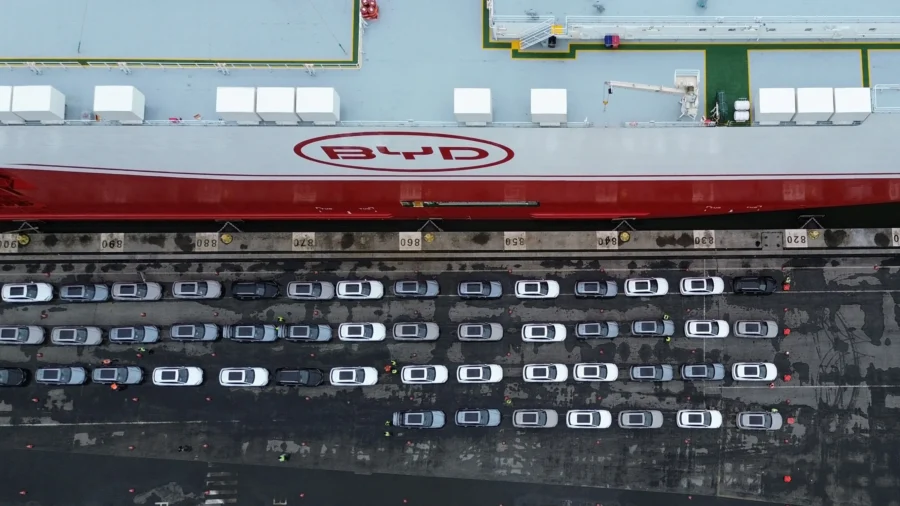
Sen. Bernie Moreno (R-Ohio) said on March 31 he will introduce legislation to ban Chinese cars and auto parts in the American market.
“There will not be a Chinese automobile here,” Moreno said at the Automotive Forum in New York City. “And what I’m hoping is that Latin America, Mexico, Canada, and Europe adopt our same standards now.”
Autos make up more than a fifth of trade between the United States, Mexico, and Canada together, and it’s the largest industry in U.S.–Mexico trade.
U.S. Ambassador to Canada Pete Hoekstra said in a recent podcast interview with Ezra Levant that those Chinese vehicles would not be allowed to cross the border into the United States.
“We’re not going to open the floodgates to have Chinese cars coming into the U.S. from Canada,” he said.
The Biden administration imposed rules by executive order that effectively banned Chinese auto imports, but some regulations addressing software and hardware were piecemeal. Moreno said his bill will be all-encompassing and close those loopholes related to software, hardware, and partnerships.
At the time, automakers said a sweeping ban would affect vehicles already on the market and pushed for a delay for manufacturers to meet new rules, which were largely driven by national security concerns after the government confirmed Chinese state-sponsored hackers had infiltrated U.S. critical infrastructure and were prepositioned for disruption.
On March 17, 2025, federal regulations went into effect requiring automakers to verify they were no longer using Chinese software in cars.
This time, U.S. automakers and industry groups appear supportive of sweeping restrictions on Chinese cars and parts, recently urging the Trump administration to take action against unfair trade practices by Chinese automakers.
“We also strongly urge the Administration to reject any attempt by Chinese manufacturers to circumvent these existing restrictions by establishing production facilities in the U.S.,” reads the letter, signed by the Alliance for Automotive Innovation, the National Automobile Dealers Association, Autos Drive America, the American Automotive Policy Council, and MEMA, the Vehicle Suppliers Association.
“The market distortions and risks to the auto industry in the U.S. are fundamentally the same whether these vehicles are imported or produced domestically,” the letter reads.
The president had said at an event in January that he would welcome Chinese automakers to build plants in the United States and hire American workers.
“If they want to come in and build a plant and hire you and hire your friends and your neighbors, that’s great, I love that,” he told the Detroit Economic Club.