


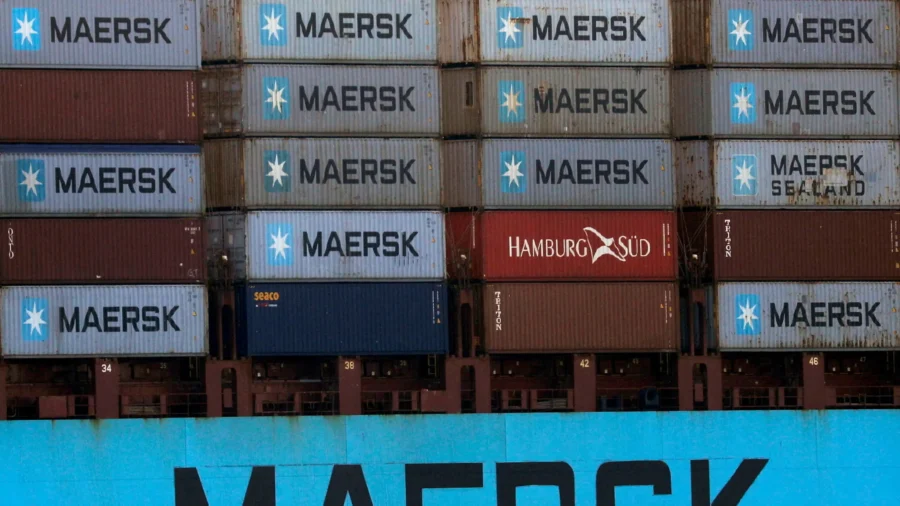
In a customer advisory, published on Wednesday as part of its North America market update, Maersk said demand had increased “as the market anticipates a tariff deal” between Washington and New Delhi.
The company said that its Middle East-Central Loop shipping route, which connects the region with India and North America, continues to operate with consistent weekly departures.
“We expect demand to rise further if a trade deal is reached,” the company added.
Trade Deal
President Donald Trump said on Nov. 10 that the United States was getting close to reaching a “fair trade deal” with India.He also suggested that tariffs on Indian goods could be lowered if talks continue to progress.
India currently faces a combined U.S. tariff rate of about 50 percent, including a 25 percent duty that Trump imposed in August over the country’s imports of Russian crude.
The U.S. goods trade deficit with India grew to $45.8 billion in 2024, up $2.6 billion from 2023.
In services, the United States moved to a $102 million surplus with India in 2024 after running a $76 million deficit the year before.
“We’re making a deal with India, a much different deal than we had in the past,” Trump told reporters at the Oval Office on Nov. 10. He said that the arrangement would be “good for everybody,” adding that the United States could cut tariffs “at some point.”
The president also said on Nov. 6 that he could travel to India next year at the invitation of Prime Minister Narendra Modi. He described Modi as “a friend,” adding that the two leaders “speak” and would “figure out” a visit, possibly next year.
India has not commented publicly on claims that it has reduced Russian-oil imports.
Red Sea and Suez Canal
Maersk’s Dec. 3 advisory also addressed conditions in the Red Sea and Suez Canal, saying it continued to evaluate security risks linked to regional instability.The company cited the progress of a Gaza cease-fire, but said it remained cautious about restoring east–west transits through the Red Sea.
“We currently have no specific timing to change the East–West (Gemini) network to sail through the Red Sea,” Maersk said. “The safety of our crew, our assets, and your cargo remains our top priority.”
The Suez Canal is a critical artery for global shipping, and any rerouting around the Cape of Good Hope adds time and cost to Asia–Europe and Asia–U.S. East Coast voyages.