


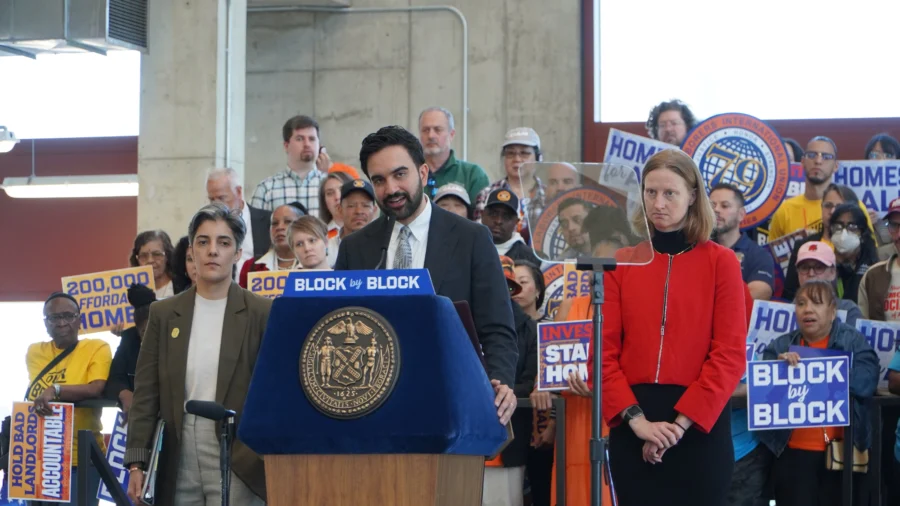
NEW YORK CITY—Mayor Zohran Mamdani has launched an ambitious housing plan to build 200,000 new units in New York City over 10 years, but also to preserve another 200,000 units through subsidy or possibly a forced takeover.
In extreme cases of landlord neglect, the city will step in to force a sale.
“When necessary, we will take aggressive legal action to remove negligent owners and property managers,” Mamdani said from the borough of Brooklyn on May 26.
The mayor said such landlords would be replaced by responsible stewards, which could include community land trusts, nonprofits, or the building’s tenants.
“We will go after the worst landlords, because landlords who were notorious to tenant organizers more than a decade ago should not still be neglecting conditions today," said Leila Bozorg, deputy mayor for housing and planning.
The plan will focus on persistently negligent landlords and highlights enhanced enforcement of housing code violations.
A democratic socialist, Mamdani ran for mayor promising to freeze the rent for the 1 million rent-stabilized apartments in the city and to build 200,000 new units of affordable housing.
The mayor’s comprehensive plan, called Block by Block: The Housing Plan for a New Era, touches on plans for new development, investment in city-owned public housing managed by New York City Housing Authority, zoning law changes, accelerated permit approvals for new construction, support for struggling owners, and efforts to change New York state property tax law.
As part of the effort to preserve 200,000 units, the mayor set aside $2 billion to grow the New York City Department of Housing Preservation and Development's preservation programs to assist property owners unable to pay their bills. The program offers tax breaks and subsidies to landlords who commit to regulatory agreements with the city. But the program also operates to transfer private property ownership to nonprofits.
This is what concerns building owners such as Ann Korchak, board president of Small Property Owners of New York. In an interview with The Epoch Times, she said that instead of addressing the real problems that some owners of old rent-stabilized buildings are already struggling with thanks to inflation, higher insurance premiums, and utilities, “now people are at risk of losing their property.”
The Block by Block plan acknowledges that many of the city’s older rent-stabilized buildings are in trouble, and that the economics for landlords have changed. Since New York state passed the Housing Stability and Tenant Protection Act of 2019, landlords of older rent-stabilized properties can no longer raise rents by 20 percent upon vacancy or charge premiums for improvements made to the unit.
Adam Lehodey, an investigative reporter at the Manhattan Institute, said that the plan diagnoses the problem accurately but that "the solution it offers is not to fix the underlying economics, it's just to channel more taxpayer funds.”
“One of the big reasons why they face these [housing code] violations in the first place is because the laws passed in 2019 have made it very, very difficult to make any profit on these buildings in order to afford the maintenance,” Lehodey said in an interview with The Epoch Times.
Korchak agreed, saying that code violations are in part a symptom of the squeeze on landlords created by the law.
“The operational shortfall is big,” Korchak said. “Because you have to pay your taxes. You have to pay your utilities. You have to pay your insurance.”
She said small property owners are forced to put off maintenance.
“You have to make this choice: Am I going to replace this roof or am I going to repair this roof?" she said. "Those sorts of things show up in the quality of the housing.”
Tenant organizer and director of New York State Tenant Bloc Sumathy Kumar said the preservation effort is to assist tenants and take buildings from negligent landlords; for responsible landlords who are struggling, the city and state offer targeted programs.
“Let's look at the real ways that there might be distress in some of these buildings and let's tackle them in the nuanced and specific ways that they need to be tackled,” Kumar said in an interview with The Epoch Times, noting that the state and city have many programs for landlords facing hardship.
Guided by Tenant Concerns
At the announcement, the mayor highlighted his experience as a housing counselor for New Yorkers facing foreclosure before his term as a New York state assemblyman. He also pointed to the Rental Ripoff hearings held earlier this year as underscoring the urgency of taking action on housing issues.At the in-person hearings held in each borough, tenants were invited to share their complaints about their living conditions. The mayor said he was moved to action by a video of a mother carrying her disabled child up the stairs of their apartment building because the elevator was broken.
Kumar said that from the get-go, tenants weighed in to help form the plan.
“Some of the things that we're most excited about are the efforts to ramp up code enforcement across the city that would really hold landlords accountable for the conditions in our homes,” Kumar said.
Mamdani said the city will focus on supporting tenants with strict housing code enforcement. Starting in October, he said, the city will investigate each individual 311 city hotline heat complaint, rather than group multiple complaints from the same building under one building address as a single case, the goal being to ensure that each case is resolved before being closed.
The plan will also address funding for New York City Housing Authority repairs, which, according to the plan, has a backlog of $78 billion in needed repairs. The plan only includes $5.6 billion to address those needs.
“It's not simply, you know, build more housing, rents will come down, that's all we have to offer," Mamdani said. "It's an entire, all of the above, comprehensive plan.”