


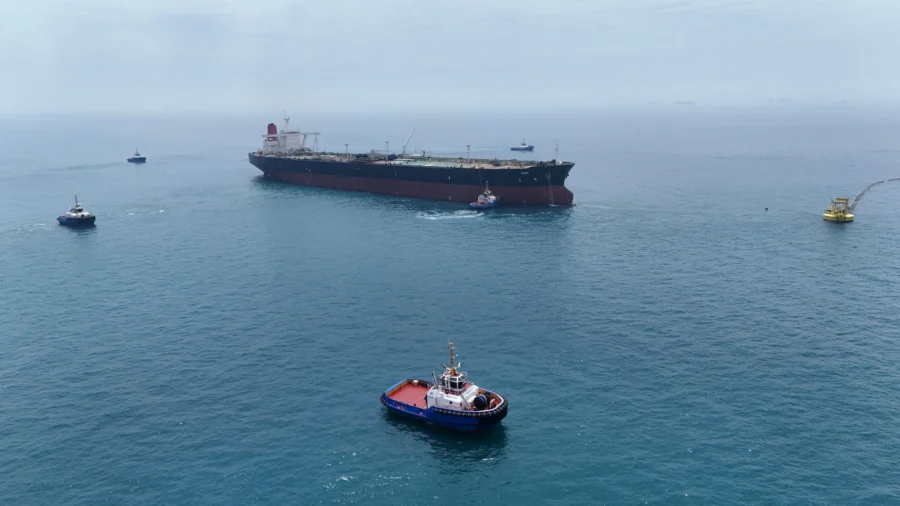
WASHINGTON—Oil prices sharply declined shortly after the United States and Iran reached the preliminary ceasefire agreement, which authorized Tehran to resume crude oil sales.
On June 23, President Donald Trump highlighted increased oil transit through the Strait of Hormuz, announcing that 19 million barrels passed through the strategic waterway the day before.
“An all time RECORD. Oil prices are tumbling down, and the World is a much safer place!!!” Trump wrote on Truth Social.
Crude oil prices have dropped sharply since the agreement was announced. On June 23, Brent Crude fell to $77 per barrel, its lowest in nearly three months. The U.S. benchmark, WTI Crude, dropped to $73 per barrel on the New York Mercantile Exchange, returning to levels seen before the conflict in Iran began on Feb. 28.
“Our stock market is through the roof,” Trump told reporters on June 23. “I think it’s going to break [through] $70 a barrel, that’s lower than we were when we started, and it’s been amazing.”
The general license issued for Iran authorizes the production and sale of Iranian crude oil, petrochemicals, and petroleum products through Aug. 21, as part of the memorandum of understanding (MOU) signed last week.
It also allows the import of Iranian oil into the United States. However, it does not allow transactions with North Korea or Cuba.
According to analysts, the sanctions relief could unlock substantial volumes of Iranian oil.
“Whether you like Trump’s deal or not, the global economy seems to be cheering it, with oil prices plunging to multi-month lows,” Phil Flynn, energy strategist at The Price Futures Group, wrote in a recent note to clients.
Iran’s exports had fallen sharply under the U.S. blockade, dropping to approximately 260,000 barrels per day in May from as much as 1.7 million barrels previously.
The agreement is expected to enable a rapid rebound in Iran’s oil exports to between 1.8 million and more than 2 million barrels a day, according to Flynn. He forecasts that this trade could generate up to $60 billion in annual revenue for Iran as oil shipments, mainly to China, resume.
In March, the Trump administration approved the emergency release of 172 million barrels of crude oil from the U.S. Strategic Petroleum Reserve. The move was part of a global effort to address the energy crisis caused by the closure of the Strait of Hormuz. Weekly releases have helped keep fuel prices steady and meet strong demand from refineries and exports.
Because of these releases, crude oil stocks in the Strategic Petroleum Reserve dropped to 331.2 million barrels last week, the lowest level since June 1983, according to the Department of Energy. This has raised concerns among some traders as it leaves a smaller cushion against future global supply disruptions.
While Trump welcomes lower oil prices, critics say that the sanctions waiver provides an essential economic lifeline to the Iranian regime. The sanctions waiver also includes key services such as banking, transportation, and insurance that are needed to support oil sales.
Trump and Vice President JD Vance also said that Tehran has agreed to permit nuclear inspections indefinitely, while Iranian officials have claimed that it has not done so.
In a post on Truth Social, the president said that Tehran had “fully and completely agreed to highest level Nuclear inspections long into the future (Infinity!!!).”
He described the arrangement as creating “Nuclear Honesty,” adding: “If they did not agree to this, there would be no further negotiations!”
Trump also stated that U.S. naval forces would remain in the region and be prepared to reimpose the blockade, if necessary, although he indicated this scenario is highly unlikely at this stage.
The Trump administration has made Iran’s nuclear program a top priority in negotiations, aiming to ensure that Tehran never acquires nuclear weapons.
“That is a major milestone for the American people and the first step in permanently denuclearizing or permanently ending a nuclear weapons program in Iran.”
Vance said technical teams from the United States, Iran, Qatar, and Pakistan will continue negotiations in Switzerland as part of a roadmap to reach a final agreement within 60 days.