


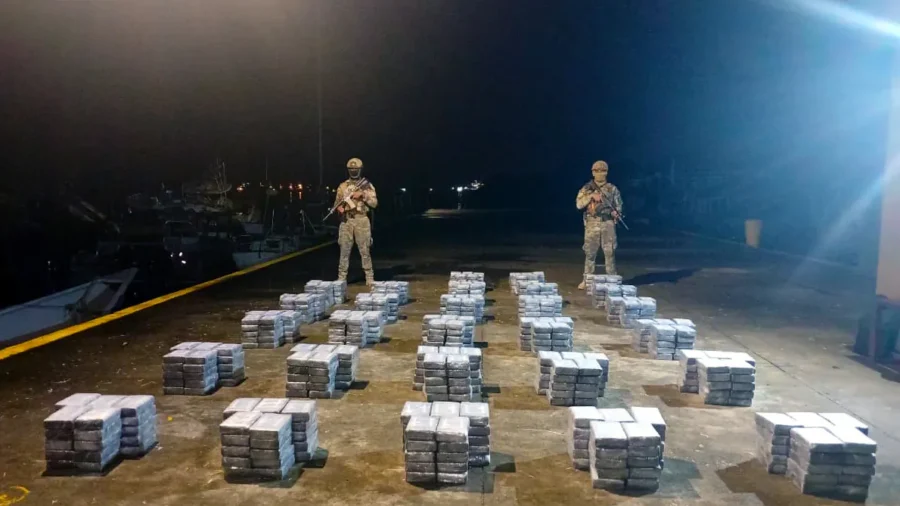
Around 5,612 pounds (2,546 kilograms) of cocaine was seized by U.S. authorities in conjunction with foreign partners in three separate instances over recent days.
In a June 11 post on X, the Joint Interagency Task Force (JIATF) South detailed the results of a cocaine seizure operation carried out in cooperation with the Department of War, U.S. Southern Command, and Panama authorities. The partners engaged in a high-speed pursuit of a Go-Fast vessel and fired warning shots, eventually seizing 783 kilos (approximately 1,726 pounds) of cocaine and detaining four smugglers.
Another operation involved JIATF South passing intel on a Go-Fast boat to Mexico, the task force said in a June 10 X post. “Mexican Marines dropped from a helicopter 350 [nautical miles] off Acapulco, securing 826kg of cocaine and detaining 5 smugglers.”
In an earlier X post on June 8, JIATF South said it tracked a Go-Fast vessel from Colombia that was intercepted by Guatemalan authorities, taking into custody 937 kilograms (approximately 2,065 pounds) of cocaine and arresting two traffickers roughly 41 nautical miles off Puerto Quetzal, Guatemala.
In total, the 2,546 kilograms of seized cocaine have an approximate market value of over $305 million.
40 Illegal Immigrants Interdicted
Meanwhile, the United States Coast Guard said in a June 9 statement that it had interdicted a makeshift vessel near Desecheo, Puerto Rico, which was boarded by 40 illegal immigrants.One illegal immigrant was from Uzbekistan, three from Haiti, and the remaining 36 from the Dominican Republic. The Coast Guard said the crew of Guard Cutter Heriberto Hernandez repatriated 32 illegal immigrants to a Dominican Republic Navy vessel at sea.
“To anyone thinking of taking part in an unlawful maritime migration voyage, don’t take to the sea! These voyages are extremely dangerous and most often involve grossly overloaded and unseaworthy vessels that take on water and have no lifesaving equipment,” said Cmdr. Matthew Romano, Sector San Juan chief of response.
Drug Vessel Strikes
The U.S. military has conducted strikes against vessels in the Eastern Pacific and the Caribbean Sea, which it said were run by drug traffickers.In May, the Pentagon’s inspector general said it would evaluate whether the military followed the established targeting framework when carrying out these strikes. The Pentagon has defended the strikes as legal and clarified that it would not investigate their legality. Some critics argue that the strikes are illegal as they were conducted without first securing congressional approval.
In a report submitted to Congress this year, the Department of War Office of Inspector General said that the strikes are within legal limits.
“Congress has not authorized the use of military force against the drug traffickers, but U.S. law allows the President to take military action without congressional approval in the event of ‘a national emergency created by attack upon the United States, its territories or possessions, or its armed forces,’” the report said.
It cited a Jan. 20, 2025, executive order signed by President Donald Trump—Designating Cartels and Other Organizations as Foreign Terrorist Organizations and Specially Designated Global Terrorists. The order said that international cartels engage in actions that are characteristic of entities engaged in “insurgency and asymmetric warfare.”
Between September 2025 and March 2026, the drug strikes conducted by the military resulted in 156 individuals being killed or presumed dead, the report said.
Last month, the Trump administration’s National Drug Control Strategy was released, detailing a roadmap for the United States to tackle illicit drug flows and ensure the country remains safe and healthy, according to a May 4 White House Fact sheet.
The strategy focuses on stopping the influx of illicit drugs into communities, securing the global supply chain from terrorist and criminal elements, defining current and emerging drug threats, and recognizing the power of faith in addiction recovery.