


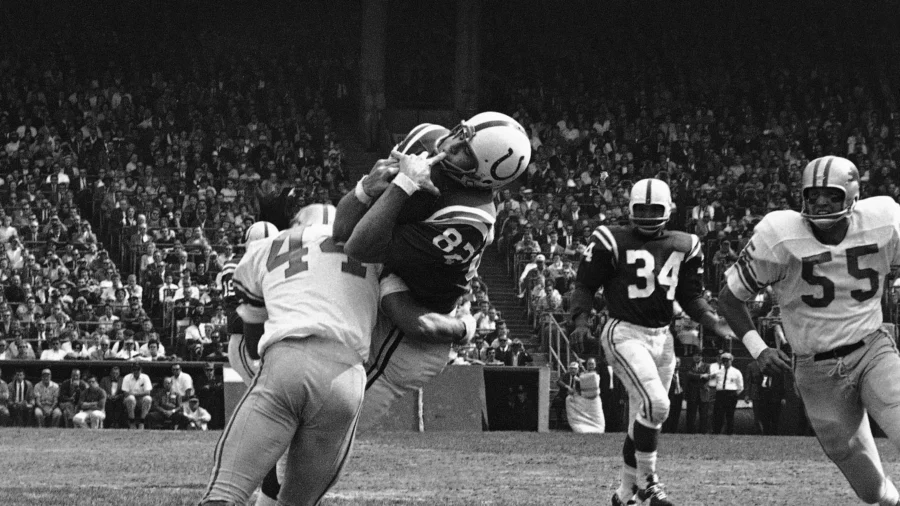
Berry's wife of 65 years, Sally, and their three children were by his side, the family said in a statement.
A two-time NFL champion with the Baltimore Colts and later head coach of the New England Patriots, Berry played a central role in one of the most celebrated moments in NFL history—the 1958 NFL Championship Game, known widely as "The Greatest Game Ever Played."
An Unlikely Star
Nothing about Berry's early career suggested greatness was coming. Born in Corpus Christi, Texas, in 1933, he played one year of junior college ball before transferring to Southern Methodist University, where he totaled just 33 catches across three seasons. The Colts still selected him in the 20th round of the 1954 NFL Draft—232nd overall.His physical limitations were well-documented. He had poor eyesight, wore a back brace to correct a spinal misalignment, and needed special shoes because one leg was shorter than the other. In high school, oversized feet earned him the nickname "Skis.” Speed was never his asset—his own offensive line coach once noted that everybody on the team could outrun him.
But what Berry lacked physically, he made up for with an almost obsessive dedication to preparation. By his own count, he developed 88 separate routes to get open, and spent countless hours after practice catching passes from teammates, ball boys—even his wife in their backyard. He used Silly Putty to strengthen his fingers and would simulate entire games on the practice field.
A Record-Setting Career
Over 13 seasons with the Colts, Berry caught 631 passes for 9,275 yards and 68 touchdowns. He led the league in receptions three consecutive seasons from 1958 to 1960 and in receiving yards three times, finishing his career atop the NFL's all-time lists in both categories at the time of his retirement in 1967. His best statistical season came in 1960, when he hauled in 74 catches for a career-high 1,298 yards and 10 touchdowns.He was named to six Pro Bowls, earned three first-team All-Pro selections, and was later honored on the NFL's 75th and 100th Anniversary All-Time Teams. The Colts retired his No. 82. SMU retired his college number, 87.
His partnership with quarterback Johnny Unitas became the template for the modern quarterback-receiver relationship. The two spent hours in voluntary practice together, building a chemistry that turned ordinary plays into something surgical.
"We worked and got to know each other and developed timing you just can't get any other way," Berry said. "He knew I was going to be there when I was supposed to be there and he knew I was going to catch it."
The Greatest Game Ever Played
Berry's defining moment came Dec. 28, 1958, when the Colts faced the New York Giants at Yankee Stadium in a nationally televised championship game that many credit as the catalyst for the NFL's surge in popularity.Playing against the league's toughest defense, Berry caught 12 passes for 178 yards and a touchdown—a championship game record that would stand for 55 years. When the Colts trailed late in regulation, Unitas went to Berry on three consecutive plays, gaining 62 yards to set up a tying field goal. In overtime, Berry added two more catches for 33 yards, helping set up Alan Ameche's game-winning 1-yard run in the NFL's first sudden-death championship finish. The final score was 23 to 17.
Coaching Career and Drug Testing Fight
After retiring following an injury-shortened 1967 season, Berry moved to coaching, working as a wide receivers coach under Hall of Famers Tom Landry with the Dallas Cowboys and later with the Cleveland Browns and Patriots. He was named New England's head coach ahead of the 1984 season, and led the team to a 48 and 39 record over six seasons, including an 11 to 5 campaign in 1985.That 1985 squad made history by becoming the first team in NFL history to reach the Super Bowl by winning three road playoff games, including a stunning AFC Championship victory over Dan Marino and the Miami Dolphins. The Patriots were beaten 46 to 10 by the iconic Chicago Bears in Super Bowl XX.
"Raymond Berry holds a special place in Patriots history," team owner Robert Kraft said. "He led our franchise to its first Super Bowl appearance following a remarkable playoff run, a milestone that was the greatest achievement in team history at the time."
Shortly after the Super Bowl, Berry became a central figure in the NFL's drug testing debate when he served as a source for a Boston Globe story revealing that several Patriots players had drug problems. His push for the team to adopt drug testing drew fierce opposition from the NFL Players Association. A deeply religious man who neither drank nor smoked, Berry said his conviction came in part from watching his former Colts teammate, All-Pro defensive tackle Gene "Big Daddy" Lipscomb, struggle with addiction without help.
"They didn't help him, they just cut him," Berry told The Patriot Ledger at the time. "Three years later, he was dead."
Berry was inducted into the Pro Football Hall of Fame in 1973 in his first year of eligibility. His former coach, Weeb Ewbank, said it best at Berry's enshrinement ceremony: "He is a perfect example, young fellows, that hard work does pay off."
He is survived by his wife Sally, three children, and nine grandchildren.