

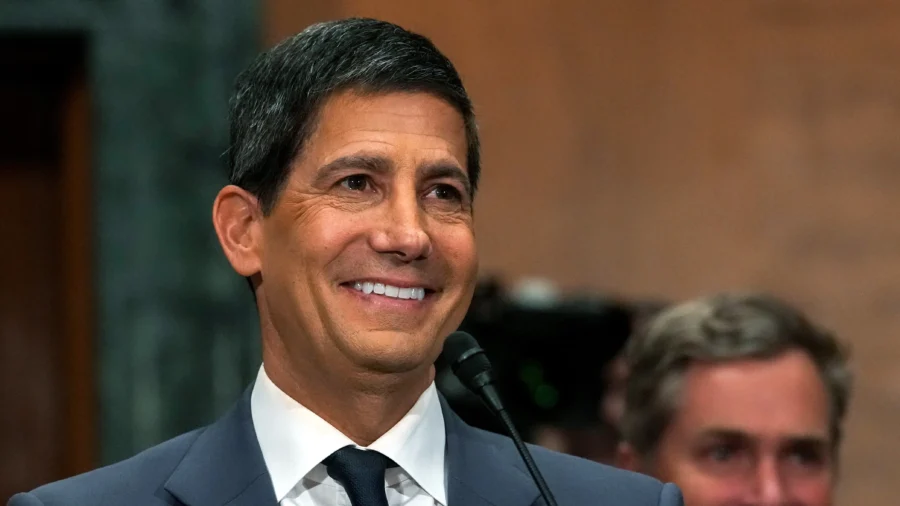
Kevin Warsh will officially become the new head of the Federal Reserve.
The Senate voted 54–45 on May 13 to confirm Warsh's four-year term as the 17th Fed chairman.
Warsh’s ascent to chairman was one of the most partisan votes in the institution’s century-long history.
Sen. John Fetterman (D-Pa.) was the lone Democrat to vote for President Donald Trump’s pick. Other Democratic lawmakers had expressed reluctance to support Warsh’s nomination.
Before the floor vote, Sen. Elizabeth Warren (D-Mass.), ranking member of the Senate Banking Committee, said Warsh could erode the Fed's independence.
"As soon as Donald Trump became president a second time, Mr. Warsh began shouting from the rooftops that the Fed should cut interest rates," Warren said. "In exchange for abandoning his principles, the president offered Mr. Warsh his dream job."
He also assured lawmakers that Trump never asked him to lower interest rates.
Ultimately, Warsh said, it is up to the Fed to remain independent.
‘Regime Change’ of Policy and Personnel
Warsh, 56, has regularly advocated for a “regime change” of policy and personnel at the Fed.Citing its track record over the past few years, he said he believes that various changes are needed to restore its credibility and public trust. Although he has yet to offer an official list of reforms, Warsh has alluded to different routes the institution could take moving forward.
One main issue is interest rates.
"My broad view is that interest rates need to be forward-looking," he said.
In the past, Warsh has supported lowering rates amid what he sees as a disinflationary climate from the artificial intelligence boom.
This could be a challenge for the incoming chairman as he grapples with brewing inflationary pressures and mixed employment conditions.
“As for policy, he enters at a time where inflation is rising, the labor market is concerned about the impact of AI and a potential spike in unemployment and three voting members have dissented about using easing language in their most recent remarks,” Jay Woods, chief global strategist at Freedom Capital Markets, told The Epoch Times in a note.
“For a Chair that wants to lower rates, he sure has his work cut out for him.”
Powell has said he plans to approach his role as a Fed board of governors member differently than he did his role as chairman.
"I plan to keep a low profile as a governor," Powell told reporters last month. "There is only ever one chair of the Federal Reserve Board. When Kevin Warsh is confirmed and sworn in, he will be that chair."
Investors do not expect any rate actions this year, and many traders are gradually pricing in a rate hike next year.
Warsh has also championed using less of the balance sheet.
Since the global financial crisis, the central bank has purchased Treasury and mortgage-backed securities to cushion economic blows and bring down rates. He has stated that this go-to quantitative easing tool for the Fed has benefited Wall Street but distorted financial markets.
Economists warn that by trimming its holdings, the Fed would risk rising long-term yields. However, Warsh said he believes that this could be offset by reducing the policy rate.
Warsh has also indicated that he would apply more focus on trimmed average or mean inflation. This measure would eliminate wild month-to-month swings, whether it be for eggs or airfares.
“The measures I prefer are looking at things that are called trimmed averages,” Warsh told lawmakers. “We take out all of the tail-risks, all of the one-off items, and we ask ourselves whether the generalized change in prices is having second-order effects on the economy.”
The oil price shock emanating from the war in Iran—nearing its 12th week—has caused headline inflation to balloon.
Using the trimmed 12-month personal consumption expenditures inflation rate, calculated by the Dallas Fed, the reading would be 2.4 percent.
Meanwhile, Warsh has also suggested changes to the Fed's communication, particularly regarding forward guidance. This tool, introduced by Alan Greenspan, is designed to shape expectations for the path of monetary policy, effectively allowing markets to adjust to future conditions.
“The Fed tells the whole world what their forecasts are going to be,” Warsh said. “Well, the Fed’s human, and then they hold on to those forecasts longer than they should.”
This could also mean changes to the number of post-meeting news conferences and the Summary of Economic Projections—a quarterly update on the Fed’s expectations for policy and the economy.
Warsh will lead his first meeting next month, when the Federal Open Market Committee convenes the June 16 to June 17 policy gathering.