


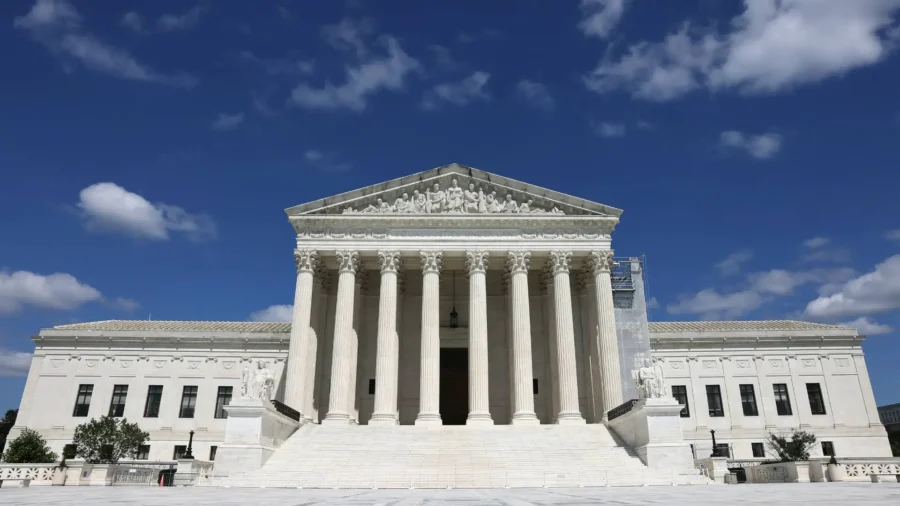
Trump attended the public hearing and is the first president to do so in the history of the United States.
"The newly freed slaves and their children have a relationship of domicile," Sauer told the nation’s highest court. "They do not have a relationship to any foreign power ... And that reinforces our point that allegiance is what the word jurisdiction means. It doesn't mean regulatory jurisdiction."
Trump’s Jan. 20, 2025, birthright citizenship executive order declared that children born to parents who are in the U.S. illegally or temporarily are not American citizens based on the 14th Amendment phrasing "subject to the [U.S.] jurisdiction thereof."
The U.S. Supreme Court first interpreted "subject to the jurisdiction thereof" as a prerequisite for birthright citizenship in 1884.
Sauer expanded the premise by clarifying that the purpose of the 14th Amendment was to establish the citizenship of enslaved African Americans and their children who were officially freed in 1865.
“The clause thus does not extend citizenship to the children of temporary visa holders or illegal aliens,” Sauer said. “Unlike the newly freed slaves, those visitors lack direct and immediate allegiance to the United States.”
Native Americans are not considered fully "subject to U.S. jurisdiction" due to multiple treaties that recognized their sovereign status as distinct political communities, compared to freed slaves who had no sovereign treaties and were instead integrated into U.S. jurisdiction upon emancipation based on their past status as chattel property under complete federal and state legal control.
“By 1866 and 1868 there was strong understanding that the Indian tribes were subject to the United States as regulatory jurisdiction, but not the same way that temporary foreigners were … meaning there was a real debate going on whether the US actually had jurisdiction over Indian tribes,” Sauer told the U.S. Supreme Court judges.
He further argued that modern illegal immigrants lack the capacity to establish domicile because they voluntarily entered illegally, unlike freed slaves who were repeatedly forced to live in the United States.
“Nineteenth century antebellum law never treated their presence as unlawful,” Sauer added. “In fact, quite the opposite. A Mississippi statute, which probably is replicated throughout the South before the Civil War, says slaves in Mississippi have an indefeasible domicile in Mississippi. Even if they run away, if they get away, Mississippi says, ‘Nope, you still live here.’”
Nineteenth-century antebellum law refers to U.S. law, doctrines, and statutes that regulated slavery.