


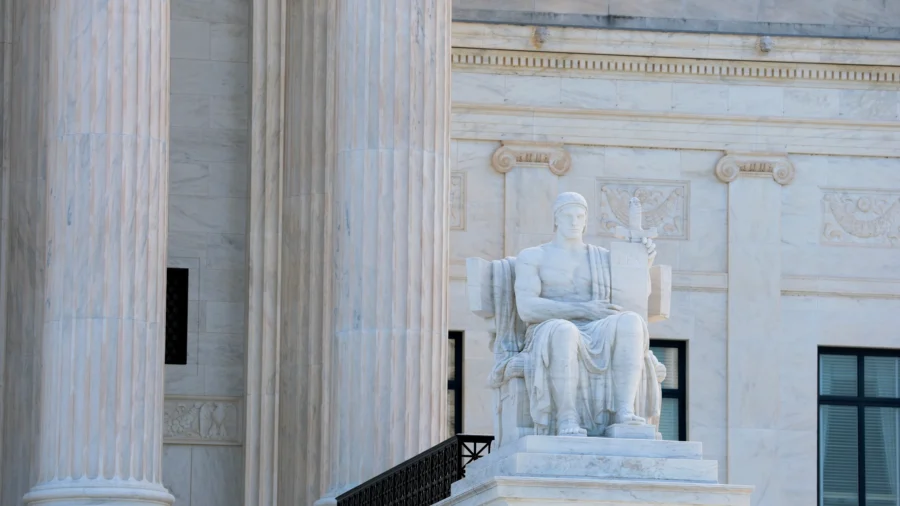
The Supreme Court on June 23 ruled in favor of tech giant Cisco, shutting down a human rights lawsuit accusing the firm of facilitating abuses in China.
The suit, brought by Falun Gong practitioners in 2011, alleged that Cisco knowingly created and customized technology for the Chinese regime to surveil and persecute Falun Gong.
In a 6–3 ruling, the court reversed a lower court decision that had sided with the Falun Gong practitioners, an outcome that could shield U.S. corporations from litigation over complicity of abuses abroad.f
Justice Amy Coney Barrett, writing for the majority, said the lawsuit cannot go forward—as the plaintiffs had argued—under the 237-year-old Alien Tort Statute and the 1991 Torture Victim Protection Act.
The Alien Tort Statute has been a vehicle for decades for lawyers to file international human rights cases in U.S. courts. The Supreme Court in recent years has been narrowing the scope of the law, restricting its reach to cases with direct, substantial U.S. connections.
The more than a dozen plaintiffs have argued that a significant portion of Cisco’s alleged actions took place on U.S. soil.
Internal documents viewed by The Epoch Times show that Cisco had boasted about its products’ capabilities to identify Falun Gong materials online. Another used a phrase targeting Falun Gong that aligned with the Chinese regime’s propaganda against the belief.
Cisco has denied wrongdoing.
Barrett said in the decision that the Torture Victim Protection Act doesn’t expressly mention the aiding-and-abetting liability.
A Door Shuts to Victims
All six conservative justices joined in the majority opinion, while the three liberal justices expressed dissenting views as to the Alien Tort Statue.Sotomayor said the court erred by “ignoring the plain meaning of the Torture Victim Protection Act” and “slamming the door completely shut to claims by U.S. citizens against those who aid and abet torture.”
The decision now effectively bars “almost any claimed violation of international law” under the Alien Tort Statute, including torture, slave labor, and even genocide, she wrote, describing the move as “yet another low point in this Court’s esteem for its precedents.”
Terri Marsh, executive director of the Human Rights Law Foundation, which sued Cisco on behalf of the plaintiffs, said she was greatly disappointed by the majority’s ruling, quoting Sotomayor’s dissent that “proper respect for Congress should have led to a different outcome.”
“As Justice Sotomayor forcefully contended, a ‘straightforward application of this Court’s settled case law’ should have allowed the Plaintiffs’ case to proceed,” Marsh told The Epoch Times.
The Foreign Policy Question
Barrett wrote that aiding-and-abetting actions could harm U.S. foreign interests.Sotomayor disagreed in her dissent.
“The political branches have already consistently condemned China’s treatment of Falun Gong members,” Sotomayor wrote, adding that the State Department and Congress have consistently denounced the persecution of Falun Gong.
Any potential foreign policy consequences will be limited because the case focuses on a U.S. company and its conduct in the United States, rather than the Chinese regime, she said.
“That China has not done so here is additional evidence that this case is unlikely to aggravate U.S.–China relations,” Sotomayor added. Her dissent was joined in part by Justices Elena Kagan and Ketanji Brown Jackson.
Plaintiff lawyer Paul Hoffman said he believes “the Founding generation would have been shocked” at the court’s interpretation of the statute.
“Only twenty years ago the same court held the opposite,” he told The Epoch Times.
“The victims of egregious human rights violations should be able to sue U.S. corporations who aid and abet those violations in U.S. courts,” Hoffman said. He urged Congress to act to allow for victims of serious human rights violations to hold complicit U.S. corporations liable.
The spiritual practice Falun Gong, which features meditation exercises and three core tenets, gained broad popularity in the 1990s in China, with more than 70 million taking it up by some estimates. The Chinese leadership in 1999 instituted a nationwide campaign to eliminate the faith. Many survivors have described torture, slave labor, and other forms of abuses.
In June, a Senate committee advanced the Falun Gong and Victims of Forced Organ Harvesting Protection Act, which aims to sanction perpetrators of the state-sanctioned, killing-for-organ industry in China.