


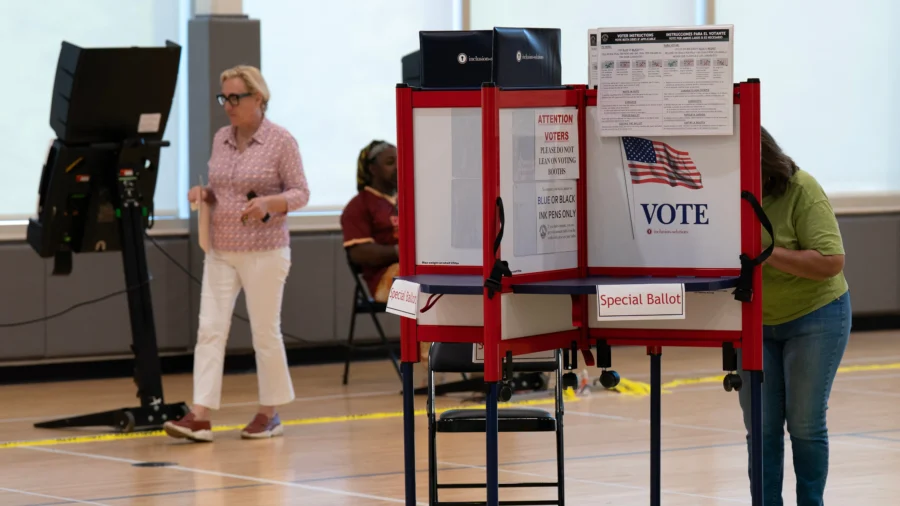
On June 16, American voters in Georgia, Alabama, Oklahoma, and Washington, D.C., went to the polls, or, in many cases, returned to them, to make their picks for a series of local and federal offices.
The top races of the night were in Georgia, where Republicans made their final picks for the gubernatorial and Senate nominations. The primary featured the second time in two weeks that Republicans rejected President Donald Trump’s pick for the governor nominee in their state.
In Alabama, voters made their pick for the state governor and U.S. Senate nominee in two runoff elections.
Voters in Oklahoma, meanwhile, cast ballots for governor in a completely open race and also made their picks for Senate.
Finally, in Washington, with the three-term incumbent mayor not seeking reelection, voters appeared to favor a progressive candidate over a business-friendly rival in a closely watched Democratic primary widely viewed as the deciding contest in the heavily Democratic capital.
Georgia Gubernatorial Upset
Self-funded billionaire Rick Jackson won the Republican nomination for Georgia governor, defeating Trump-backed Lt. Gov. Burt Jones in an upset victory in the June 16 runoff.While Jones entered the night as the frontrunner, boosted by Trump's powerful endorsement, results quickly revealed that Jackson had consolidated crucial support in the Atlanta metropolitan area and surrounding areas.
Jones’s key support base—the state’s rural counties—was unable to bridge the gap, cementing a roughly 5.5-point electoral upset for Jackson when the race was called.
When the race was called by The Associated Press at 9:45 p.m. ET, Jackson led with 52.7 percent of the vote to Jones’s 47.3 percent.
Jones, who poured more than $93 million of his own money into his campaign, will face the Democratic nominee, former Atlanta Mayor Keisha Bottoms, in November.
Jackson’s upset victory marks the second time in the past two weeks that Republican voters have rejected Trump’s pick for governor of their state, with a similar scene playing out in Iowa’s match-up between Trump-backed contender Rep. Randy Feenstra (R-Iowa) and challenger Zach Lahn.
Georgia Senate
Georgia Rep. Mike Collins prevailed in the U.S. Senate Republican primary runoff on Tuesday and will take on Democratic incumbent Sen. Jon Ossoff in the general election this fall.Collins, who received a late endorsement from Trump days before the contest, garnered 55.2 percent of the vote by 8:37 p.m. ET, when The Associated Press called the race, over challenger Derek Dooley, who trailed with 44.8 percent.
“Georgia, I’m honored to be your Republican nominee for the United States Senate,” Collins wrote in a post on X after the race was called. “Now it’s time to get to work, defeat Jon Ossoff, and take this seat back for the people of this state.”
Alabama Runoff Elections
In Alabama, voters in both parties will make critical picks for a runoff election for governor and Senate.The state’s Senate seat is being vacated this year by Sen. Tommy Tuberville (R-Ala.), who is stepping down to run for governor.
Tuberville easily won his party’s nomination, raking in 85.5 percent of the vote on May 19, while Democrats nominated former U.S. Sen. Doug Jones (D-Ala.), who won an upset special election victory to the federal upper chamber in 2017.
The party hopes for another surprise win from Jones, given his reputation and political status in the state.
Tuberville’s bid for the governor’s mansion left his Senate seat open, and candidates on both sides competed for the nomination to fill it on Tuesday.
Rep. Barry Moore (R-Ala.) ultimately won the Senate GOP runoff in Alabama on June 16.
Moore’s rival has yet to be determined as the race between pet care business owner Dakarai Larriett and attorney Everett Wess for the Democratic nomination remains uncalled.
Given that Alabama is a deep-red state, Moore is all but guaranteed to win regardless of the eventual Democratic nominee.
Trump had endorsed Moore, noting that Moore had been the first elected official in the country to endorse him during his initial 2015 presidential run.
“As your next Senator, Barry will continue to fight tirelessly to Grow our Economy, Cut Taxes and Regulations, Promote MADE IN THE U.S.A., Champion American Energy DOMINANCE, Keep our Border SECURE, Stop Migrant Crime, Ensure LAW AND ORDER, Strengthen our Brave Military/Veterans, Safeguard our Elections, and Defend our always under siege Second Amendment,” Trump wrote on Truth Social on June 15.
Oklahoma Governor
Tulsa businessman and former state Sen. Mike Mazzei will face Oklahoma Attorney General Gentner Drummond in the Aug. 25 gubernatorial primary runoff election.Drummond received 26.3 percent of the vote to Mazzei’s 25.9 percent. The runoff was triggered because neither received at least 50 percent of the vote.
Mazzei has been touting Trump’s May 29 endorsement in his campaign ads.
“Mike knows the AMERICA FIRST Policies required to Grow our Economy, Create GREAT Jobs, Cut Taxes and Regulations, Promote MADE IN THE U.S.A., and Unleash American Energy DOMINANCE,” the president wrote in a post on Truth Social.
The remaining Republicans on the ballot were Chip Keating, a former state trooper and son of former Gov. Frank Keating; former Oklahoma House Speaker Charles McCall; and Jake Merrick, a former Oklahoma state senator from 2020 to 2022.
Keating took around 18.5 percent, Merrick won around 14.5 percent of the vote McCall received under 12 percent.
Republicans Jennifer Domenico, Leisa Mitchell Haynes, Kenneth Sturgell, and Calup Anthony Taylor rounded out the GOP ballot.
The winner of the GOP runoff will face Democratic Oklahoma House Minority Leader Cyndi Munson, who took nearly 75 percent of the primary votes over two challengers.
Former Democratic state Sen. Connie Johnson won 22.3 percent of the Democratic vote, falling in second place.
Oklahoma voters from each party also selected their candidates for the U.S. Senate seat vacated by Markwayne Mullin, who left office on March 24 to become Secretary of Homeland Security. Mullin was elected in 2023 and served until he was appointed to the position by Trump.
Trump-endorsed First District Congressman Kevin Hern got the Republican U.S. Senate nomination with nearly 70 percent of the vote, easily defeating challengers Sean Buckner, Gary Ty England, Nick Hankins, and Brian Ragain.
Democrats seeking the nomination for the Senate seat were RW Cassity, Troy Green, Jim Priest, N’Kiyla Jasmine Thomas, and Ervin Yen.
DC Mayor
In the nation’s capital city, Washington, D.C., Mayor Muriel Bowser previously announced that she wouldn’t seek reelection to a fourth term, leaving the race wide open.The district is overwhelmingly Democratic, making the race effectively serve as the general election. Two primary contenders are seeking the Democratic nomination.
Results show that Janeese Lewis George is leading in the race, though The Associated Press has not made a final call.
A former juvenile prosecutor and a current member of the city council, George is running as a progressive Democratic candidate. Her campaign has won the support of the city’s left flank, having drawn some comparisons to the progressive policies of New York City Mayor Zohran Mamdani, with a campaign focus on expanding public childcare funding, rent control, and crime reduction.
Meanwhile, at-large D.C. Councilmember Kenyan McDuffie is running as a business-friendly candidate heavily aligned with outgoing Bowser’s legacy.
George leads in the tally by around 16 percent.