


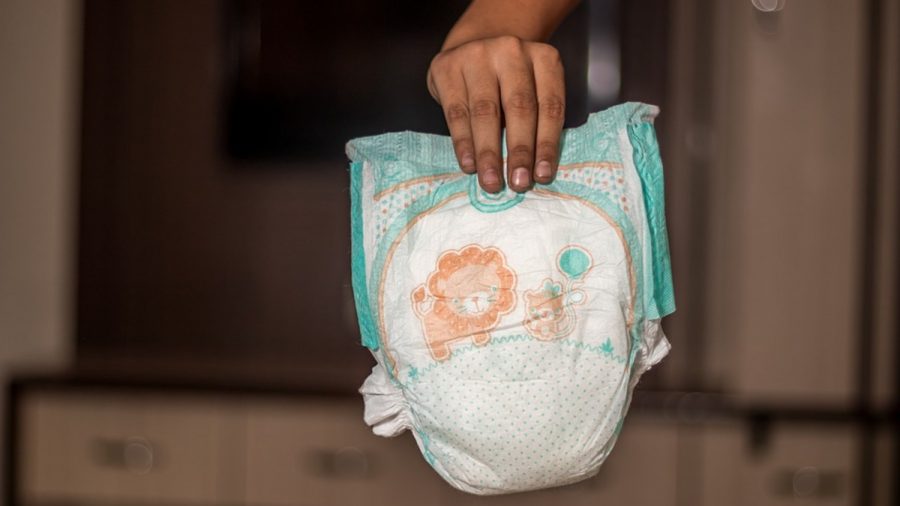
Swathes of Chinese consumers are heading to Hong Kong to buy diapers after reports emerged that certain infant and toddler brands contain the toxic substance formamide, a discovery that has triggered intense public anxiety.
According to the report, several infants developed severe redness and even skin ulcerations on their buttocks after using specific diaper brands. These symptoms subsided significantly once they stopped using the products.
Following up on initial complaints, the media outlet commissioned a professional testing agency to sample and examine various infant diapers available on the market. The resulting report revealed that the toxic synthetic chemical formamide was detected in infant diapers and training pants across multiple major brands.
Among the implicated labels were Huggies—owned by the U.S. multinational Kimberly-Clark—alongside prominent domestic brands Biba Bebe and Babycare.
NTD reached out to Kimberly Clark for comment.
Formamide is widely classified as a reproductive toxic substance. It is a synthetic chemical that can be easily absorbed through the skin, and long-term exposure is known to damage both the liver and kidneys while hindering the reproductive development of infants and toddlers.
Reflecting its known dangers, China’s own Inventory of Prohibited Ingredients for Cosmetics explicitly bans formamide from being added to any skin-contact beauty or skincare products.
To verify the exposure risks, the investigating journalist reportedly wore a diaper overnight and underwent a medical screening, which showed that the concentration of formamide in their blood nearly doubled.
In the immediate wake of the report, sales of the implicated brands plummeted in China. Desperate to find safe alternatives, waves of parents have flocked across the border into Hong Kong to clear out local retail stocks.
In areas closest to border checkpoints or densely populated with mainland travelers—including Sheung Shui and Tuen Mun in the New Territories North, and Sha Tin in the New Territories East—baby diapers temporarily vanished from shelves over the weekend and holidays.
Major chain stores near the border checkpoints quickly introduced emergency guidelines, capping individual purchases at two to four packs to protect local inventory for Hong Kong parents. However, diaper stocks in more central urban areas of Hong Kong remain abundant.
On social media, the atmosphere has been defined by overwhelming parental fury. Demands for transparency surged online, and by June 22, diaper-related topics dominated the hot search lists on Weibo, China’s equivalent of X.
The comments section was flooded with thousands of emotional responses. One parent said:
“Children are the moral baseline. We have zero tolerance for this—we must be given an explanation!”
Another said: “Can you provide a healthy and safe environment for children to grow up in before urging young people to have babies?”
“I honestly feel so desperate and powerless. Why target the children?”
“Can we claim compensation and bankrupt these companies?”
“How do we check if a child has been poisoned? If they are, how do we treat it?”
“What about women’s sanitary pads? I’m so worried.”
“I guarantee those [sanitary pads] are toxic too.”
Some questioned how authorities can continue urging young people to have children when they fail to provide a safe and healthy environment for them to grow up in.
One wrote: “And they are still encouraging people to have kids? Have a kid? When even the most basic safety of women’s and baby products can’t be guaranteed, it’s an absolute joke.”
This panic is a painful echo of past trauma rather than an isolated incident. Most notably, the 2008 melamine scandal involved multiple domestic infant milk powder brands being exposed for adding toxic industrial chemicals to their formulas. That crisis caused a catastrophic wave of kidney stones and severe urinary tract diseases, affecting nearly 300,000 children.
Shaken by the domestic failure, a massive wave of distrustful Chinese citizens swarmed Hong Kong’s highly regulated market to panic-buy formula, emptying store shelves across the city.
To safeguard the basic food supply for local infants during that crisis, the Hong Kong government intervened in 2013 by enacting the well-known milk powder export restriction law.
People aged 16 or older departing the territory are only allowed to carry a total net weight of 1.8 kilograms of infant formula—roughly equivalent to two standard cans—within a 24-hour period.