


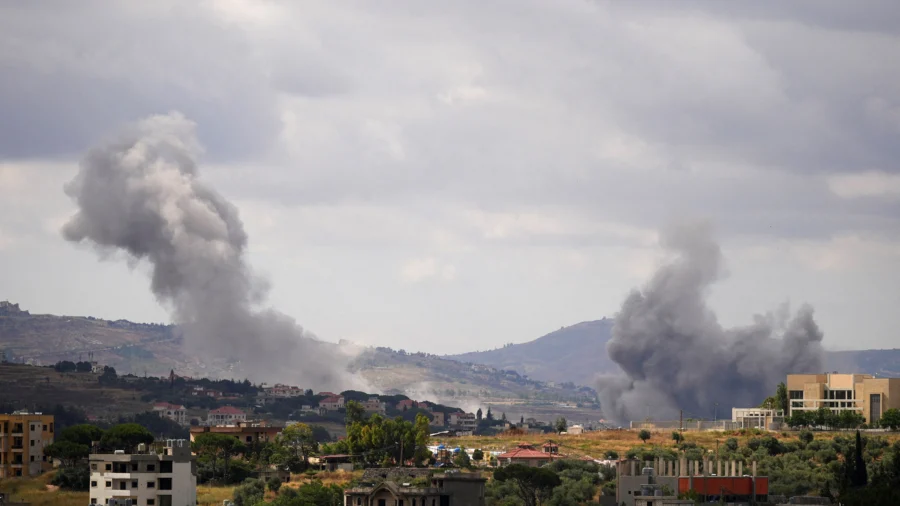
DUBAI/WASHINGTON—President Donald Trump criticized an Israeli strike on Lebanon that could complicate attempts to finalize a framework deal between the United States and Iran on Sunday on ending their war, but said an agreement was nonetheless close.
Iranian negotiator Mohammad Baqer Qalibaf said Israel's attack on the southern suburbs of Beirut, which Israel said targeted Iranian-backed Hezbollah militants, showed the United States lacks the will or ability to fulfill its commitments.
Iran's foreign ministry said it holds the United States responsible for Israel's attack in Lebanon. Iran warned of a "strong response." Its top joint military command said the "finger [is] on the trigger" ready to fire at the "enemy's heart."
In a post on his Truth Social platform on Sunday, Trump said: "This morning's attack on Beirut should not have happened, particularly on a special day when we are so close to a Peace Deal with Iran."
Israel-Hezbollah Conflict Reignited
The conflict between Israel and Iran-aligned Hezbollah in Lebanon was reignited by the start of the U.S.–Israeli war against Iran in February.Israel has said it is not party to the planned U.S.–Iran deal. Prime Minister Benjamin Netanyahu has differed with Trump over American demands that Israel curb its military action in Lebanon to allow the United States to reach a deal with Iran.
"If you lack the will and ability to fulfill your commitments, speaking of continuing the path is not possible," Qalibaf wrote on X, criticizing the United States.
Trump and mediator Pakistan said on Saturday they expected the deal would be signed on Sunday, which is the U.S. president's 80th birthday. An official involved in the talks said on Sunday that mediators were optimistic the deal was "nearly over the line." A Kremlin aide said Trump told Russian President Vladimir Putin by phone on Sunday that a deal was near.
Iran cast doubt over the timing even before the strike on Beirut, saying on Saturday that the signing would not be on Sunday though it could happen in the coming days.
The Israeli military said on Sunday Hezbollah had launched three projectiles towards communities in northern Israel. Israel then fired at what it called Hezbollah targets in the Dahiyeh neighborhood of Beirut in an attack that Lebanon's civil defense said killed three people.
Uncertainty Over Timing of Signing
Thousands of people have been killed, mostly in Iran and Lebanon, since the U.S. and Israeli forces began attacks on Iran on Feb. 28. Iran has struck Israel and Gulf states hosting U.S. bases, and has effectively blockaded the Strait of Hormuz, a vital artery for global oil supplies, pushing up global energy prices. U.S. forces have blocked Iranian ports.Iran's Fars news agency, citing an informed source, said on Sunday Iran has not yet made a final decision on the framework agreement, with reviews of its political, legal and technical aspects under way.
A U.S. official said the agreement would ultimately lead to the dismantling of Iran's nuclear program, with its stockpile of highly enriched uranium to be destroyed and removed.
Pentagon chief Pete Hegseth said the end of the naval blockade on Iran would "start immediately" once an accord is signed, but the timing would depend on the strait reopening. Hegseth said the United States has the capacity to clear the strait to ensure safe transit.
Hegseth, speaking on CBS's "Face the Nation" program, said the United States plans to keep enough military force in the region to "make sure the military option is still there" during negotiations on Iran's nuclear program.