



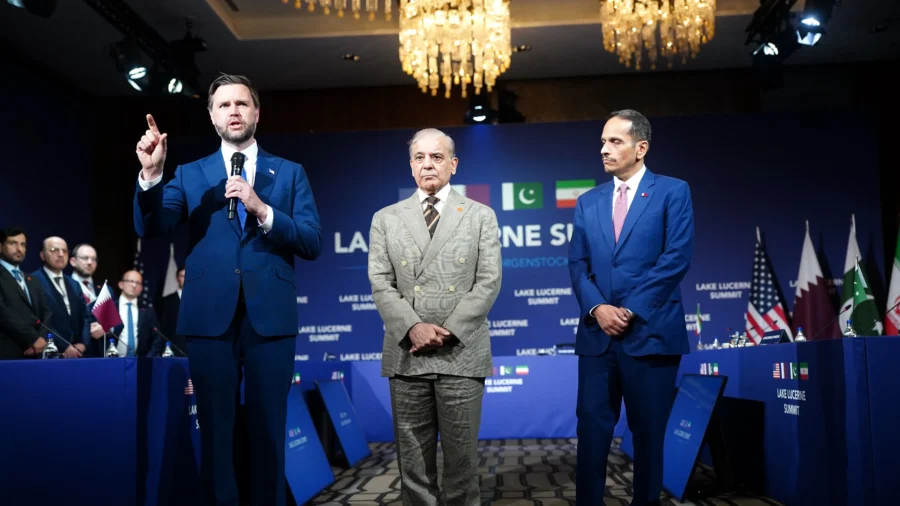
The first round of high-level peace talks between the United States and Iran have concluded with “encouraging progress” made, mediators Pakistan and Qatar said early June 22 in a joint statement.
The highly-anticipated talks at the Bürgenstock Resort Lake Lucerne, near Stansstad, Switzerland, were conducted in “a positive and constructive atmosphere,” the mediators said.
Technical talks are to start immediately and continue for the remainder of the week, with a roadmap to reach a final deal within 60 days, the statement said.
To address the issues in Lebanon, a “de-confliction cell” involving the United States, Iran, and Lebanon will be facilitated by Pakistan and Qatar to ensure “the adherence of the termination of military operations in Lebanon” in line with the MOU.
A communication line will also be established as per the MOU to “avoid incidents and miscommunication with the aim of safe passage for commercial vessels through the Strait of Hormuz.”
U.S. Vice President JD Vance joined leaders from Iran, Pakistan, and Qatar on June 21 to advance the peace agreement with Iran.
The talks at the Bürgenstock Resort mark the highest-level direct engagement between the United States and Iran since tensions escalated following military exchanges earlier this year.
The memorandum reached last week will continue to provide the framework for the technical discussions aimed at easing the armed standoff between the two parties and to allow for further negotiations on the long-term disposition of Iran’s nuclear program and other obstacles toward a lasting peace between the parties.
During a break on June 21, Vance called the efforts so far “a historic meeting” and also said the parties made “great progress.” He said he sees a future in which everyone can work together to promote peace and prosperity.
Vance was joined by special envoys Steve Witkoff and Jared Kushner, with Pakistani Prime Minister Shehbaz Sharif and Pakistani Army Chief Field Marshal Asim Munir also in attendance.
The Lebanon Issue
Before his departure, Vance said, “We’re going to hopefully make progress on the nuclear issue, make progress on the Lebanon ceasefire issue—those are the two big things that I think we’re going to be focused on.”The vice president described Lebanon as a “chicken and egg” problem, in which one side attacks and the other side responds. He said U.S. Secretary of State Marco Rubio is managing what is going on in Lebanon. Rubio is scheduled to host Lebanese President Joseph Aoun for talks on the Hezbollah terrorist group and Lebanon’s territorial sovereignty in Washington June 23–25.
“Despite the headlines, things are actually getting better there,” Vance said. “Things have calmed down a little bit. It is going to be something that we are going to have to continue to manage to ensure that Israel and Lebanon are both safe and secure. That’s one of the goals, is to make the whole region safe and secure.”
On June 21, as negotiations were underway, Trump said Iran had to do better with Lebanon.
“Iran must immediately stop their highly paid proxies in Lebanon from causing trouble,” Trump posted on Truth Social. “If they don’t, we’ll hit Iran very hard again, just like we did last week, only harder!”
Iran’s state-run media responded by reporting that the Iranian delegation was weighing its next steps.
“The Iranian delegation has raised its objections to the American side and is currently assessing the conditions to give a proper response to Trump’s verbal threats,” reported PressTV, an Iranian state-owned news organization owned by Islamic Republic of Iran Broadcasting.
Four Israeli soldiers were killed on June 19 while uprooting underground Hezbollah terrorist group weapons caches and fighting positions.
Israeli forces responded with dozens of retaliatory strikes throughout southern Lebanon.
Israeli Ambassador to the U.S. Yechiel Leiter said on June 20 that it was the Hezbollah terrorist group that broke the ceasefire.
“Terrorists lie,” Leiter wrote on X. “Iran is using its proxy to extract concessions. That is the modus operandi of the murderous regime in Tehran.”
The Strait of Hormuz Issue
Before the peace talks began, Iranian authorities said they closed the Strait of Hormuz in response to Israeli military operations in Lebanon.On June 20, Trump threatened to impose a toll on maritime traffic in the Strait of Hormuz if a long-term peace deal is not reached in the next two months.
“There will be no tolls in the Hormuz Strait for 60 days during the Cease Fire Period, and there will be no tolls after the 60 day period has expired, unless they are imposed by and for the United States of America, should the deal not be completed, for services rendered as the Guardian Angel to the countries of the Middle East for purposes of both past, present, and future reimbursement of costs,” Trump posted on Truth Social.
The Strait of Hormuz is one of the world’s most important transit points for oil and natural gas.
U.S. Energy Secretary Chris Wright told Fox News on June 21 that “traffic is flowing through the strait quite nicely.”
Wright said 67 ships passed through the Strait of Hormuz on June 20 and 55 transited on June 19. He said that that was about the same level of traffic as before the conflict with Iran began on Feb. 28.
He said that Iran has still not removed mines from the central shipping channel but that the United States opened another channel farther south and that the U.S. military has been escorting ships through that path.
The average price of a gallon of regular gas in the United States was $3.94 as of June 21, according to the American Automobile Association. That was 14 cents lower than a week ago.
Mike Waltz, U.S. ambassador to the U.N., said on CBS News’s “Face the Nation” that all Americans want lower gas prices.
“Just a few months ago ... analysts were saying oil would be upwards of $150 to $200 a barrel and it is not, it is now under $80,” Waltz said.
“Of course, everyone wants cheaper energy. But what President Trump is doing is striking that balance with also ensuring that a genocidal regime that none of us trust can never have a nuclear weapon. And that process is underway right now as we speak.”