


WASHINGTON—The White House said Thursday night that Vice President JD Vance was delaying a trip to Switzerland to lead a new round of negotiations with Iran over its nuclear program.
It said the team lead by Vance had been ready to leave but was postponing, citing difficult logistics for negotiations. The announcement followed a report from Al-Mayadeen, a pan-Arab satellite channel that is politically allied with the Iranian-backed Lebanese terrorist group Hezbollah, that Iran was delaying sending its delegation to Switzerland over Israel’s ongoing military campaign in Lebanon.
The postponement came after the United States said it had lifted its blockade, allowing oil tankers to begin freely moving through the Strait of Hormuz after months of being unable to use the critical channel.
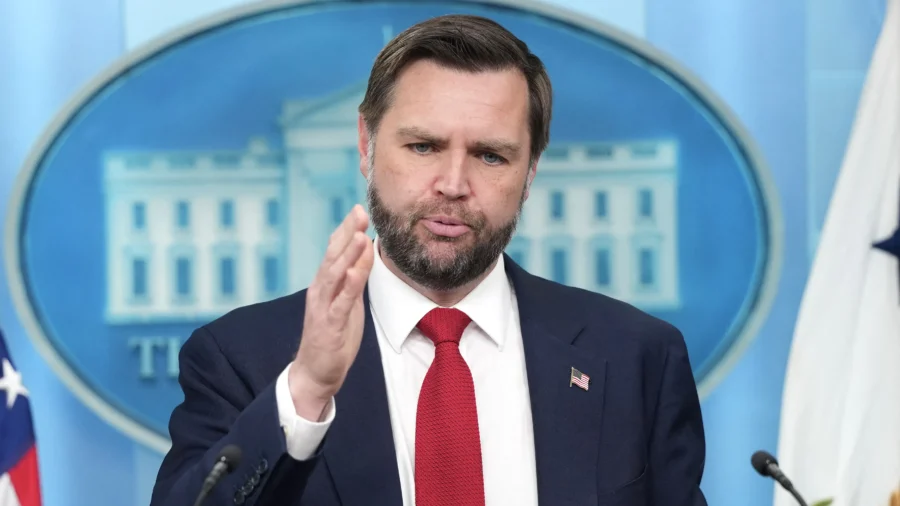
Earlier, Vance appeared at the White House to defend the deal, saying that while it offers concessions, Iran first has to comply with U.S. demands.
“As they dial up their good behavior, we can dial up the economic relief,” Vance said. “If they dial down their good behavior, we can turn it off.”
The vice president had said during those remarks that he was not sure of the timing of the planned trip to Switzerland, and the postponement makes that even less clear.
A top Trump administration envoy told U.S. lawmakers in a private briefing that Iran will invite the U.N.’s nuclear watchdog agency to inspect its nuclear sites. And Iranian Supreme Leader Ayatollah Mojtaba Khamenei had seemed to endorse direct negotiations for his officials.
“It is obvious that the face-to-face negotiations that will be held in the future will not mean accepting the enemy’s opinion,” he said in a statement read by state media.
It was Khamenei’s first reaction to the agreement, and it was interpreted as a shift in Iran’s approach. Hard-liners, especially Khamenei’s father, the previous supreme leader, have long opposed direct talks, especially after the United States pulled out of the 2015 nuclear deal between Iran and world powers.
Lawmakers Told Iran Will Invite UN Inspectors to Its Nuclear Sites
The agreement states that Iran’s stockpile of highly enriched uranium must at minimum be diluted under international supervision. It also says that Iran shall not procure or develop nuclear weapons—a commitment it has made previously.Trump envoy Steve Witkoff told members of Congress that Iran will invite the International Atomic Energy Agency to inspect its nuclear sites and begin work on identifying and uncovering the locations of Tehran’s enriched material, which is believed to be buried under rubble.
Witkoff's private briefing was described by two people familiar with the conversation who spoke to The Associated Press on condition of anonymity to share the closed-door details.
The agreement requires Iran to “commit to renounce their nuclear ambitions in writing,” said White House spokeswoman Olivia Wales. The IAEA did not respond to a request for comment.
Witkoff told congressional leadership and members of national security-related committees that the agreement that the United States struck with Iran did not include any side deals, but a side letter was drafted between Tehran and the IAEA extending the invitation.
Shipping Starts to Pick Up
Trump said he signed the agreement to avoid “economic catastrophe” in the United State, after the war caused oil prices to skyrocket, made financial markets skittish and fueled inflation. The deal caused gas prices to fall and stock markets to rise—though rallies could be threatened again depending on how the next round of U.S.–Iran talks go.The vice president said more than 12.5 million barrels of oil went through the Strait of Hormuz on Wednesday night and said that the United States easing its blockade of Iran means “honoring our end of the early part of the agreement on the military side.”
U.S. Central Command said American warships “will remain in the general area to make sure that all aspects of the agreement are adhered to, obeyed and in full force and effect.”
Iranian state media said shipping had “normalized” at Iran’s southern ports but added that the strait remains supervised and under the control of the Iranian military, and transiting through the vital waterway still requires coordination.
Major shipowners began moving vessels through the strait after the agreement was signed, according to maritime data company Lloyd’s List Intelligence, though Lloyd's did not give data on how many ships have passed through the strait as of Thursday.
In a media briefing, Richard Meade, editor-in-chief of Lloyd’s List, said for the first time in 110 days, ships owned by major companies are transiting the strait after effectively being marooned there since February.