


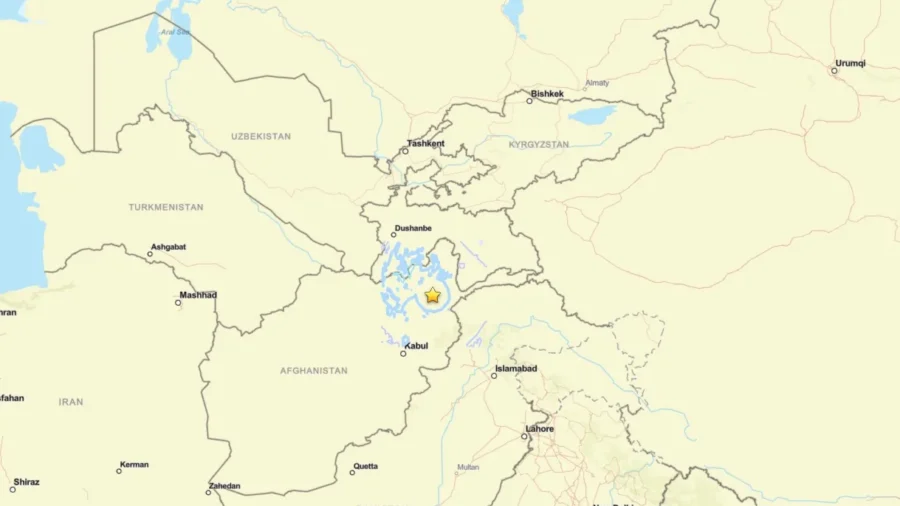
The USGS placed the quake's depth at approximately 212.9 kilometers, or nearly 135 miles, beneath the surface. India's National Center for Seismology, which also recorded the event, reported the earthquake struck at 11:27 p.m. local time, with coordinates placing the epicenter at 36.567°N 70.449°E.
Jurm sits within Badakhshan province, a rugged, mountainous region of northeastern Afghanistan that lies along the Hindu Kush mountain range.
The area is no stranger to seismic activity—the collision of the Indian and Eurasian tectonic plates makes it one of the most earthquake-prone zones in the world.
Wednesday's tremor came just four days after a magnitude-6 earthquake struck Afghanistan's Hindu Kush region on Saturday, according to the European Mediterranean Seismological Centre (EMSC).
That quake, centered 100 kilometers beneath the surface, was strong enough to send shockwaves rippling through the capital Kabul and across the border into Pakistan.
Quake Rocks Pakistan
A separate magnitude-5.4 earthquake also struck Pakistan on Saturday, according to EMSC. More than 20 people were injured, and dozens of houses were damaged in different areas of the Musakhail district in Pakistan, the district's deputy commissioner Abdul Razzaq Khajak told Reuters.Balochistan province's disaster management authority reported that roughly 125 houses were damaged, with relief teams dispatched to carry tents, food, solar panels, and blankets.
Repeated Tragedies
Wednesday's tremor follows a string of deadly disasters that have battered Afghanistan in recent years. In September 2025, a magnitude-6.0 earthquake tore through the eastern provinces of Kunar and Nangarhar, killing more than 800 people initially. As rescue teams pushed into remote communities days later, the death toll climbed past 2,200, with at least 2,800 people injured, according to Taliban authorities.Before that, in October 2023, a magnitude-6.3 earthquake and a series of powerful aftershocks near the western city of Herat killed more than 2,000 people and left thousands more injured.
Relief and rescue operations in Afghanistan are routinely complicated by the country's geography. Mountain roads, limited communication infrastructure, and sparse resources frequently delay both damage assessments and the delivery of aid to affected communities.