

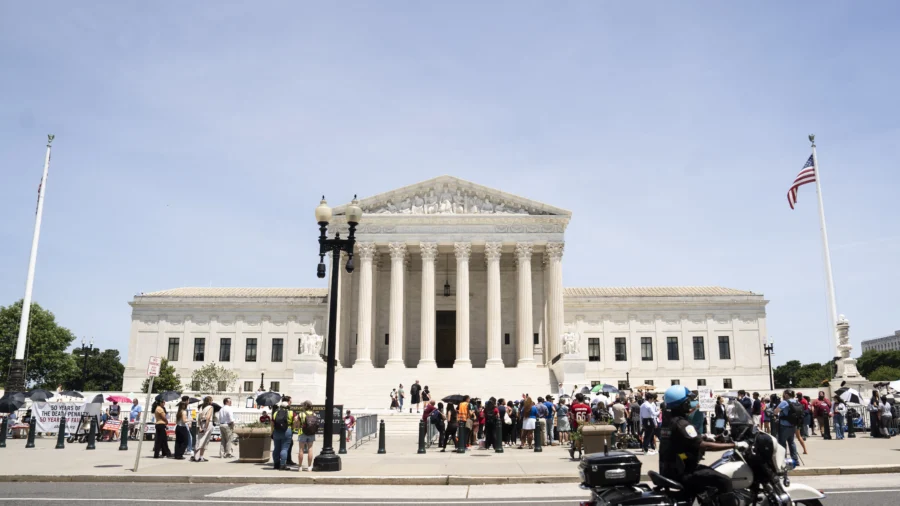
The Supreme Court concluded its current term on June 30 by invalidating President Donald Trump’s executive order that would have prevented the children of illegal immigrants and legal temporary visitors from being deemed citizens at birth.
The clause states, “All persons born or naturalized in the United States, and subject to the jurisdiction thereof, are citizens of the United States and of the state wherein they reside.”
Allegiance Not a Factor
Writing for the majority, Chief Justice John Roberts said the 14th Amendment was based on English legal tradition, which generally allowed someone to be a citizen if they were born in the country.In old England, a child “owed an implied allegiance to the sovereign who protected him at birth—no matter how ‘momentary and uncertain’ his presence in the King’s realms.”
The majority said that the phrase “subject to the jurisdiction thereof” in the 14th Amendment referred to the idea that someone was subject to American laws.
The Trump administration had argued that newborns’ parents should have some kind of allegiance to the United States in the form of permanent residence or domicile. Domicile is a legal concept referring to the place a person resides in and treats as his or her permanent home.
Roberts rejected that argument and the idea that the framers of the 14th Amendment intended to condition citizenship on domicile.
Kavanaugh Says Congress Decides
Five of the justices, including Roberts, backed this view of birthright citizenship and the 14th Amendment. Justice Brett Kavanaugh joined them in rejecting Trump’s order but did so for different reasons.In a narrow concurring opinion, Kavanaugh said he disagreed with the majority’s holding that the order ran afoul of the 14th Amendment. Instead, he would have struck down the order because it violated the Immigration and Nationality Act.
Congress passed that law in the 20th century, and a key provision mirrors the language in the 14th Amendment. Kavanaugh said that if Congress wanted to exclude certain people from birthright citizenship, it would have said so.
Thomas Says 14th Amendment Was for Freed Slaves
In his dissent, Justice Clarence Thomas argued the 14th Amendment, passed after the Civil War, was intended for freed slaves rather than illegal immigrants.He said blacks were entitled to citizenship because they were Americans, had no other homeland, did not owe allegiance to a foreign country, and were not subject to any other authority. They “fought and bled in the same battles,” and could be called upon to defend the country, like any other citizen, he said.
“The same could not be said for the children of foreign temporary visitors … [who] were attached to their home country, lacked similar bonds to this country, and would not be called upon in time of war,” Thomas added.
In her concurrence, Justice Ketanji Brown Jackson said Thomas, “despite his longstanding endorsement of a ‘colorblind’ Constitution,” argued the Citizenship Clause was “a race-conscious remedial measure” relating to freed slaves.
Thomas suggested that children born in the United States but not domiciled here lack entitlement to birthright citizenship, she said.
Trump, DOJ Vow Action
Trump described the ruling as “bad for the country,” a “win” for China, and vowed to pursue legislation and enhanced enforcement.“We will work with Congress to fix this and end the abuse once and for all,” he said, in an apparent reference to possible remedial legislation and combating birth tourism.
The Department of Justice (DOJ) reacted to the ruling by pledging to prioritize investigations of birth tourism schemes.
Senior DOJ official Colin McDonald sent a memo to employees saying that individuals who visit the United States under “false pretenses” to give birth and gain citizenship for their child may be charged under criminal laws against visa fraud, identity theft, money laundering, and wire fraud.
The department “will zealously protect the sanctity of United States citizenship by investigating and prosecuting those who fraudulently exploit our immigration system,” the memo said.