


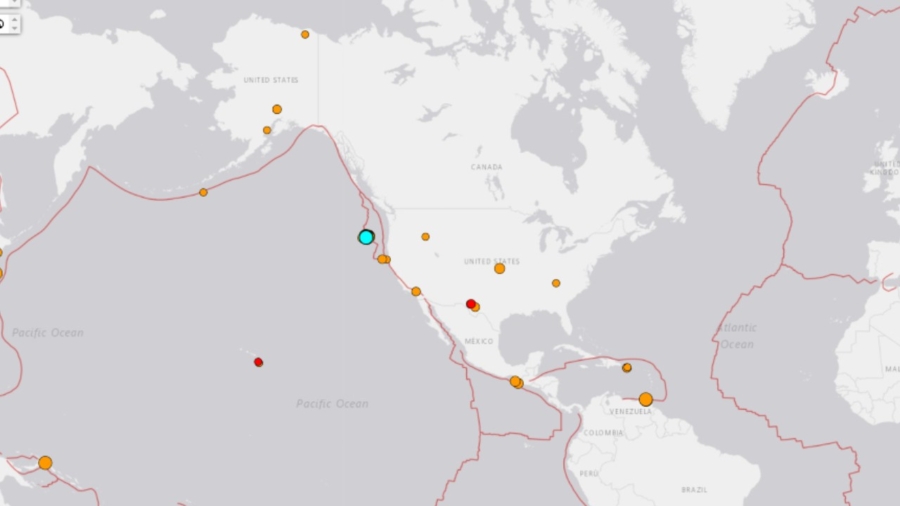
One of North America's most active fault lines sprung to life on Tuesday after a swarm of more than 40 earthquakes—ranging from a magnitude 3.5 to 5.8—rattled off the coast of Oregon, catching the attention and concern of millions in the region.
The series of quakes, which began early Tuesday morning and continued into Wednesday, were all clustered between 200-250 miles west of the coastal town of Newport, OR, far enough to be mostly undetected on land, but given the area's seismic history, it is creating quite a buzz.
"If you had asked me yesterday where on Earth would be most likely to produce a bunch of magnitude 5.0+ quakes in a single day, this would have been high on my list," Harold Tobin, Director of the Pacific Northwest Seismic Network at the University of Washington, told CNN.
Not All Quakes Are Created Equal
What has been most impressive about this week's quakes is the swarm has included at least 9 tremors reaching a magnitude 5.0 to 5.8, with the majority occurring at a shallow depth of only 10 km.The sheer number of magnitude 5.0 or greater quakes in the region triples the annual average (three 5.0+ quakes per year) since 1980, according to the USGS database.
Fortunately, according to the U.S. National Tsunami Warning Center, none of this week's quakes have triggered a tsunami alert.
This Is Not Necessarily a Precursor for the So-called 'Big One'
Though the epicenter of this week's swarm of quakes, the Blanco Fracture Zone, is among the most seismically active in North America, it rarely leads to destructive quakes.The fault is some 275 miles west of the Oregon coastline and about 200 miles west of the Cascadia Subduction Zone, where the largest and most destructive Northwest quakes have historically taken place.
"Blanco Fracture zone quakes are strike-slip (lateral motions of the crustal blocks on either side, rather than up-down displacement), so it is very unlikely for them to pose a tsunami threat, even if a bigger quake happened, like a magnitude 7.0 for example," Tobin told CNN.
According to seismologist Dr. Lucy Jones, there have been more than 133 quakes of magnitude 5 or greater on the Blanco Fracture Zone since 1980 and have never been followed by something on land.
"Today's quakes can be thought of as something like a main-shock and a swarm of aftershocks, the one distinction being that in this case, there's not a lot of magnitude difference among them," Tobin said.
Though this week's quakes have raised the concerns the so-called "big one" could be near, Tobin assured it is not necessarily the case.
"There's quite a lot of distance from these quakes to the Cascadia Subduction Zone," Tobin explained. "Our best current understanding of how stress transfers through the crust (and mantle) would suggest that these events don't change the stress on the subduction zone appreciably."
He pointed out, although we have had a remarkable number of magnitude 5.5+ quakes in a short period of time, it is not inherently alarming but rather seismologically interesting.