


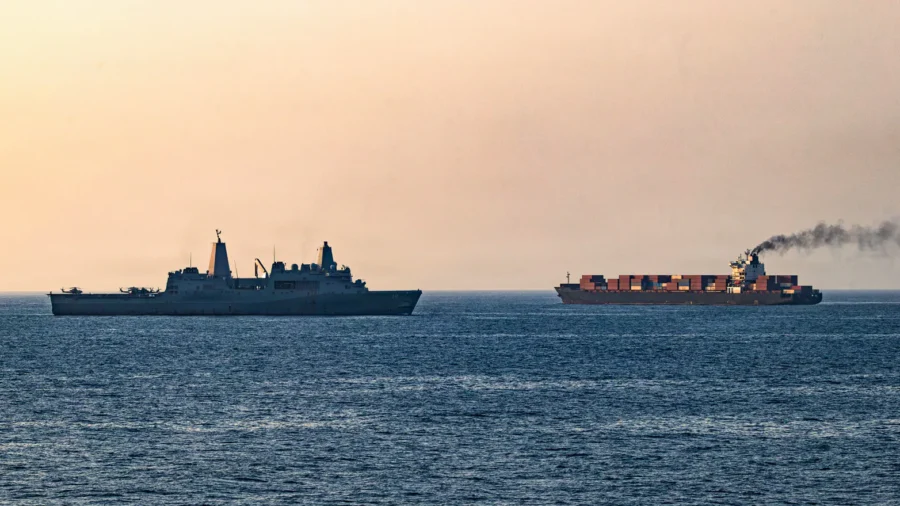
President Donald Trump said Friday that he intends to declare the Strait of Hormuz, one of the world's most important shipping routes, as United States territory.
Trump made the comments during remarks at the David S. Mack Center for Training and Intelligence in Nassau County, New York.
“After we finish defeating Iran, which is being very badly defeated, pretty soon I’ll be declaring the Hormuz Strait a territory of the United States,” the president said.
About one-fifth of global oil supplies passed through the Strait of Hormuz before the U.S.-Israel and Iran war erupted on Feb. 28. Countries including Saudi Arabia, Iraq, Kuwait, the United Arab Emirates, Qatar, and Iran depend on the waterway to transport oil and natural gas to international markets.
After the conflict began, Iran largely closed the strait, while the United States later imposed a naval blockade around Iranian ports. Shipping traffic, as a result, dropped dramatically.
“We have the blockade,” Trump said Friday. “No ships get through unless we want them to.”
Trump also told supporters that he has used the military more than he wanted to during the conflict, but argued pressure on Tehran is necessary to prevent the Iranian regime from obtaining a nuclear weapon.
War Secretary Pete Hegseth has maintained that the United States has the capability of maintaining a naval blockade of Iranian ports indefinitely.
Iran has disputed U.S. control and says the strait remains under Iranian control and management.
The disruption to the Strait of Hormuz has affected the global energy market by limiting the flow of oil and increasing concerns about fuel shortages and higher prices. Oil prices have risen amid uncertainty and the International Energy Agency has warned that the conflict could contribute to a significant global oil supply shortfall in 2026.
Treasury Secretary Scott Bessent also said the Trump administration is preparing unprecedented economic measures against Iran, with additional actions expected to be announced next week. He said the measures are intended to further isolate and pressure Tehran economically.