


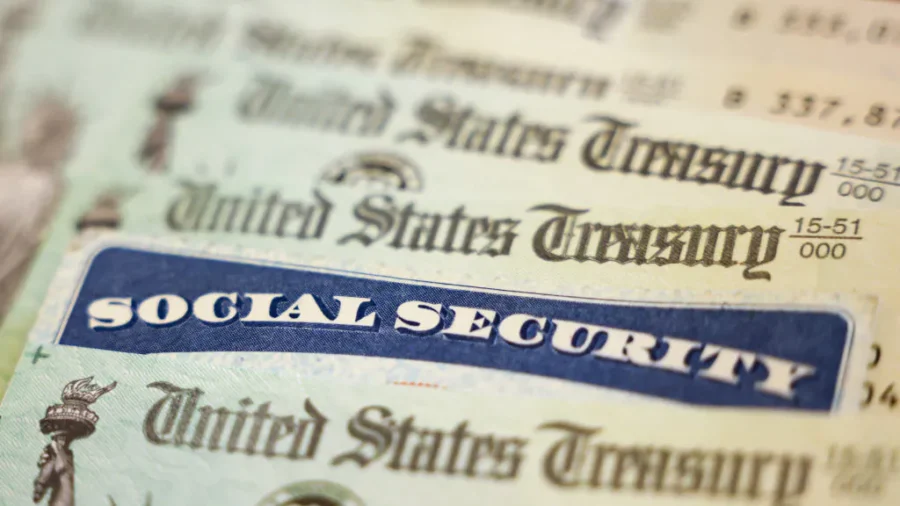
U.S. retirees may want to circle 2032 on their calendars, as an updated federal government report notes that it's the year when the well will run dry for the Social Security Trust Fund.
In previous CBO reports, budget officials have estimated the Trust Fund would run out of funding in 2033. Now that the date has been updated, the fallout could result in automatic benefit cuts totaling $18,400 annually for the typical U.S. couple.
It’s the sole source of reserve Social Security funding
According to the CBO report, Social Security is part of the unified federal budget, but its benefits are paid from trust funds funded by payroll taxes, interest on the trust funds’ balances, and income taxes on Social Security benefits. That’s important because the Trust Fund can’t pay out once those funding sources are exhausted, which is expected to happen in six years.“The rules that govern baseline construction require CBO to assume that scheduled payments from federal trust funds will continue to be made in full even if the balance of the trust fund has been exhausted and there is no legal authority to make such payments,” the report noted. “Under current law, the Social Security Administration may not pay benefits in excess of the available balances in a trust fund.”
The most recent Social Security Trust Fund was created in the mid-1980's, when the SSA and Congress realized that the projected benefits for the Baby Boomer generation were going to fall short.
The Trust Fund may run out of assets, but Social Security cash should still flow, to a point
When people hear that the Social Security Trust Fund could run out of money by 2032, it sounds alarming, but it's important to clarify what that actually means.“Social Security is not going bankrupt,” Michael Liner, founder of Liner Legal, a law firm specializing in Social Security disability benefits, told NTD News.
What's projected to be depleted is the Retirement Fund Reserves, not the entire system.
The Fund’s payment formula works out against Social Security recipients
Potential tax cuts and the Trust Fund’s mathematical makeup spell trouble for Social Security recipients.On the campaign trail and in the Oval Office, President Donald Trump has frequently called for no or low taxation on Social Security benefits.
“That’s a good thing for Social Security recipients, but it would have dissolved taxes, which is the other major trust fund revenue generator,” Walton said. “That would further deplete the Trust Fund at an even faster clip.”
Currently, approximately 90 percent of a monthly Social Security benefit payout comes from taxpayer contributions, while another 10 percent is drawn from the trust fund each month, Walton noted.
“Next year, roughly 88 percent will come from taxpayer contributions and 12 percent is pulled from the trust fund,” he said. “Each future year, less and less comes from the taxpayer contributions due to a lower birth rate, which translates to fewer workers contributing, AI eliminating jobs, lower levels of FICA contributing immigrants, and other factors.”
Combine that with a depleted trust fund, and in 2032, Americans can expect to see anywhere from a 23 to 30 percent cut across the board in Social Security benefits.
How Can the Social Security Trust Fund Be Replenished?
It won’t be easy, Walton said, but there is a “combination of steps" that can be taken to fix Social Security.“That starts with increasing the full retirement age by a year or two, capping annual individual benefits at $50k, and making adjustments to funding indexes,” he said.
The adjustment that may most affect the trust fund is to abolish the Social Security income cap.
“Currently, we all contribute taxes up to $184,500 that fund Social Security, and the income cap goes up approximately 10 percent per year,” Walton noted. “But any income above $184,500 is not taxed for Social Security.”
That’s unlike Medicare tax contributions, which have no income cap.
“Every dollar we report as earned income is taxed for Medicare, but Social Security has a cap,” Walton added. “Why is that? Removing the Social Security cap would replenish the trust fund and keep current monthly benefits for 20-25 years.”