


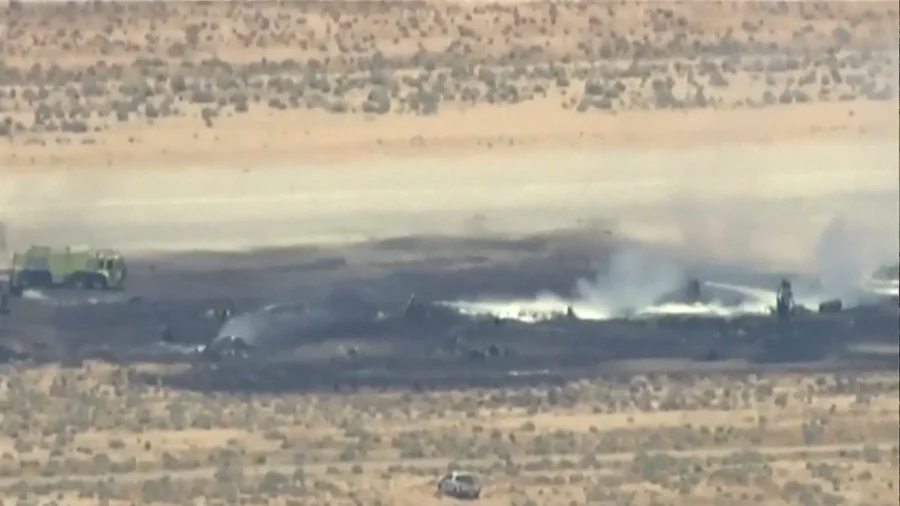
A U.S. Air Force B-52 Stratofortress bomber crashed shortly after takeoff from Edwards Air Force Base in California on Monday, killing all eight people aboard.
"We lost eight great Americans," Hayes said, adding that officials were working to notify their families.
After reviewing footage of the crash, it was determined that no one could have survived, Hayes said. First responders cordoned off the area and extinguished the fire. An emergency operations center and wing operations center were established to coordinate command and control of the response and recovery effort.
"This is a tragedy, and this is going to be the worst days of their lives," Hayes said of the victims' families. "We understand that, and we want to keep them in our thoughts and prayers."
Airfield Closed and Inboard Flights Diverted
As of 12:48 p.m. PT, the airfield was closed and all inbound aircraft were being diverted. Non-commercial visitor passes were suspended until further notice as the installation handled the emergency response.Officials said no cause for the crash has been determined. Hayes said an interim safety board would be stood up to gather initial facts, followed by a safety investigation board to examine root causes—a process that takes approximately 30 days. That will then lead to an accident investigation board, which Hayes said could take upwards of six months before findings are released to the public.
Video footage from the scene captured a thick column of black smoke climbing into the desert sky.
Edwards, located roughly 100 miles north of Los Angeles, is the historic desert installation where Chuck Yeager broke the sound barrier in 1947. The base serves as the nerve center of U.S. Air Force aircraft testing and development. The 412th Test Wing, which oversees base operations, is responsible for developmental testing of all Air Force aircraft, weapons systems, software, and components—both prior to purchase and throughout their operational lifespans.
Not Isolated Incident
Monday's crash is not an isolated moment in a string of U.S. military aviation incidents in recent years. In January 2024, all six crew members aboard a Navy MH-60R Seahawk helicopter miraculously survived after the aircraft went down in San Diego Bay near Naval Amphibious Base Coronado during a routine training mission. A safety boat was already on location due to the nature of the training, which aided in the quick rescue, according to Cmdr. Beth Teach of the Naval Air Force Pacific Fleet.The KC-135 crash was the fourth U.S. aircraft lost during Operation Epic Fury, following the friendly-fire shootdown of three F-15E Strike Eagles over Kuwait earlier that month.
Monday's crash also follows a close call last July, when a regional airliner flying over North Dakota was forced into an unexpected sharp turn to avoid a potential midair collision with a military B-52 that had entered its flight path.