


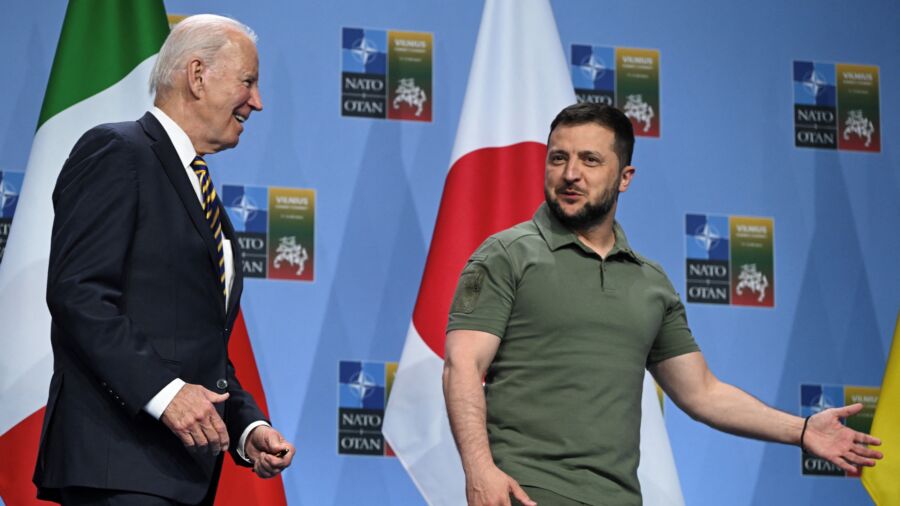
VILNIUS, Lithuania—President Joe Biden met with Group of Seven (G–7) leaders on July 12 at the North Atlantic Treaty Organization (NATO) summit to offer security assistance for Ukraine in its fight against Russia.
This joint declaration will "make it clear that our support will last long into the future,” Mr. Biden announced after the conclusion of the meeting.
“We're going to help Ukraine build a strong capable defense, across land, air, and sea," he added, noting that this step will ensure regional stability and avert all threats.
“I think it's a powerful statement, a powerful statement of our commitment to Ukraine, as it defends its freedom today and as it rebuilds the future and we're going to be there as long as that takes,” Biden concluded.
Before the summit, the White House indicated that Ukraine could receive “Israel-style” security guarantees in its fight against Russia.
That means the United States would “provide various forms of military assistance, intelligence and information sharing, cyber support, and other forms of material support so that Ukraine can both defend itself and deter future aggression,” Mr. Sullivan briefed reporters on July 9.
As part of this declaration, Biden explained that each country will individually negotiate long-term bilateral security arrangements with Ukraine.
“Ukrainian delegation is bringing home significant security victory for the Ukraine, for our country, for our people, for our children,” Zelenskyy said after the event.
Biden later met with Zelenskky in a bilateral discussion, during which he said that Russia's invasion of Ukraine is straight out of the 14th century and praised his courage and resilience.
Biden acknowledged Zelenskyy's frustration with the slow pace of U.S. assistance.
Ukraine’s Path to NATO Membership
The announcement of security guarantees came after Zelenskyy expressed frustration about the NATO communiqué released on July 11 that failed to provide a timeline for Ukraine’s accession to the military alliance.Leaders of NATO member countries participating in this year’s summit in Vilnius issued a communiqué on July 11, stating that Ukraine can join the military alliance "when Allies agree and conditions are met."
White House Defends NATO Communiqué
In response to Zelenskyy’s message, the White House on July 12 defended NATO’s decision, noting that it sends a "very strong, forward-leaning message" for Ukraine."I would agree that the communiqué is unprecedented, but I see that in a positive way," Amanda Sloat, White House National Security Council senior director for Europe, told reporters on July 12.
"We joined with Allies yesterday in agreeing to a very strong, positive message. We reaffirmed that Ukraine will become a member of the NATO Alliance," she said.
The allies reaffirmed their commitment made at the 2008 Bucharest Summit and acknowledged that Kyiv has made "substantial progress on its reform path."
In the communiqué, NATO also removed the requirement that Ukraine implement a so-called Membership Action Plan.
Instead, the members have decided to form the "NATO-Ukraine Council," a new joint organization in which allies and Ukraine sit as equal members to further political dialogue and cooperation.
They’ve also adapted an "Annual National Program" to review progress on a regular basis.
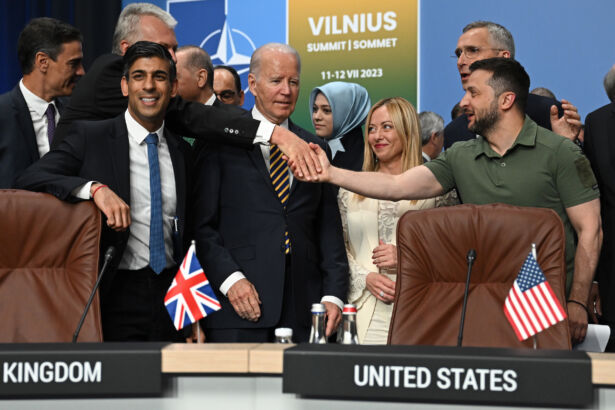
She said that the G–7 allies would continue to provide Kyiv with ongoing security assistance to help Ukraine both on the battlefield and on the economic and humanitarian side.
However, the decision disappointed Zelenskyy.
Mr. Zelenskyy also said Ukraine "deserves respect" and criticized the communiqué’s phrasing for being "discussed without Ukraine."
National Security Advisor Jake Sullivan reiterated Mr. Biden's position that admitting Ukraine to NATO would result in conflict with Russia.
"Look, I understand Ukraine's desire to be in the NATO as fast as possible. That is absolutely their right to seek admission, and press for it, and to advocate for it," he told CNN on July 12.
"But every NATO ally, including the United States, needs to look squarely at the fact that admission of Ukraine into NATO at this juncture means war with Russia, that is an inescapable fact," he said.
Sullivan also stated that for Ukraine’s membership, the allies could not "put a mechanical formula down because war is dynamic, the situation is dynamic."