


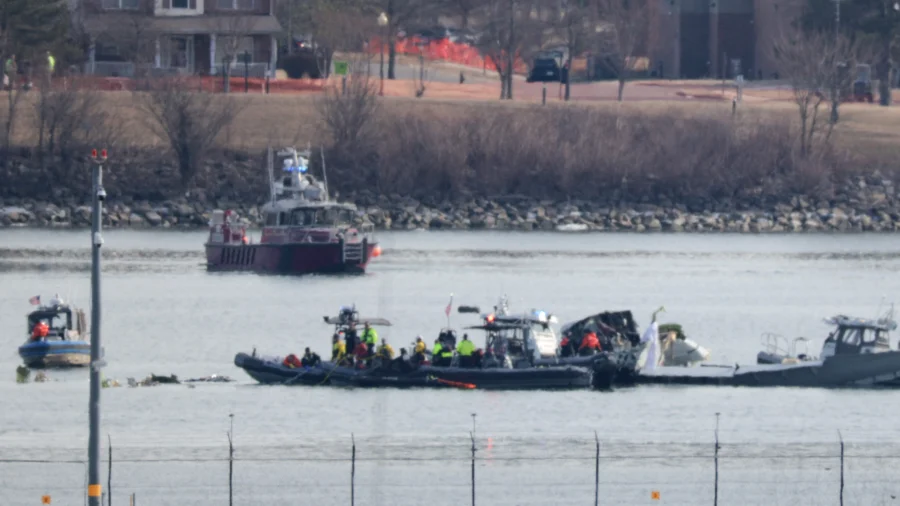
The crew of the Black Hawk helicopter involved in last month's collision with a passenger jet likely did not hear important instructions from air traffic control and possibly had inaccurate altitude readings, the National Transportation Safety Board (NTSB) revealed Friday.
The agency revealed that air traffic controllers at one point told the Black Hawk crew to pass behind the American Airlines jet, but the Black Hawk crew may not have heard the complete audio transmission, specifically the words "pass behind the."
That's because the audio was disrupted, according to NTSB Chair Jennifer Homendy.
"Transmission was stepped on by a point eight second mic key from the Black Hawk. The Black Hawk was keying the mic to communicate with [air traffic control]."
Additionally, the NTSB is looking at the possibility of inaccurate data in the Black Hawk cockpit, which may have led to discrepancies in attitude readings. Before the collision, the helicopter’s pilot called out that the Black Hawk was flying at 300 feet, but the instructor pilot said the helicopter was at 400 feet.
"We are looking at the possibility of, there may be bad data," Homendy said.
The Black Hawk pilot at the time was performing a "checkride" night vision exam, an annual test that pilots must pass as part of training. The helicopter crew was likely wearing night vision goggles during the flight. If the goggles were removed at any point during the flight, the crew was required to have a discussion about going unaided, but there was no proof that the goggles were removed.
NTSB will continue to investigate the crash and soon remove the crash wreckage from the airport to a secure location.