


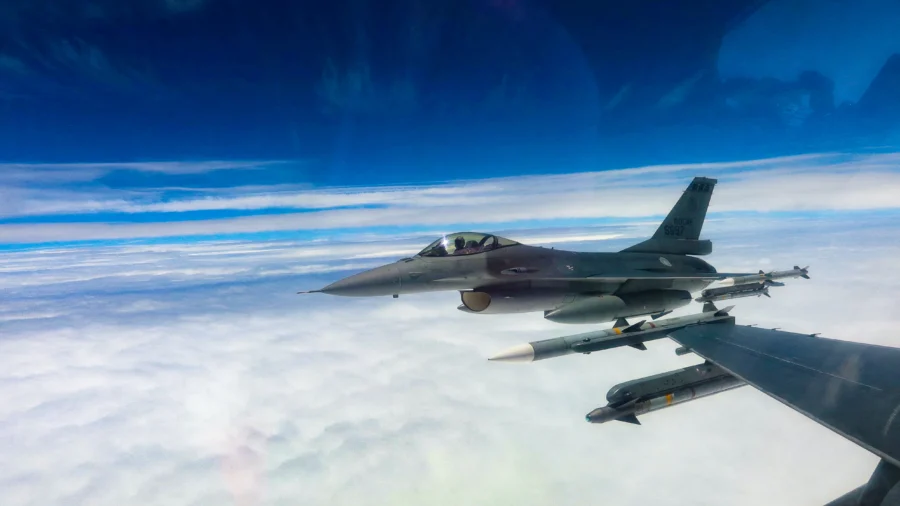
Taiwan on May 16 pressed the case for continued U.S. arms support and closer security cooperation after U.S. President Donald Trump said he had not yet decided whether to move forward with a major weapons package for the self-governing island, which Beijing claims as its territory and has threatened to take by force.
Speaking to reporters while traveling to Alaska on May 15, Trump said Taiwan was one of the main issues discussed during his talks with Xi, who warned that the issue could trigger confrontation between the world’s two largest economies.
“On Taiwan, he does not want to see a fight for independence because that would be a very strong confrontation,” Trump said of Xi’s position.
Asked whether tensions over Taiwan could escalate into military conflict between the United States and China, Trump expressed confidence that war could be avoided.
“I think we’ll be fine,” Trump said, adding that Xi “doesn't want to see a war.”
“I will make a determination over the next fairly short period,” Trump said.
At another point during the exchange, Trump said he wanted to speak directly with Taiwan’s leader Lai Ching-te before deciding whether to proceed.
“I have to speak to the person that right now ... is running Taiwan,” Trump said.
Taiwan Cites China’s Military Pressure
Taiwan’s Presidential Office said in a May 16 statement that the island would continue strengthening ties with Washington and described U.S.-Taiwan defense cooperation as essential to preserving peace in the Indo-Pacific region.Spokesperson Karen Kuo said Taiwan had noted repeated statements from Trump and Secretary of State Marco Rubio reaffirming that U.S. policy toward Taiwan remained unchanged.
“Our nation is grateful to President Trump for his continued support for security in the Taiwan Strait since his first term in office,” Kuo said.
She said Taiwan would continue working closely with the United States “to achieve peace through strength,” adding that peace and stability in the Taiwan Strait served the interests of Taiwan, the United States, and the broader democratic world.
Kuo also said that China’s expanding military presence and activities in the region were the main source of regional instability.
“China’s escalating military threat is the sole destabilizing factor within the Indo-Pacific region, including the Taiwan Strait,” she said.
She added that countries along the so-called first island chain, which includes Taiwan, were increasingly cooperating with Washington to strengthen defense capabilities and that “Taiwan cannot and will not be an exception.”
Taiwan’s government also defended the importance of U.S. arms sales, saying they reflect Washington’s pledges to Taipei and discourage acts of hostility.
“Military sales between Taiwan and the U.S. are not only a reflection of the U.S. security commitment to Taiwan as stipulated in the Taiwan Relations Act, but also serve as a mutual deterrence against regional threats,” Kuo said.
Mainland Affairs Council Deputy Minister and spokesman Liang Wen-chieh told reporters in Taipei on May 14 that Taiwan had seen “no surprising information so far” from the Trump-Xi summit and would continue maintaining close communication with Washington.
Liang said the real threat to peace in the Taiwan Strait stemmed from China’s military activities rather than Taiwan’s desire to preserve its democratic system of governance and way of life.
Beijing Warns Against Taiwan Independence
China’s foreign ministry issued a statement on May 14 noting that, during the summit, Xi warned Trump that Washington “must exercise extra caution” in handling Taiwan or the relationship between the United States and China will be in "great jeopardy" and devolve into "clashes and even conflicts."The White House released a brief summary of the summit that did not mention Taiwan, instead highlighting discussions on Iran, trade, and maintaining shipping through the Strait of Hormuz.
Secretary of State Marco Rubio, who participated in the Beijing meetings, said Xi’s comments on Taiwan were expected and stressed that U.S. policy toward the island had not changed.
“They always raise it on their side. We always make clear our position, and we move on to the other topics,” Rubio told NBC News.
Rubio also warned that it would be “a terrible mistake” for China to attempt to take Taiwan by force.
“There would be repercussions for that globally, not just from the United States,” Rubio said.
Trump declined to say whether the United States would defend Taiwan militarily in the event of a Chinese attack.
“I don’t want to say that,” Trump told reporters aboard Air Force One on Friday. “There’s only one person that knows that ... me.”