


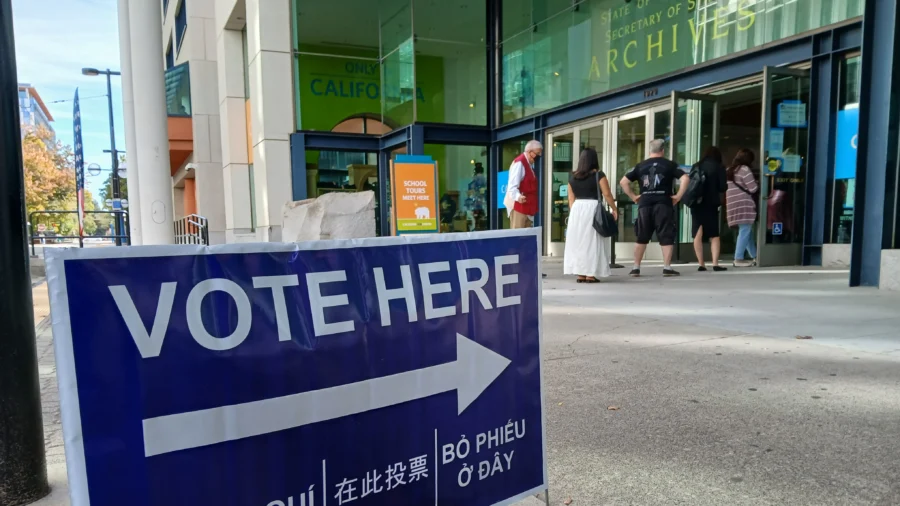
California voters have the opportunity to decide this November whether or not to require photo identification at polling places, as the secretary of state certified that supporters had collected more than enough valid signatures to put the question on the ballot.
California Secretary of State Shirley N. Weber announced this week that the proposed constitutional amendment had met the threshold for the Nov. 3 general election ballot. The measure will be formally certified for the ballot on June 25 unless its proponents withdraw it, her office said.
The initiative would add a new section to the state Constitution requiring voters to show government-issued identification when voting in person, or to give the last four digits of a unique government-issued identifying number when voting by mail. The state would have to provide a voter ID card at no cost upon request.
The amendment would also direct the secretary of state and county registrars to keep accurate voter rolls, verify citizenship attestations, and publicly report the share of the rolls that have been verified.
Assemblyman Carl DeMaio of San Diego, state Sen. Tony Strickland of Huntington Beach, and businessman Donald DiCostanzo are the main supporters of the amendment. The signature push was organized by Reform California and a coalition called Californians for Voter ID.
The measure's path became clear in 2025, as the secretary of state's office announced that the proposal, formally dubbed an initiative that "establishes additional voter identification and citizenship verification requirements,” had cleared review by the attorney general and entered into circulation. Volunteers and paid canvassers worked across the state in the following months to gather signatures.
Opponents contend that there is little evidence of in-person voter fraud, warning that the requirement would impose new costs on counties and burden voters who do not have a current driver's license or state ID. Backers counter that providing the card at no cost removes that barrier and that the citizenship-verification provisions would ensure noncitizens do not appear on voter rolls.
California currently allows registered voters to cast a ballot at their polling place by stating their name and address. First-time voters who registered by mail without providing identifying information may be asked for ID under federal law. The new measure would replace that patchwork of laws with a uniform statewide rule.
The secretary of state has also approved measures on local taxes, housing finance, health care spending, and political contributions to appear on the ballot.