

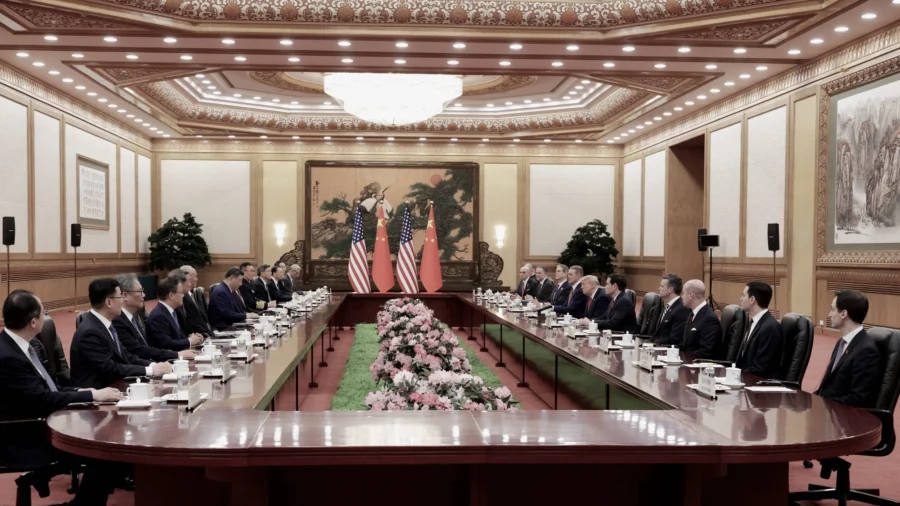
The summit in Beijing between U.S. President Donald Trump and Chinese leader Xi Jinping concluded its first day, May 14, with a notable flashpoint: Taiwan and U.S. arms sales to the island.
According to a statement released by China’s Ministry of Foreign Affairs, Xi warned Trump about the handling of the issue.
“The U.S. side must exercise extra caution in handling the Taiwan question,” the statement reads.
“If it is handled properly, the bilateral relationship will enjoy overall stability. Otherwise, the two countries will have clashes and even conflicts, putting the entire relationship in great jeopardy.”
The White House released a brief readout of the meeting between Trump and Xi. Unlike Beijing’s announcement, it made no mention of Taiwan, instead focusing extensively on the Iran war, the Strait of Hormuz, and economic cooperation between the two countries.
A source familiar with the talks told The Epoch Times that the administration had expected Beijing to bring up Taiwan at the summit and had already decided to disregard it and move on. And that’s exactly how Trump and his team in Beijing handled it, the source said.
U.S. Secretary of State Marco Rubio confirmed that Xi raised the issue, but he said that arms sales were not a primary topic in the discussion.
“U.S. policy on the issue of Taiwan is unchanged as of today, and as of the meeting that we had here today,” he told NBC News.
Rubio said that when discussions about Taiwan arise, the United States consistently responds that any attempt to force a change in the island through military action “would be problematic.” He emphasized that U.S. policy on the issue has remained “consistent across multiple presidential administrations.”
Rupert Hammond-Chambers, president of the U.S.-Taiwan Business Council, said that China’s statement about Taiwan was unsurprising, describing it as “pretty rote,” and commended Trump for disregarding it.
“They have raised the level of their rhetoric somewhat over the last few years when it comes to Taiwan, but it remains pretty much in the same running lane,” he told The Epoch Times. “And hat tip to the president, he pretty much just ignored it.”
Taiwan remains one of the most sensitive issues between Washington and Beijing. The Chinese Communist Party (CCP) claims the democratically governed island as its territory, while Taiwan rejects this and maintains its own government. The United States officially maintains a policy of strategic ambiguity on Taiwan but continues to provide the island with defensive arms, a practice Beijing strongly opposes.
The latest package covers a wide range of items, including high-mobility artillery rocket systems, self-propelled howitzers, two different Altius loitering munition drones, Javelin anti-tank missiles, anti-armor missiles, AH-1W helicopter spare and repair parts, and refurbishment kits for Harpoon missiles.
On May 8, Taiwan’s opposition-dominated parliament approved a $25 billion special defense budget, mainly to buy U.S. weapons, well below the $40 billion sought by the Taiwanese government.
The Chinese military said the drills were meant to serve as a “serious warning” against what it called “Taiwan Independence” separatist forces.
Yui said the Chinese regime is the aggressor that is “militarily preparing for conflict.”
Human Rights
Trade, Taiwan, and Iran have so far dominated discussions in Beijing, but the Trump administration made it clear before the trip that Beijing’s human rights violations and wrongful detentions would also be addressed.On May 11, Trump said he planned to discuss the cases of media entrepreneur Jimmy Lai and pastor Ezra Jin Mingri with Xi.
The House measure, which passed unanimously, was introduced by Rep. Chris Smith (R-N.J.), cochair of the Congressional-Executive Commission on China. The measure named five individuals who are described as unfairly punished by Beijing for exercising freedom of speech and religion: Jin, Lai, Dr. Gulshan Abbas, and Pastor Gao Quanfu and his wife, Pang Yu.
“Human rights cannot be separated from America's engagement with China,” former House Speaker Rep. Nancy Pelosi (D-Calif.) said on the House floor on May 12. “The release of these individuals must remain a priority at the highest level of diplomacy.”